Showing posts with label the Left. Show all posts

Wednesday, February 1, 2012

Selling Social Darwinism

Robert Reich has a blog that is well worth following. He is a knowledgeable person with the facts and the social empathy to present an honest account of the situation that the 99% find themselves in.

Here is his latest post:
The Republican Myth of Obama's "Entitlement Society"

One of the few things Mitt Romney and Newt Gingrich agree on is that President Obama is turning America into “European-style welfare culture.”

In his standard stump speech Romney charges Obama with creating a nation of dependents. “Over the past three years Barack Obama has been replacing our merit-based society with an entitlement society.”

Gingrich calls Obama “the best food-stamp president in American history.”

What’s their evidence? Both rely on federal budget data showing direct payments to individuals shot up by almost $600 billion, a 32 percent increase, since the start of 2009.

They also point to Census data showing that 49 percent of Americans now live in homes where at least one person is collecting a federal benefit – Social Security, food stamps, unemployment insurance, worker’s compensation, or subsidized housing. That’s up from 44 percent in 2008.

Finally, they trumpet Social Security Administration figures showing that the number of people on Social Security disability jumped 10 percent in Obama’s first two years in office.

They argue our economic problems stem from this sharp rise in “dependency.” Get rid of these benefits and people will work harder.

They have cause and effect backwards. The reason for the rise in food stamps, unemployment insurance, and other safety-net programs is Americans got clobbered in 2008 with the worst economic catastrophe since the Great Depression. They and their families have needed whatever helping hands they could get.

If anything, America’s safety nets have been too small and shot through with holes. That’s why the number and percentage of Americans in poverty has increased dramatically over the past three years, including over a third of families with young children.

One scandal, for example, is that only 40 percent of the unemployed qualify for unemployment benefits because they weren’t working full time or long enough on a single job before they were canned. The unemployment system doesn’t take account of the fact that a large portion of the workforce typically works part time on several jobs, and moves from job to job.

Republicans also object to Obama’s health care law, which covers 30 million more Americans than were covered before. But it still leaves over 20 million without health insurance. They’ll get emergency care when they’re in dire straights — hospitals won’t refuse them — but we all end up paying indirectly.

Regressive Republicans pretend they’re about opportunity. In reality they’re back at what they’ve been doing for years — promoting Social Darwinism.
Go read his blog.

The manipulation of statistics to sell their Social Darwinism is utterly cynical. The political right knows that it is lying. It isn't naive. But it trusts in the big lie technique. They know that if they repeat their right wing lies long enough and through enough media, most people will assume it is true because the message is so prevalent.

I remember being incredulous when I matured and discovered that my father believed that if something was printed it had to be true. In his mind, nobody would go to the expense of printing something unless it was true. I could never change his mind. He proved to me just how effective a propaganda campaign could be. He lived a life believing falsehoods simply because "they were printed" and I could never change his mind because my arguments were "just words" and he refused to look at the printed material I presented to him. Propaganda can be very, very effective.

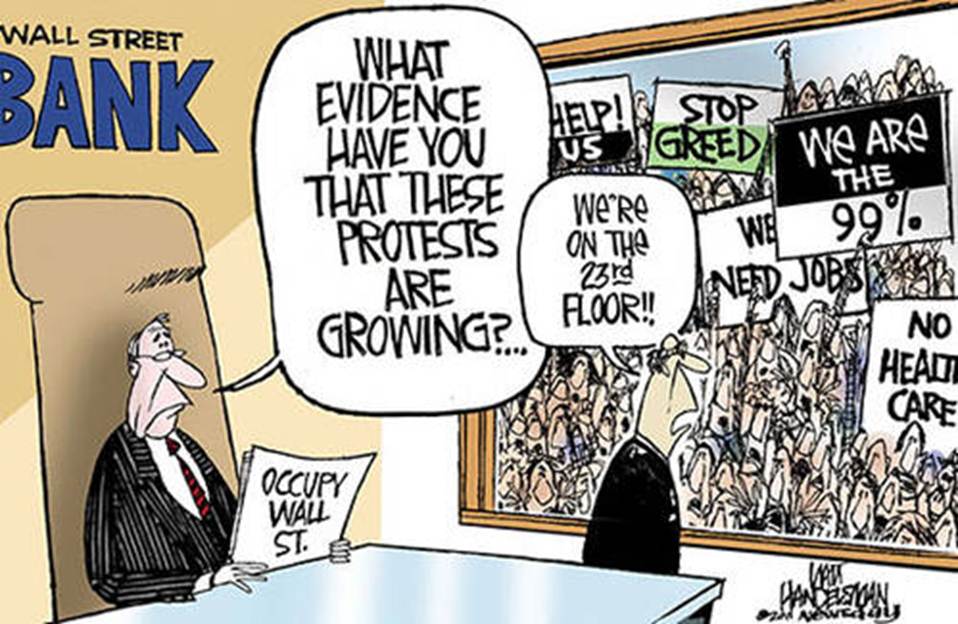
Saturday, October 29, 2011

Stopgaps and Half Measures

Here is a bit from an article in the NY Magazine on the rising inequality in the US and the failure of policy makers to either admit the problem exists or come up with any policy to effectively deal with the problem. The Republicans deny it exists and the Democrats are willing only to propose partial remedies:
Over the last few decades, income growth for most Americans has slowed to a crawl, while income for the very rich has exploded. That’s a reversal of the three decades following World War II, when all income groups got richer, with the poor and middle class rising at a faster rate than the rich. Crucially, the Congressional Budget Office’s new analysis shows that changes in government policy over this period have made inequality worse. (In CBO-speak: “The equalizing effect of transfers and taxes on household income was smaller in 2007 than it had been in 1979.”)

We’re not having a debate about how to reverse or even stop the growth of inequality. Nobody has a real plan to do that. The Democratic plan is to slightly arrest the growth of inequality by hiking taxes on the rich a few percentage points, so as to minimize the need to cut the social safety net. The Republican plan is to slash taxes for the rich and programs for the poor, thereby massively increasing inequality.

That is a hard position to defend in the context of exploding inequality, and conservatives would rather not defend it. Instead the right’s response has been to persistently deny or ignore the facts. Rick Perry, pressed by a reporter to explain why he was proposing a tax plan that would widen income inequality further, replied, "I don’t care about that." The Wall Street Journal editorial page today dismissed the Tax Policy Center, whose calculations persistently show the ways in which various Republican tax proposals would widen inequality, as “liberal.” It didn’t even pretend to dispute the substance of the calculations. Eric Cantor gave a speech about income inequality centering on stories about how his grandmother worked hard and pulled herself up by the bootstraps in the old days. It was a nice speech if you like stories about plucky grandmothers. It failed to grasp the central dilemma, which is that it was a lot easier for poor people to move up sixty years ago, when tax rates on the rich happened to be far higher, than it is today.

...

The way to understand Ryan is that he’s deeply influenced by the theories of Ayn Rand, who believed that the root of all evil lay in attempts to alter the wealth distribution created by the free marketplace. Rand may have been a deranged cult leader, but she did live at a time when the fear of the poor devouring the rich had an actual real-world basis. She escaped communist Russia for the United States, Franklin Roosevelt — while not a reprise of the communists, as she mistakenly believed — really did denounce the rich and impose confiscatory tax rates. The world of Rand’s imagination bore a slight resemblance to the world she inhabited, but it bears no resemblance to the contemporary United States.

Ryan cannot process the realities of this world because they are so at odds with the imagined world of his ideology. After his speech, he was asked about the CBO’s report on inequality, and he brushed it off, falling back on Rand-esque lingo the virtuous rich (“takers”) and parasitic poor (“makers”):
“Let’s not focus on redistribution, let’s focus on upward mobility,” he said. “If these studies are used as justification for erecting new and more barriers for making it harder for people to rise, all that will do is reduce our prosperity in this country.”

“We’re coming close to a tipping point in America where we might have a net majority of takers versus makers in society and that could become very dangerous if it sets in as a permanent condition.
Don’t confuse Paul Ryan with the facts. If studies run up against Ryan’s ideology, then the studies must give way.
Sadly, the politics in America a deeply dysfunctional. No major party is addressing the concerns of the 99% so clearly visible in the Occupy Wall Street movement.


Friday, October 21, 2011

Obama Joins Wall Street Against Occupy Wall Street

Here are some key bits from a post by Matt Taibbi in his Rolling Stone blog:
... there have been two disgusting developments in the realm of plutcratic intervention on behalf of Wall Street that everyone protesting should take note of.

The fact that both of the following things took place in the middle of the full fever of OWS, when everyone is supposedly trying to placate anti-banker sentiment and Obama and the DCCC are supposedly pledging support of the protesters, shows how completely bankrupt this system is and how necessary street-level protests have become. Popular uprising is probably the only move left to stop developments like the following:

1) Bank of America is shifting a huge collection of Merrill Lynch derivatives contracts onto its own federally-insured balance sheet. This move of risky instruments off the uninsured Merrill balance sheet onto the commercial bank's balance sheet was done to prevent Bank of America's creditors from attacking the firm with collateral calls and other sorties. Essentially, an irresponsible debtor, B of A, is keeping a loan shark from breaking his legs by getting his rich parents to co-sign his loan. The parents in this metaphor would be the FDIC.

The FDIC naturally is not pleased with this development, but the Fed, the supreme banking regulator, is apparently encouraging this move. Here's how Bloomberg characterized this move:
In short, the Fed's priorities seem to lie with protecting the bank-holding company from losses at Merrill, even if that means greater risks for the FDIC's insurance fund.
Again and again, the Fed proves it has not appetite for allowing Wall Street to eat its own pain, and continually encourages banks to stick the government with its losses and bad assets. This move will allow Bank of America to keep a Band-Aid over its disastrous financial situation far longer than it would be able to in a genuinely free market. People should be outraged at this development.

2) Barack Obama is apparently expressing willingness to junk big chunks of Sarbanes-Oxley in exchange for support for his jobs program. Business leaders are balnking at creating new jobs unless Obama makes compiance with S-O voluntary for all firms valued at under $1 billion.

Here's how to translate this move: companies are saying they can't attract investment unless they can hide their financials from investors. So the CEOs and gazillionaires on Obama's Jobs Council want the politically-vulnerable president to give them license to cook the books in exchange for support for his jobs program. From the Pittsburgh Post-Gazette:
"All you're going to do is have more fraud. The ultimate losers are going to be investors," said Jeff Klink, a former federal prosecutor whose Gateway Center firm helps clients prevent and detect fraud.
If the financial crisis proved anything, it's that Wall Street companies in particular have been serial offenders in the area of dishonest accounting and book-cooking. Sarbanes-Oxley is obviously no panacea, but removing it in exchange for a temporary, election-year job boost is exactly the kind of myopic, absurdly irresponsible shit that got us into this mess in the first place. For Obama to pull this in the middle of these protests is crazy.
That Obama is pulling this stunt shows that he is as corrupt as the Republicans. Poor America. It has no political party that represents the 99%. The GOP and Dems are completely sold out to the 1%. Your choice is between getting yourself kicked in the teeth by the GOP or whether you are quietly stabbed in the back.

The GOP is up front in its hostility to the 99%. Cain tells you "if you don't have a job, it's your own fault" and they keep yelling for more "tax cuts" and more "deregulation". The Dems pretend to be "on the people's side" but they keep stabbing them in the back where nobody can see it.

Monday, October 17, 2011

A Day Late and a Dollar Short

The "poltics" in America is pathetic. Nobody is addressing the real needs. The major parties are playing a three card monte game with posturing and distractions. This day late and a dollar short politics has got to end.

Here's a bit from a relevant Robert Reich post:
Republicans are debating again tomorrow night. And once again, Americans will hear the standard regressive litany: government is bad, Medicare and Medicaid should be cut, “Obamacare” is killing the economy, undocumented immigrants are taking our jobs, the military should get more money, taxes should be lowered on corporations and the rich, and regulations should be gutted.

Four years ago the most widely-watched TV debate among Republican aspirants attracted 3.2 million viewers. This year it’s almost twice that number. And for every viewer assume a multiplier effect as he or she shares what’s heard with friends and family.

Americans are listening more intently this time around because they’re hurting and they want answers. But the answers they’re getting from Republican candidates – tripping over themselves trying to appeal to hard-core regressives – are the wrong ones.

The correct ones aren’t being aired.

That’s partly because there’s no primary contest in the Democratic party. So Republicans automatically get loads of free broadcast time to air their regressive nonsense while the Democrats get none.

But even if the President had equal time, the debate about what to do about the crisis would still be frighteningly narrow.

That’s because the President’s answers don’t nearly match up to the magnitude of the crisis.

Without bold alternatives, Americans desperate for big solutions are attracted to bold crackpot ideas like Herman Cain’s “9-9-9” proposal, which would raise taxes on the poor and cut them for the rich.

This is where the inchoate Occupy Wall Street movement could come in. What’s needed isn’t just big ideas. It’s people fulminating for them – making enough of a ruckus that the ideas can’t be ignored. They become part of the debate because the public demands it.

The biggest thing the President has proposed is a plan to create 2 million jobs. But that’s not nearly big enough. Today, 14 million Americans are out of work, and 11 million more are working part-time who’d rather be working full time.

The nation needs a real jobs plan, one of sufficient size and scope to do the job – including a WPA and a Civilian Conservation Corps, to put the millions of long-term unemployed and young unemployed to work rebuilding America.
I'm reading material from the 1930s and we've been down this path before. The politics is a distraction. We know how to fix the economy. It takes a big jolt of spending to fix the huge number of people caught in a credit squeeze. Pussyfooting around only stretches out the pain. Most politicians know this, but they aren't honest with the public. They would rather play their games and go for personal gain rather than do their duty and build a better tomorrow.

Wednesday, October 12, 2011

A Clear Political View of "Occupy Wall Street"

Here is Lawrence Lessig giving an excellent political understanding of the Occupy Wall Street movement.


For some background, he mentions:
I like his message that Occupy Wall Street should be a movement that unites the political left and right to defeat corruption and return democracy to the people.

Friday, October 7, 2011

Populist Revolt in America

Here is a bit from a post by Robert Reich that looks at populist revolts in the US.
Will the Wall Street Occupiers morph into a movement that has as much impact on the Democratic Party as the Tea Party has had on the GOP? Maybe. But there are reasons for doubting it.

Tea Partiers have been a mixed blessing for the GOP establishment – a source of new ground troops and energy but also a pain in the assets with regard to attracting independent voters. As Rick Perry and Mitt Romney square off, that pain will become more evident.

So far the Wall Street Occupiers have helped the Democratic Party. Their inchoate demand that the rich pay their fair share is tailor-made for the Democrats’ new plan for a 5.6 percent tax on millionaires, as well as the President’s push to end the Bush tax cut for people with incomes over $250,000 and to limit deductions at the top.

And the Occupiers give the President a potential campaign theme. “These days, a lot of folks who are doing the right thing aren’t rewarded and a lot of folks who aren’t doing the right thing are rewarded,” he said at his news conference this week, predicting that the frustration fueling the Occupiers will “express itself politically in 2012 and beyond until people feel like once again we’re getting back to some old-fashioned American values.”

But if Occupy Wall Street coalesces into something like a real movement, the Democratic Party may have more difficulty digesting it than the GOP has had with the Tea Party.

After all, a big share of both parties’ campaign funds comes from the Street and corporate board rooms. The Street and corporate America also have hordes of public-relations flacks and armies of lobbyists to do their bidding – not to mention the unfathomably deep pockets of the Koch Brothers and Dick Armey’s and Karl Rove’s SuperPACs. Even if the Occupiers have access to some union money, it’s hardly a match.

Yet the real difficulty lies deeper. A little history is helpful here.
Go read the full post. It has some very interesting history. It will help you understand where we are at and why the Democrats won't absorb the Occupy Wall Street populism like the Republicans gathered in the Tea Party protesters.

Wednesday, October 5, 2011

Thinking Seriously About Taxes

Here are some bits from a good article by David published by Reuters:
From the way Washington politicians in both parties tell it, you may well think that multinational companies favor low-tax jurisdictions when investing overseas. They don't.

The multinationals prefer investing in high-tax jurisdictions because it so happens that is where they can earn the highest returns.

Multinational companies then reduce or eliminate those seemingly high taxes by using simple, widely used devices to take profits in low-tax and no-tax jurisdictions.

Such practices create "stateless income," in the words of Edward Kleinbard, whose new scholarship on corporate taxation deserves our attention.

As defined by Kleinbard, stateless income means profits earned in a country other than where the firm is headquartered and subject to tax only in a third country which imposes little or no tax.

Kleinbard shows why stateless income is the most serious threat to the corporate tax base even as Washington politicians blather on about less important corporate tax issues that their remarks show they do not understand.

...

Ignoring the reality of tax erodes the tax base, distorts economic decisions and through shortsighted policy enriches the few at the expense of the many.

That corporations prefer investing overseas in high tax countries may seem to defy common sense. But much of tax is counterintuitive and requires careful study of a kind that was once much more common on Capitol Hill. Sadly, as partisanship has grown along with reliance on campaign donors, serious thinking about taxes has been supplanted by ideological marketing that has more in common with advertising than serious policy debates.

Since tax is the largest economic activity in the world, it is crucial that we base our policies on facts, not fantasies, if civilization is to endure. Get tax wrong and the damage diminishes markets, distorts investments, destroys private wealth and endangers social stability.
The idiocy of American political partisanship has not only crushed that country with a Lesser Depression, it has wrecked the world economy. Somehow common sense, pragmatism, collegiality, and reasoned discourse needs to be knocked into the heads of the politicians in Washingon. (I don't want to create the idea of a false equivalence. About 90% of the idiocy is in the ranks of Republican ideologues and 10% in the ranks of Democratic ideologues.)

Sunday, October 2, 2011

Then and Now

Back when the US was a heathy country under a good leader with a real vision for the future, here's what he had to say about high unemployment:
To those who say that our expenditures for Public Works and other means for recovery are a waste that we cannot afford, I answer that no country, however rich, can afford the waste of its human resources. Demoralization caused by vast unemployment is our greatest extravagance. Morally, it is the greatest menace to our social order. Some people try to tell me that we must make up our minds that for the future we shall permanently have millions of unemployed just as other countries have had them for over a decade. What may be necessary for those countries is not my responsibility to determine. But as for this country, I stand or fall by my refusal to accept as a necessary condition of our future a permanent army of unemployed. On the contrary, we must make it a national principle that we will not tolerate a large army of unemployed and that we will arrange our national economy to end our present unemployment as soon as we can and then to take wise measures against its return. I do not want to think that it is the destiny of any American to remain permanently on relief rolls.
That is a from a fireside chat by FDR on September 30, 1934. Compare that to the right wing Republicans who are happy to wreck the economy, leave unemployment high, allow home foreclosures to continue while they give ever more tax cuts to the ultra-rich. Or compare that to the timid and feeble actions of Obama and the Democrats.

How the mighty have fallen. Given the state of incompetence among the political class in America and given the supine acceptance of the lousy situation by the American public, I see no future recovery for the US. I see a lost decade or two for America just like the Japanese have suffered since 1991.

Here is the foreseeable future for the US:

Thursday, September 29, 2011

American Political Leaders Continue to Turn Down a "Free Lunch"

It isn't often that you see an economist identify a "free lunch" and tell you it isn't a scam, that it literally is like a $100 bill lying on the sidewalk waiting to be picked up. Sure there are right wing economists who would walk right by that $100 bill because they believe in "efficient markets" which assures them the bill can't be real because if it were then somebody would have already bent down and pocketed the free money.

Here is the opening of an excellent article by Brad DeLong pointing out a "free lunch" that Obama, the Republicans, and the Democrats are ignoring. They believe the following is like the $100 on the sidewalk. It can't be real otherwise somebody else (the "job creators" in Republican lingo) would have already bent down and grabbed it. But the "free lunch" is real. Here is DeLong spelling it out:
Former US Treasury Secretary Lawrence Summers had a good line at the International Monetary Fund meetings this year: governments, he said, are trying to treat a broken ankle when the patient is facing organ failure. Summers was criticizing Europe’s focus on the second-order issue of Greece while far graver imbalances – between the EU’s north and south, and between reckless banks’ creditors and governments that failed to regulate properly – worsen with each passing day.

But, on the other side of the Atlantic, Americans have no reason to feel smug. Summers could have used the same metaphor to criticize the United States, where the continued focus on the long-run funding dilemmas of social insurance is sucking all of the oxygen out of efforts to deal with America’s macroeconomic and unemployment crisis.

The US government can currently borrow for 30 years at a real (inflation-adjusted) interest rate of 1% per year. Suppose that the US government were to borrow an extra $500 billion over the next two years and spend it on infrastructure – even unproductively, on projects for which the social rate of return is a measly 25% per year. Suppose that – as seems to be the case – the simple Keynesian government-expenditure multiplier on this spending is only two.

In that case, the $500 billion of extra federal infrastructure spending over the next two years would produce $1 trillion of extra output of goods and services, generate approximately seven million person-years of extra employment, and push down the unemployment rate by two percentage points in each of those years. And, with tighter labor-force attachment on the part of those who have jobs, the unemployment rate thereafter would likely be about 0.1 percentage points lower in the indefinite future.

The impressive gains don’t stop there. Better infrastructure would mean an extra $20 billion a year of income and social welfare. A lower unemployment rate into the future would mean another $20 billion a year in higher production. And half of the extra $1 trillion of goods and services would show up as consumption goods and services for American households.

In sum, on the benefits side of the equation: more jobs now, $500 billion of additional consumption of goods and services over the next two years, and then a $40 billion a year flow of higher incomes and production each year thereafter. So, what are the likely costs of an extra $500 billion in infrastructure spending over the next two years?

For starters, the $500 billion of extra government spending would likely be offset by $300 billion of increased tax collections from higher economic activity. So the net result would be a $200 billion increase in the national debt. American taxpayers would then have to pay $2 billion a year in real interest on that extra national debt over the next 30 years, and then pay off or roll over the entire $200 billion.

The $40 billion a year of higher economic activity would, however, generate roughly $10 billion a year in additional tax revenue. Using some of it to pay the real interest on the debt and saving the rest would mean that when the bill comes due, the tax-financed reserves generated by the healthier economy would be more than enough to pay off the additional national debt.

In other words, taxpayers win, because the benefits from the healthier economy would more than compensate for the costs of servicing the higher national debt, enabling the government to provide more services without raising tax rates. Households win, too, because they get to buy more and nicer things with their incomes. Companies win, because goods and workers get to use the improved infrastructure. The unemployed win, because some of them get jobs. And even bond investors win, because they get their money back, with the interest for which they contracted.

So what is not to like? Nothing.
Go read the whole article.

The political "leadership" in America is a joke. These are political hacks more interested in grandstanding and playing ideological gamesmanship than in saving the ship of state from the shoal of depression and years of economic hardship. It is practically criminal that this is happening!

What History Teaches Us

Here is an interesting article by David Wessel in that bastion of capitalism the Wall Street Journal:
There is an optimistic scenario for the U.S. economy: Europe gets its act together. The pace of world growth quickens, igniting demand for U.S. exports. American politicians agree to a credible compromise that gives the economy a fiscal boost now and restrains deficits later. The housing market turns up. Relieved businesses hire. Relieved consumers spend.

But there are at least two unpleasant scenarios: One is that Europe becomes the epicenter of a financial earthquake on the scale of the crash of 1929 or Lehman Brothers 2008. The other is that Europe muddles through, but the U.S. stagnates for another five years, mired in slow growth, high unemployment and ugly politics…. No one would intentionally choose the second or third, yet policy makers look more likely to stumble into one of those holes than find a path to the happier ending.

Why? Liaquat Ahamed has been pondering that question…. "Is it because people don't know what to do (or there's disagreement about what to do)," he wonders, "or is it the politics, particularly the reluctance to ask some people to pay for the mistakes of others?" "In the '20s," he says, "there was much more ignorance"—the disastrous fealty to the gold standard, the Federal Reserve's failure to understand its role as lender of last resort. Today? Mr. Ahamed can't decide if it's ignorance or insurmountable political barriers that keep governments from doing what needs to be done.

In the 1920s, two crises fed on each other: a banking crisis in the U.S. and a sovereign-debt crisis in Europe. (Sound familiar?) In our time, the U.S. handled its banking crisis better than it did back then. (Yes, much better, despite missteps and criticism.) But Europe? The problems go well beyond the inevitable Greek default on its debts. "We are discussing a broken ankle in the presence of organ failure," Lawrence Summers, the former U.S. Treasury secretary, quipped last week about the fixation on Greece….
I find it funny. I'm reading Ron Suskind's book Confidence Men: Wall Street, Washington, and the Education of a President. He makes it clear that in August 2007 Wall Street insider Robert Wolf let Obama know that a really big crash, not a plain vanilla recession, but a big crash was coming: "This is a market-driven disaster that could crush Wall Street and with it the whole U.S. economy."

That was 4 years ago. Finally in September 2011 Obama announces that he is "worried" about jobs. For those who have been unemployed for 3+ years that has to be good news. But Obama and Wall Street have known for 4 years that the US was going to go into the ditch with a world class depression. But he has done nothing.

It isn't only Obama. The political leadership in Washington continue to do their best imitation of Nero fiddling while Rome burns. They are jockeying to win in 2012 while the country is in the gutter and tens of million are unemployed, many more have joined the impoverished below the "poverty level", many millions have lost their homes, and the future has remained bleak for 3 full years. Nothing. That is Washington's answer. Nothing.

Oh sure, Washington talks up "jobs" but it also talks up "deficits and debt". It talks up a war here and a war there. It talks up putting the pledge of allegiance and Bible reading into every classroom. It talks up making math mandatory until you are 45 so that America can be competitive with the rest of the world. It talks up putting Santa Claus in charge of the poverty program and putting stop loss orders on tooth fairies so that the hungry can wake in the morning with a can of beans under their pillow. Washington is pathetic.

History teaches us that when leaders can't or won't lead, then the people rise up and find their own leaders. That time has come.

Monday, September 26, 2011

Finding the Middle in Middle America

Here is an interesting article by Frank Rich in the New York Magazine that points up the fallacy of believing in a "middle ground" in American politics, the infamous "bipartisanship" that supposedly will save the country. Sadly, from my perspective, this "middle" is always just one more step to the right. But here is Frank Rich's take:
As these elites see it, Obama must always hold his fire because we are perennially just one step away from the nirvana of national unity, no matter how glaring the evidence to the contrary. A classic example was a David Brooks column headlined “The Grand Bargain Lives!” published on July 22 of this year and predicting an Obama–John Boehner mind meld on a far-reaching debt-reduction deal. That same day, embarrassingly enough, those negotiations collapsed, with Obama complaining that Boehner hadn’t returned his calls and Boehner stating that “the deal was never reached, and was never really close.” Brooks, who also flogged the unheeded Simpson-Bowles fiscal commission as “the only way to realistically fix this problem,” has merely picked up where the Polonius of bipartisan Washington punditry, David Broder of the Washington Post, left off when he died in March. So beguiled was Broder after the “Gang of Fourteen” halted filibusters (temporarily) on judicial appointments that in 2007 he wrote that Harry Reid and Mitch McConnell had “forged a personal relationship of unusual trust,” setting off a “powerful current toward consensus building” in the Senate.

This delusional faith in comity reached its apotheosis in the debt-ceiling showdown. With the reliable exception of Paul Krugman, who shuns Washington and calls centrism “the cult that is destroying America,” almost every Establishment observer in our own time bought into the magical thinking that the radical Republicans would never go so far as to risk a default of the American government. Only when the tea-party cabal in the House took Washington hostage did it fully dawn on the Beltway gentry that the country was in danger. But even now, Obama keeps being urged to make nice with the rebels so that he can woo independents, who, we’re constantly told, value bipartisanship every bit as much as the pundits do. The “all-important independent voters,” as the “Lexington” columnist at The Economist recycled the conventional wisdom earlier this month, “are said to be looking for a president who defuses partisan tensions, rather than inflaming them.” Said by whom? Mainly other Washington bloviators.

Obama, after all, is exactly that president. For the good deed of trying to defuse partisan tensions, he has been punished with massive desertions by the very independents who are supposed to love his pacifism.
Rich goes for the jugular with this:
Yet the glorification of bipartisanship as a political steroid is actually gaining favor in the Beltway, especially in liberal quarters, as Election Year approaches. The first trial balloon, all but bursting with hot air, was the announcement of an organization called No Labels last December. Venerating the “vital center” and vilifying “hyperpartisanship,” No Labels was endorsed by Michael Bloomberg, the former George W. Bush operative Mark McKinnon, and MSNBC’s bipartisan-minded morning talk show Morning Joe, which celebrated No Labels’ opening festival of civic-minded treacle as if it were the birth of the United Nations. ... No Labels, meanwhile, has gone on to create a blog that awards “high-fives” to politicians upholding its content-free ideals. Among the winners have been Boehner (for asking his caucus to show up for Obama’s address to Congress) and Gabrielle Giffords (for showing up to vote for the debt-ceiling bill). While Woody Allen may be right that 80 percent of success is showing up, if that’s now the high bar for a functioning government, America can pack it in.

...

The other new bipartisan scheme is a web-based campaign, Americans Elect, promoted by Thomas L. Friedman, ­McKinnon, and Douglas Schoen, a Bill Clinton and Bloomberg pollster with a sideline of using Murdoch outlets to berate Obama for not sufficiently emulating Clinton and Bloomberg. Americans Elect has collected more than 1.8 million signatures to put a third-party presidential candidate on the ballot in six states (so far) next year. ... And what would be Friedman’s third-party platform? His domestic bullet points include a short-term stimulus, Simpson-Bowles deficit cuts, a gasoline tax for government-supported scientific research, and a carbon tax to finance new infrastructure and clean-power innovation. That’s an agenda to delight attendees at the Aspen Ideas Festival, Morning Joe devotees, Bloomberg fanciers, and, for that matter, Barack Obama. It would draw only a fraction of those independent voters identified by Pew and no Republicans except for the one percent that likes Jon Huntsman, a No Labels “high-five” honoree whose presidential campaign, dedicated to bipartisan civility, is in a race to the bottom of the polls with Rick Santorum’s.

If Americans Elect gains traction, virtually every vote it receives will be at the Democrats’ expense. The Democrats, and Obama, may well deserve it. But does the country?

...

“Maybe it’s time to have some provocative language in this country,” Perry said at his maiden debate. It is time, and Obama is certainly capable of giving as good as he gets. The Washington hands who assume Perry and his constituency will self-destruct are as misguided as those who thought the conservative movement couldn’t survive provocative language like the 1964 Goldwater mantra “Extremism in defense of liberty is no vice.” Extremism in defense of liberty may be a vice, but so is retreat in the face of extremism. The many who would have Obama surrender without a fight in 2012—whether Beltway wise men addicted to bipartisanship, vain and deluded third-party entrepreneurs, or White House strategists chasing phantom independents—are fiddling while America burns. If Obama succumbs to their siren call again, he will too.
The Obama "compromises" have been a disaster. Finding middle ground is ridiculous. What is needed is a pragmatic politics, the politics of what is doable. Fighting to win "points" or to "bring down government" (the favourite of the Republicans) is insane. But to continue compromising by giving away your position as Obama has done is equally insane.

The pragmatic politics needed by America is finding solutions and fighting for them. Putting consequence before partisanship and putting needs before negotiation. America needs a leader who will fight for the future.

The True Heart of Communism

Here's a short but too-the-point posting on the BoingBoing site:
China Communist Party official who kept sex slaves in basement loses job

By Xeni Jardin at 12:36 pm Monday, Sep 26

A man who is accused of holding six women as sex slaves in a dungeon for two years and killing two of them has been terminated from his government post and stripped of his Communist Party membership.
I guess they are going to have to dig up Mao and strip him of his "party membership" since he was guilty of enslaving nearly a billion Chinese and killing 40 million Chinese. Sadly, we know they won't because slavery and killing people is at the heart of Communism. It has been there since the "communism" was founded when a minority split from the Marxist Russian Social Democratic Labor Party and had the audacity to call themselves the "majority" (in Russian "Bolshevik").

Burying bodies is something that the political extremes of both the left and right love to indulge in. They both beat their chest over their "love of the people" but as best I can tell, they want robots not people and they are only too happy to kill those who don't fit their blinkered view of "the good life". The 20th century was the scourge of history because of political extremists on right and left indulged their fanaticism and left hundreds of millions of dead bodies littering that "stage of history".

Friday, September 23, 2011

Unraveling the Complexity of US Politics

What people say is not what they mean, especially politicians in the US. But even the electorate is sending mixed messages. Here's an attempt to unravel the complexity. Read these bits from an article by James Surowiecki in The New Yorker looking at Obama's "jobs plan" and the current political reality in the US:
There is no truer truism in American politics than James Carville’s catchphrase from the 1992 election “It’s the economy, stupid.” When people discuss Barack Obama’s current approval rating, which is at its lowest level ever, they may invoke his supposed lack of toughness or his tendency toward moderation, but the only really important factor is the dismal state of the U.S. job market. The American Jobs Act, which Obama is now promoting across the country, is an attempt to change this, by giving the economy a temporary boost with a mixture of tax cuts and government spending amounting to $447 billion. It’s an excellent idea: many independent analysts suggest that it could boost G.D.P. growth over the next year by 1.5 per cent or better, and create as many as one and a half million jobs. And it’s ideologically canny. A hefty chunk of it comes in the form of tax cuts, which Republicans typically love, and much of the rest would go toward more spending on infrastructure, which House Majority Leader Eric Cantor has expressed support for. Even so, it’s unlikely that House Republicans will pass the bill, and there’s a good chance that they’ll stop it even from coming up for a vote.

...

But people are underestimating a number of factors that could allow the G.O.P. to pursue an obstructive line without being much punished for it. To begin with, studies show that voters are more likely to hold politicians accountable for economic conditions when there’s “clarity of responsibility”—and responsibility for the economy now belongs to Obama and the Democrats. The recession started long before Obama took office. But, from a voter’s perspective, he had two years with sizable majorities in Congress to do something about it. While the 2009 stimulus plan succeeded in making the recession less awful than it might have been, you rarely get credit in politics for what didn’t happen. More important, in launching the plan, the President effectively took responsibility for the result. If you try to fix it, it’s yours.

...

It’s not that the Republican approach is popular: one recent Bloomberg poll found that forty-five per cent of those surveyed think congressional Republicans are responsible for the gridlock in Washington. But it seems to be working: for the past year and a half, the Party has consistently gone for a do-nothing approach and voters have consistently rewarded it. In the run-up to last year’s midterms, Republicans were explicit about their opposition to past, present, and future stimulus programs. They won a landslide victory. And, just last week, in two special elections for the House, Republican candidates who campaigned largely against Obama’s policies won seats in Nevada and New York by margins that were much bigger than expected. Americans may be saying that they want the government to use fiscal policy to get the economy moving again, but the way they vote tells a different story. Perhaps fourteen more months of economic stagnation and no job creation will change that. But, for now, it’s not only our representatives who are to blame. It’s ourselves.
So the story is complex. The Republicans profess a deep love of country but they are willing to block any attempt to revive the economy. The Democrats claim an eagerness to fix the economy but they put in place a stimulus which is too small and call it "adequate" and ignore the suffering. And to top it all off, the electorate wants to "send a message" but they use election results which will be read by the Republicans as a pat on the back and a "job well done!" when in fact the electorate is boiling with rage and feeling impotent. What a mess.

Elizabeth Warren on the Campaign Trail

Here she goes with a wonderful message of social justice...


I sure hope she is the first sprig of green in a new springtime of democracy in America. I hope many more follow her example and take to the hustings to bring the bottom 90% some hope of a better tomorrow, a more just tomorrow, a tomorrow where future generations have a chance at a decent life.

Friday, September 16, 2011

The American Electoral Choice

Here is the stark choice for Americans:
We’re on the cusp of the 2012 election. What will it be about? It seems reasonably certain President Obama will be confronted by a putative Republican candidate who:

Believes corporations are people, wants to cut the top corporate rate to 25% (from the current 35%) and no longer require they pay tax on foreign income, who will eliminate capital gains and dividend taxes on anyone earning less than $250,000 a year, raise the retirement age for Social Security and turn Medicaid into block grants to states, seek a balanced-budged amendment to the Constitution, require any regulatory agency issuing a new regulation repeal another regulation of equal cost (regardless of the benefits), and seek repeal of Obama’s healthcare plan.

Or one who:

Believes the Federal Reserve is treasonous when it expands the money supply, doubts human beings evolved from more primitive forms of life, seeks to abolish the Internal Revenue Service and shift most public services to the states, thinks Social Security is a Ponzi scheme, while governor took a meat axe to public education and presided over an economy that generated large numbers of near-minimum-wage jobs, and who will shut down most federal regulatory agencies, cut corporate taxes, and seek repeal of Obama’s healthcare plan.

Whether it’s Romney or Perry, he’s sure to attack everything Obama has done or proposed.
That's what Robert Reich has written in a post on his blog.

And he points out that the "choices" that Americans will get definitely will not include the following:
Within these narrow confines progressive ideas won’t get an airing. Even though poverty and unemployment will almost surely stay sky-high, wages will stagnate or continue to fall, inequality will widen, and deficit hawks will create an indelible (and false) impression that the nation can’t afford to do much about any of it – proposals to reverse these trends are unlikely to be heard.

Neither party’s presidential candidate will propose to tame CEO pay, create more tax brackets at the top and raise the highest marginal rates back to their levels in the 1950s and 1960s (that is, 70 to 90 percent), and match the capital-gains rate with ordinary income.

You won’t hear a call to strengthen labor unions and increase the bargaining power of ordinary workers.

Don’t expect an argument for resurrecting the Glass-Steagall Act, thereby separating commercial from investment banking and stopping Wall Street’s most lucrative and dangerous practices.

You won’t hear there’s no reason to cut Medicare and Medicaid – that a better means of taming health-care costs is to use these programs’ bargaining clout with drug companies and hospitals to obtain better deals and to shift from fee-for-services to fee for healthy outcomes.

Nor will you hear why we must move toward Medicare for all.

Nor why the best approach to assuring Social Security’s long-term solvency is to lift the ceiling on income subject to Social Security payroll taxes.

Don’t expect any reference to the absurdity of spending more on the military than do all other countries put together, and the waste and futility of an unending and undeclared war against Islamic extremism – especially when we have so much to do at home.

Nor are you likely to hear proposals for ending the corruption of our democracy by big money.

Although proposals like these are more important and relevant than ever, they won’t be part of the upcoming presidential election.
Pathetic.

The American Theory of Government

Funny... Americans will chew your ear off over their Constitution and their liberties. But the actual embodiment of those ideas, their government, they hate it!

Here's a bit from a post by Robert Reich on his blog:
But the truly remarkable thing is how little faith Americans have in government to set things right. This cynicism poses an even bigger challenge to Obama and the Democrats – and perhaps to all of us.

When I worked in Robert Kennedy’s senate office in the summer of 1967, America also seemed off track. Our inner cities were burning. The Vietnam War was escalating.

Yet most Americans still held government in high regard. A whopping 66 percent of the public told pollsters that year that they trusted government to do the right thing all or most of the time.

Now 30 percent of Americans say they trust government to do the right thing.

What’s responsible for this erosion? Not the Great Recession or the government’s response to it. Most of the decline in public trust occurred years before.

While 66 percent trusted government in 1967, by 1973 that percent had eroded to only 52 percent. By 1976, barely 32 percent of Americans said they trusted government to do the right thing. By 1992, 28 percent. Trust bounced up during the Clinton administration (I’m happy to report) but cratered again during the George W. Bush’s presidency, ending at 30 percent, and hasn’t recovered since.

Call it the Republican Weapon of Mass Cynicism.

...

Decades of Republican rhetorical scorn – Reagan’s repeated admonition, for example, that government is the problem rather than the solution – have contributed. But the most powerful sources of cynicism have been actions rather than words.

One has been the misuse of public authority. Consider Nixon’s Watergate, the Reagan White House’s secret sale of arms to Iran while it was subject to an arms embargo and illegal slush fund for the Nicaraguan Contras, Tom DeLay’s extensive system of bribery, and the Republican House’s audacious impeachment of Bill Clinton. To the extent these abuses generated public scandal and outrage, so much the better for the Weapon. The scandals fueled even more public cynicism.

Another source has been a flood of money pouring into government from big corporations, Wall Street, and the super rich – in return for public subsidies, bailouts, tax breaks, and a steady lowering of tax rates. Democrats aren’t innocent, but Republicans have been in the forefront. (As governor, Rick Perry has raised more money than any politician in Texas history, rewarding his major funders with generous grants, contracts, and appointments.)

The GOP has pioneered new ways to circumvent campaign finance laws, blocked all attempts at reform, and appointed and confirmed Supreme Court justices who believe corporations have First Amendment rights to spend whatever they want to corrupt our politics.

A third source has been regulatory agencies staffed by industry cronies more interested in protecting their industries than the public. Here again Republican administrations have led the way: the failure of financial regulators to prevent the Savings & Loans implosion; corporate looting at Enron, WorldCom, Adelphia other big companies; and then the biggest speculative bubble since 1929, bursting in ways that hurt almost everyone except the financiers who created it. A Mineral’s Management Service that turned a blind eye to disastrous oil spills from the Exxon-Valdez to BP; mine Safety regulators whose nonfeasance lead to the Massey mine disaster; an FDA that allowed in tainted meds from China.

Democrats have had their share of political hacks and cronies, but Republicans have made an art of cashing in on government service through sweetheart deals for their former companies (think of Dick Cheney’s stock options with Halliburton), and cushy jobs and lobbying gigs when they leave office. And the GOP has taken the lead in resisting all attempts to prevent such conflicts of interest.

The cynicism has been fueled, finally, by repeated Republican threats to bring the whole government to a grinding halt – from Newt Gingrich and fellow House Republicans’ shutdowns in the 1990s to John Boehner and companies’ near assault on the full faith and credit of the United States government months ago. When the whole process of governing becomes bitterly partisan and rancorous – when common ground is unreachable because one side won’t budge – government looks like a cruel game.

...

Back to that summer more than four decades ago when I worked in Robert Kennedy’s senate office. There was no doubt in my mind I’d devote part of my adult life to public service. It wasn’t so much that I trusted government – the Vietnam War had already tapped a cynical vein – as that I looked to government as the major instrument of positive social change in America.

I was not alone. The Civil Rights and Voting Rights acts, Medicare, an American landing on the moon – and before that an interstate highway system, expansion of higher education, GI Bill – and before that, The New Deal and World War II – all had engraved in the public’s mind the sense that government was something to be proud of, an entity that we could rely on when times got tough.

Times are tough again, but the Weapon of Mass Cynicism has convinced most Americans they can’t rely on government to help them out now. The nation is even entertaining the possibility of cutting Medicare and Medicaid, college aid, food stamps, Head Start. Perry calls Social Security a Ponzi scheme, and many are ready to believe him.

But if we can’t trust government at a time like this, whom can we trust? Corporations? Wall Street? Bill Gates and Warren Buffett?

Or is each of us now simply on our own?
Pathetic.

For a country that started on the theory "if we don't all hang together we shall certainly all hang separately" to come to now "understanding" their Constitution as a radical libertarian doctrine of "each man for himself" and "there is no society except the contract you sign with another". The fact that families exist, the the US still has large numbers of volunteer organizations is solid proof that Americans understand that society is not a pure cash transaction. But they've been so bullied by right wing propaganda, that they mouth it and tell pollsters that they don't trust anybody and that it is a dog-eat-dog world and that's exactly what the Constitution called for: minimal government, small enough to drown in a bathtub. It is really hard to understand how people have been sold this right wing nonsense when the very Constitution begins with...
We the People of the United States, in Order to form a more perfect Union, establish Justice, insure domestic Tranquility, provide for the common defence, promote the general Welfare, and secure the Blessings of Liberty to ourselves and our Posterity, do ordain and establish this Constitution for the United States of America.
Nothing in there about the right to carry AK-47s with 100 round clips, that the rich have the right to watch the poor starve by the side of the street, that life is so precious that you save embryos but let the teenagers starve and underfund schools until they are simply prisons, that corporations are full-fledged citizens with full rights to buy any election they want, etc., etc.

Thursday, September 15, 2011

Finally a Voice of Reason in the Democratic Party

Here's a bit from James Carville, a behind-the-scenes political advisor who has more horse sense than any of the politicians he is paid to advise:
This is what I would say to President Barack Obama: The time has come to demand a plan of action that requires a complete change from the direction you are headed.

James Carville

I don't know how else to break this down. Simply put:

1. Fire somebody. No -- fire a lot of people. This may be news to you but this is not going well. For precedent, see Russian Army 64th division at Stalingrad. There were enough deaths at Stalingrad to make the entire tea party collectively orgasm.
Obama: America can't 'wait 14 months'
Branson: Obama's timing is off
Obama: If you love me, help pass bill

Mr. President, your hinge of fate must turn. Bill Clinton fired many people in 1994 and took a lot of heat for it. Reagan fired most of his campaign staff in 1980. Republicans historically fired their own speaker, Newt Gingrich. Bush fired Defense Secretary Donald Rumsfeld. For God's sake, why are we still looking at the same political and economic advisers that got us into this mess? It's not working.

Furthermore, it's not going to work with the same team, the same strategy and the same excuses. I know economic analysts are smart -- some work 17-hour days. It's time to show them the exit. Wake up -- show us you are doing something.

2. Indict people. There are certain people in American finance who haven't been held responsible for utterly ruining the economic fabric of our country. Demand from the attorney general a clear status of the state of investigation concerning these extraordinary injustices imposed upon the American people. I know Attorney General Eric Holder is a close friend of yours, but if his explanations aren't good, fire him too. Demand answers to why no one has been indicted.

Mr. President, people are livid. Tell people that you, too, are angry and sickened by the irresponsible actions on Wall Street that caused so much suffering. Do not accept excuses. Demand action now.

3. Make a case like a Democrat. While we are going along with the Republican austerity garbage, who is making the case against it? It's not the Democrats!

We are allowing the over-educated, over-explanatory bureaucrat by the name of (Congresssional Budget Office director Douglas) Elmendorf do all the talking. Do not let him make your case. Let us make your case. Is it any wonder that we were doing better in the middle of the stimulus-spending period than we are doing with the austerity program?

4. Hold fast to an explanation. Stick to your rationale for what has happened and what is going to happen under your leadership. You must carry this through until the election (never say that things are improving because evidently they are not).

As I watch the Republican debates, I realize that we are on the brink of a crazy person running our nation. I sit in front of the television and shudder at the thought of one of these creationism-loving, global-warming-denying, immigration-bashing, Social-Security-cutting, clean-air-hating, mortality-fascinated, Wall-Street-protecting Republicans running my country.

The course we are on is not working. The hour is late, and the need is great. Fire. Indict. Fight.
That sounds like an approach that would work. Will Obama do it? I suspect not. He is in the pocket of Wall Street. His personality is to wimpy. He will temporize and rationalize and attempt to find some "middle way" until he loses the 2012 election and takes the Democrats down in flames with him. That's what my crystal ball tells me.

I like James Carville's "down home" style. He tells the unvarnished truth. We need more of that in politics.

On the Horns of a Dilemma

The problem with the US is that it has two political parties that have taken two different approaches to the Lesser Depression: stimulus vs. austerity. But as Dani Roderick points out in the following article in Project Syndicate the solution is a merge of the two via a one-two punch requiring politicians to commit to a medium-to-long term solution. Something they just can't do:
Greedy banks, bad economic ideas, incompetent politicians: there is no shortage of culprits for the economic crisis in which rich countries are engulfed. But there is also something more fundamental at play, a flaw that lies deeper than the responsibility of individual decision-makers. Democracies are notoriously bad at producing credible bargains that require political commitments over the medium term. In both the United States and Europe, the costs of this constraint on policy has amplified the crisis – and obscured the way out.

Consider the US, where politicians are debating how to prevent a double-dip recession, reactivate the economy, and bring down an unemployment rate that seems stuck above 9%. Everyone agrees that the country’s public debt is too high and needs to be reduced over the longer term.

While there is no quick fix to these problems, the fiscal-policy imperative is clear. The US economy needs a second round of fiscal stimulus in the short term to make up for low private demand, together with a credible long-term fiscal-consolidation program.

As sensible as this two-pronged approach – spend now, cut later – may be, it is made virtually impossible by the absence of any mechanism whereby President Barack Obama can credibly commit himself or future administrations to fiscal tightening.
Sadly sensible policies are not an option. In the US it requires heroic stands against the intransigence of "the other" to be politically successful. I believe the Democrats are willing to commit to the one-two punch, but they are stymied by the Republican insistence that austerity be achieved on the backs of the bottom 90%. That is just plain unfair. The rich have made out like bandits since the "trickle down economics" of Reagan in 1980. It is time for the rich to be taken by the heels and shaken until all the loose billions fall out and they be employed in saving the economy.

Rodrik ends with a condemnation of the politicians:
Politics, it is said, is the art of the possible. But possibilities are shaped by our decisions as much as they are by our circumstances. As matters currently stand, when future generations place our leaders in historical perspective, they will most likely reproach them, above all, for their lack of institutional imagination.

Sunday, September 11, 2011

A Wonderful Review of American Political Leftism

Here are some bits from a post by Richard Kline on Yves Smith's Naked Capitalist blog:
Those anywhere to the liberal side of the Anglo-American political spectrum have been on a long losing streak. As of this summer of 2011, they are wholly in disarray. In my considered view, ‘progressives’ lose because they do not have it as a goal to win. Their principal concern is to criticize the moral failings of others in society, particularly the moral failings of those in power.

At best, progressives seek to convert. In the main, they name and shame—ineffectively. American ‘progressives’ distrust political power, period, are queasy about anyone having it, and suspicious toward anyone who actively seeks it, including other putative progressives. The contest as progressives conceive it is fundamentally a moral one: they believe they are right, and want their opposition to see the light and reform/conform. Thus, they don’t frame what they engage in as a fight but rather as a debate.

There has been another and more radical trend on the left-liberal end of the spectrum previously. That trend derived from radicalized, Continental European, immigrants, it sourced much of labor activism, and is largely extinct in America as of this date. It is the atrophy of this latter muscle in particular which has rendered progressive finger-wagging impotent.

...

Anglo-American ‘progressivism’ has its origins in Non-Conformist religious reform communities. These date to Lollard times in England c. 1400, before the US was settled, and always had a significant social reformist element beyond within a professed Christian carapace, as it were. Literacy, education, personal liberty, and economic liberalism are all embedded in this worldview, formed as it was between the contesting pressures of a rapacious, French-speaking aristocracy and a crypto-absolutist monarchy with scant regard for the rule of law, while a venal and irreligious church hierarchy provided no relief. England from c. 1350-1500 was a place of intense factions and irruptions of civil war, leaving a distaste for power-seekers and military rebellion. Few of them were rich; it was a proto-bourgeois and petite bourgeois community, but with religious congregants in the lesser nobility giving them communication with power. The suffered erratic but at times severe religious persecution prior to c. 1600, and political disenfranchisement even after that, which much shaped their negative view of state power. There is much more to this subject, which demands a text no one has yet written. This is a social tradition are both fairly well-defined and quite longstanding.

The first key point is that the tradition of progressive dissent is integrally a religious one. The goal isn’t usually power but ‘truth;’ that those in the right stand up for what is right, and those in the wrong repent. The City on the Hill and all that, but that is the intrinsic value. This is a tradition of ideas, many of them good, many of them implemented—by others, a point to which I’ll return. Coming forward to a recent and then present American context, consider these policies, all of which still hold for most who would define themselves as progressive:

Anti-colonialism
Anti-militarism
Abolition
Universal, secular education
End to child labor
Universal suffrage
Female legal equality
Consumer protections
Civil rights
Conservation/environmentalism

Consider as well notable progressives who have held executive or even power positions in national governance. I struggle to name one. Progressives largely worked in voluntary organizations and reform societies outside of the notoriously corrupt political parties of America. (It is interesting and relevant to note that as a society we recapitulate that endemic historical venality once again c. 2011.)

...

If it all seems black, consider: Social justice never seemed deader than 1957, but enormous reforms were enacted by 1974. Progressivism was never more prostrate than c. 1900, but a broad reformist agenda was emplaced by 1916.

...

Progressives have become far too obsessed with ‘the agenda of the right’ to the point that they themselves presently have no positive agenda, certainly none that can draw in the uncommitted. Progressive actions are wholly defensive rather than offensive, and this maximizes the oligarchy’s huge advantage in money and organization. In an endless search for ‘equality,’ progressive activists have handcuffed themselves to the contemporary equivalent of campaigning for temperance (banning alcohol so as to ‘force’ uplift). These activisms and other, broader forms of identity politics aren’t something I would call for abandoning. They cannot, however, recruit a wider reform movement, and indeed actively repel those of limited political education because they focus inherently on ‘some, not all.’

...

To me, the only way out of these dead ends lies in committing to a defined agenda of institutionalized, economic justice because this affects all. Social justice cannot be secured absent economic justice. Any such agenda is going to be anti-corporate, anti-poverty, pro-education (and job re-education), and pro-regulation. It has to be citizen-based outside of existing political parties. This kind of program can be articulated as pro-community rather than pro-faction if the organizing is done. This has to be pursued from a defined agenda, unapologetically, and from a pro-citizen(ship) position regardless of other more discrete goals.

...

To me, the only way out of these dead ends lies in committing to a defined agenda of institutionalized, economic justice because this affects all. Social justice cannot be secured absent economic justice. Any such agenda is going to be anti-corporate, anti-poverty, pro-education (and job re-education), and pro-regulation. It has to be citizen-based outside of existing political parties. This kind of program can be articulated as pro-community rather than pro-faction if the organizing is done. This has to be pursued from a defined agenda, unapologetically, and from a pro-citizen(ship) position regardless of other more discrete goals.
Go read the whole post. It is thoughtful and insightful and a wonderful historical review of leftist politics. I could quibble with bits, but on the whole it is very nicely thought out.

Friday, September 2, 2011

The Breadth and Depth of the US "Little Depression"

Luckily the current 3+ year recession isn't as bad as the Great Depression, but it is certainly far worse than any recession seen since WWII. This graphic from the Calculated Risk blog makes that very clear.

Click to Enlarge

You can't look at the above graph and not realize that America is in one big rut and Obama and all the politicians in Washington need to stop bickering and pass a really big stimulus bill to put many, many millions of people back to work.

I don't believe the Republicans have it in them to be honest and put the interest of the country before their cynical and petty political maneuvering. I really do believe they want to sabotage the US economy in the crazy belief that that will deliver them big electoral wins in 2012.