Showing posts with label social policy. Show all posts

Wednesday, December 7, 2011

Obama in Osawatomie

Here is Obama giving a key political speech calling for a better economic deal for the middle class:


My problem with Obama: he gives great rhetoric, but if you measure his promises in 2008 with his delivery over the past 3 years, it is clear that you can't trust what he claims to stand for.

I hope I'm wrong and Obama truly is going to support a more progressive agenda for America. The bottom 99% really do need a new deal that ends the war on the bottom 99% by the ultra-rich that has been going on for 30+ years in America.

Here is Robert Reich's take on Obama's Osawatomie speech:
The President’s speech today in Osawatomie, Kansas — where Teddy Roosevelt gave his “New Nationalism” speech in 1910 — is the most important economic speech of his presidency in terms of connecting the dots, laying out the reasons behind our economic and political crises, and asserting a willingness to take on the powerful and the privileged that have gamed the system to their advantage.

Here are the highlights (and, if you’ll pardon me, my annotations):
For most Americans, the basic bargain that made this country great has eroded. Long before the recession hit, hard work stopped paying off for too many people. Fewer and fewer of the folks who contributed to the success of our economy actually benefitted from that success. Those at the very top grew wealthier from their incomes and investments than ever before. But everyone else struggled with costs that were growing and paychecks that weren’t - and too many families found themselves racking up more and more debt just to keep up.
He’s absolutely right – and it’s the first time he or any other president has clearly stated the long-term structural problem that’s been widening the gap between the very top and everyone else for thirty years – the breaking of the basic bargain linking pay to productivity gains.
For many years, credit cards and home equity loans papered over the harsh realities of this new economy. But in 2008, the house of cards collapsed.
Exactly. But the first papering over was when large numbers of women went into paid work, starting the in the late 1970s and 1980s, in order to prop up family incomes that were stagnating or dropping because male wages were under siege – from globalization, technological change, and the decline of unions. Only when this coping mechanism was exhausted, and when housing prices started to climb, did Americans shift to credit cards and home equity loans as a means of papering over the new harsh reality of an economy that was working for a minority at the top but not for most of the middle class.
We all know the story by now: Mortgages sold to people who couldn’t afford them, or sometimes even understand them. Banks and investors allowed to keep packaging the risk and selling it off. Huge bets - and huge bonuses - made with other people’s money on the line. Regulators who were supposed to warn us about the dangers of all this, but looked the other way or didn’t have the authority to look at all.

It was wrong. It combined the breathtaking greed of a few with irresponsibility across the system. And it plunged our economy and the world into a crisis from which we are still fighting to recover. It claimed the jobs, homes, and the basic security of millions - innocent, hard-working Americans who had met their responsibilities, but were still left holding the bag.
Precisely – and it’s about time he used the term “wrong” to describe Wall Street’s antics, and the abject failure of regulators (led by Alan Greenspan and the Fed) to stop what was going on. But these “wrongs” were only the proximate cause of the economic crisis. The underlying cause was, as the President said before, the breaking of the basic bargain linking pay to productivity.
Ever since, there has been a raging debate over the best way to restore growth and prosperity; balance and fairness. Throughout the country, it has sparked protests and political movements - from the Tea Party to the people who have been occupying the streets of New York and other cities. It’s left Washington in a near-constant state of gridlock. And it’s been the topic of heated and sometimes colorful discussion among the men and women who are running for president.

But this isn’t just another political debate. This is the defining issue of our time. This is a make or break moment for the middle class, and all those who are fighting to get into the middle class. At stake is whether this will be a country where working people can earn enough to raise a family, build a modest savings, own a home, and secure their retirement.
Right again. It is the defining issue of our time. But I wish he wouldn’t lump the Tea Party in with the Occupiers. The former hates government; the latter focuses blame on Wall Street and corporate greed – just where the President did a moment ago.
Now, in the midst of this debate, there are some who seem to be suffering from a kind of collective amnesia. After all that’s happened, after the worst economic crisis since the Great Depression, they want to return to the same practices that got us into this mess. In fact, they want to go back to the same policies that have stacked the deck against middle-class Americans for too many years. Their philosophy is simple: we are better off when everyone is left to fend for themselves and play by their own rules.
He might have been a bit stronger here. The “they” who are suffering collective amnesia include many of the privileged and powerful who have gained enormous wealth by using their political muscle to entrench their privilege and power. In other words, it’s not simply or even mainly amnesia. It’s a clear and concerted strategy.
Well, I’m here to say they are wrong. I’m here to reaffirm my deep conviction that we are greater together than we are on our own. I believe that this country succeeds when everyone gets a fair shot, when everyone does their fair share, and when everyone plays by the same rules. Those aren’t Democratic or Republican values; 1% values or 99% values. They’re American values, and we have to reclaim them.
Amen.


In 1910, Teddy Roosevelt came here, to Osawatomie, and laid out his vision for what he called a New Nationalism. “Our country,” he said, “…means nothing unless it means the triumph of a real democracy…of an economic system under which each man shall be guaranteed the opportunity to show the best that there is in him.”
Some background: In 1909, Herbert Croly, a young political philosopher and journalist, argued in his best-selling The Promise of American Life that the large American corporation should be regulated by the nation and directed toward national goals. “The constructive idea behind a policy of the recognition of the semi-monopolistic corporation is, of course, the idea that they can be converted into economic agents…for the national economic interest,” Croly wrote. Teddy Roosevelt’s New Nationalism embraced Croly’s idea.
For this, Roosevelt was called a radical, a socialist, even a communist. But today, we are a richer nation and a stronger democracy because of what he fought for in his last campaign: an eight hour work day and a minimum wage for women; insurance for the unemployed, the elderly, and those with disabilities; political reform and a progressive income tax.

Today, over one hundred years later, our economy has gone through another transformation. Over the last few decades, huge advances in technology have allowed businesses to do more with less, and made it easier for them to set up shop and hire workers anywhere in the world. And many of you know firsthand the painful disruptions this has caused for a lot of Americans.

Factories where people thought they would retire suddenly picked up and went overseas, where the workers were cheaper. Steel mills that needed 1,000 employees are now able to do the same work with 100, so that layoffs were too often permanent, not just a temporary part of the business cycle. These changes didn’t just affect blue-collar workers. If you were a bank teller or a phone operator or a travel agent, you saw many in your profession replaced by ATMs or the internet. Today, even higher-skilled jobs like accountants and middle management can be outsourced to countries like China and India. And if you’re someone whose job can be done cheaper by a computer or someone in another country, you don’t have a lot of leverage with your employer when it comes to asking for better wages and benefits - especially since fewer Americans today are part of a union.

Now, just as there was in Teddy Roosevelt’s time, there’s been a certain crowd in Washington for the last few decades who respond to this economic challenge with the same old tune. “The market will take care of everything,” they tell us. If only we cut more regulations and cut more taxes - especially for the wealthy - our economy will grow stronger. Sure, there will be winners and losers. But if the winners do really well, jobs and prosperity will eventually trickle down to everyone else. And even if prosperity doesn’t trickle down, they argue, that’s the price of liberty.

It’s a simple theory - one that speaks to our rugged individualism and healthy skepticism of too much government. It fits well on a bumper sticker. Here’s the problem: It doesn’t work. It’s never worked. It didn’t work when it was tried in the decade before the Great Depression. It’s not what led to the incredible post-war boom of the 50s and 60s. And it didn’t work when we tried it during the last decade.
Obama is advocating Croly’s proposal that large corporations be regulated for the nation’s good. But he’s updating Croly. The next paragraphs are important.
Remember that in those years, in 2001 and 2003, Congress passed two of the most expensive tax cuts for the wealthy in history, and what did they get us? The slowest job growth in half a century. Massive deficits that have made it much harder to pay for the investments that built this country and provided the basic security that helped millions of Americans reach and stay in the middle class - things like education and infrastructure; science and technology; Medicare and Social Security.

Remember that in those years, thanks to some of the same folks who are running Congress now, we had weak regulation and little oversight, and what did that get us? Insurance companies that jacked up people’s premiums with impunity, and denied care to the patients who were sick. Mortgage lenders that tricked families into buying homes they couldn’t afford. A financial sector where irresponsibility and lack of basic oversight nearly destroyed our entire economy.

We simply cannot return to this brand of you're-on-your-own economics if we’re serious about rebuilding the middle class in this country. We know that it doesn’t result in a strong economy. It results in an economy that invests too little in its people and its future. It doesn’t result in a prosperity that trickles down. It results in a prosperity that’s enjoyed by fewer and fewer of our citizens.

Look at the statistics. In the last few decades, the average income of the top one percent has gone up by more than 250%, to $1.2 million per year. For the top one hundredth of one percent, the average income is now $27 million per year. The typical CEO who used to earn about 30 times more than his or her workers now earns 110 times more. And yet, over the last decade, the incomes of most Americans have actually fallen by about six percent.
The very first time the President has emphasized this grotesque trend. Now listen for how he connects this with the deterioration of our economy and democracy:
This kind of inequality - a level we haven’t seen since the Great Depression - hurts us all. When middle-class families can no longer afford to buy the goods and services that businesses are selling, it drags down the entire economy, from top to bottom. America was built on the idea of broad-based prosperity - that’s why a CEO like Henry Ford made it his mission to pay his workers enough so that they could buy the cars they made. It’s also why a recent study showed that countries with less inequality tend to have stronger and steadier economic growth over the long run.

Inequality also distorts our democracy. It gives an outsized voice to the few who can afford high-priced lobbyists and unlimited campaign contributions, and runs the risk of selling out our democracy to the highest bidder. And it leaves everyone else rightly suspicious that the system in Washington is rigged against them - that our elected representatives aren’t looking out for the interests of most Americans.

More fundamentally, this kind of gaping inequality gives lie to the promise at the very heart of America: that this is the place where you can make it if you try. We tell people that in this country, even if you’re born with nothing, hard work can get you into the middle class; and that your children will have the chance to do even better than you. That’s why immigrants from around the world flocked to our shores.
And what it’s done to equal opportunity, and how it’s eroded upward mobility:
And yet, over the last few decades, the rungs on the ladder of opportunity have grown farther and farther apart, and the middle class has shrunk. A few years after World War II, a child who was born into poverty had a slightly better than 50-50 chance of becoming middle class as an adult. By 1980, that chance fell to around 40%. And if the trend of rising inequality over the last few decades continues, it’s estimated that a child born today will only have a 1 in 3 chance of making it to the middle class.

It’s heartbreaking enough that there are millions of working families in this country who are now forced to take their children to food banks for a decent meal. But the idea that those children might not have a chance to climb out of that situation and back into the middle class, no matter how hard they work? That’s inexcusable. It’s wrong. It flies in the face of everything we stand for.
What should we do about this? Not turn to protectionism or become neo-Luddites. Nor turn to some version of government planning.
Fortunately, that’s not a future we have to accept. Because there’s another view about how we build a strong middle class in this country - a view that’s truer to our history; a vision that’s been embraced by people of both parties for more than two hundred years.

It’s not a view that we should somehow turn back technology or put up walls around America. It’s not a view that says we should punish profit or success or pretend that government knows how to fix all society’s problems. It’s a view that says in America, we are greater together - when everyone engages in fair play, everyone gets a fair shot, everyone does their fair share.
So what does that mean for restoring middle-class security in today’s economy?
It starts by making sure that everyone in America gets a fair shot at success. The truth is, we’ll never be able to compete with other countries when it comes to who’s best at letting their businesses pay the lowest wages or pollute as much as they want. That’s a race to the bottom that we can’t win - and shouldn’t want to win. Those countries don’t have a strong middle-class. They don’t have our standard of living.

In 1910, Teddy Roosevelt came here, to Osawatomie, and laid out his vision for what he called a New Nationalism. …

The fact is, this crisis has left a deficit of trust between Main Street and Wall Street. And major banks that were rescued by the taxpayers have an obligation to go the extra mile in helping to close that deficit. At minimum, they should be remedying past mortgage abuses that led to the financial crisis, and working to keep responsible homeowners in their home. We’re going to keep pushing them to provide more time for unemployed homeowners to look for work without having to worry about immediately losing their house.
I wish the Obama administration had made this a condition for the banks receiving bailouts.

But there’s far more to the speech. Read it in full. It lays out the basis for what could be the platform Obama will run on in 2012 — increasing taxes on the rich, investing in the rest us, requiring corporations and Wall Street banks that reap benefits from being in America create good jobs for Americans, and protecting our democracy from being corrupted by money — a new New Nationalism.

Here, finally, is the Barack Obama many of us thought we had elected in 2008. Since then we’ve had a president who has only reluctantly stood up to the moneyed interests Teddy Roosevelt and his cousin Franklin stood up to.

Hopefully Obama will carry this message through 2012, and gain a mandate to use his second term to take on the growing inequities and game-rigging practices that have been undermining the American economy and American democracy for years.
If you don't read Robert Reich's blog, you should be. As his blurb on his blog points out, here is uniquely qualified to provide insight into the economy & politics of today:
Robert Reich is Chancellor's Professor of Public Policy at the University of California at Berkeley. He has served in three national administrations, most recently as secretary of labor under President Bill Clinton. He has written thirteen books, including The Work of Nations, Locked in the Cabinet, Supercapitalism, and his most recent book, Aftershock. His "Marketplace" commentaries can be found on publicradio.com and iTunes. He is also Common Cause's board chairman.

Update 2011dec08: In contrast to Robert Reich's hopefulness about Obama, here is a strongly negative response by Yves Smith at her Naked Capitalism blog:
Wow, I have to hand it to Obama’s spinmeisters. They’ve managed to find a way to resurrect his old hopium branding by calling it something completely different that still has many of the old associations.

And we have a twofer in Obama’s launch of his new branding as True Son of Teddy Roosevelt. Never mind that Teddy, unlike Obama, was accomplished in many walks of life and had meaningful political accomplishments (such as reforming the corrupt New York City police department) before becoming President at the tender age of 42. The second element of this finesse is that Obama is using the Rooseveltian imagery to claim he will pass legislation to get tough on Big Finance miscreants. That posture, is of course meant to underscore the idea that you just can’t get the perps with the present, weak set of laws.

...

While we have the Feds insisting that it’s just too hard to go after miscreants in finance, this week we have Nevada Attorney General Catherine Cortez Masto continuing with her step-by-step, classic prosecution strategy of going after low level organization members to roll the higher ups. As we’ve indicated, she has targeted Lender Processing Services and is going after more mid level employees. Her effort has the potential to bust open bad conduct across all major servicers. LPS has among other things, allegedly engaged in escrow abuses and charging other impermissible fees, as well as foreclosure related abuses. LPS maintains that everything it did was with the full knowledge and approval of its clients, meaning the big servicers.

And the reach of Masto’s effort, and the potential damage to the Administration’s credibility has just grown considerably. Yesterday, California attorney general Kamala Harris joined the Masto effort. This strongly suggests that Harris will also be seeking indictments. And remember, California, unlike Nevada, has a major bank headquartered in state (Wells) as well as other substantial banking operations (the legacy Countrywide units). For Harris, who is reputed to be, shall we say it politely, sensitive to the political winds, to make a shift like this, suggests a real change in the political climate is underway.

...

The list of evidence supporting this view is so lengthy that I am certain to miss quite a few items: the lack of serious investigation, the phony stress tests, the perpetually missing in action DOJ, allowing the banks to exit the TARP pronto, the mortgage fraud whitewash investigation, the clever sidelining of Elizabeth Warren, the way too weak Dodd Frank legislation, which is being watered down further with the blessing of Timothy Geithner. And speaking of legislation, gee, if it was really that hard to prosecute bank miscreants, why wasn’t that incorporated in Dodd Frank? Awfully convenient to notice that supposed oversight now, with no hope of getting a tough bill passed at this juncture and statutes of limitations running out.

Frankly, the fact that the Administration has joined Khuzami in the “oh, it’s SO hard to prosecute” messaging leads me to believe the SEC really will throw the case. It’s plenty clear this Administration has let the people who really count know it has no intention of ever carrying a stick.

Monday, December 5, 2011

Tim Harford Exposes Screwy Reasoning

Here is an excellent post by the economist Tim Harford. It takes to task the ridiculous right with their simplistic "arguments" about the public sector being parasites on the private sector:
“We will set public sector pay awards at an average of 1 per cent for each of the two years after the pay freeze ends . . . while I accept that a 1 per cent average rise is tough, it is also fair to those who work to pay the taxes that will fund it.”

... the chancellor’s autumn statement
“Did you hear about that 1 per cent pay rise?”

“I did. Tough but fair, if you ask me.”

“Why’s that?”

“Well, we in the private sector have to work to pay for you in the public sector. It’s only fair that you show some restraint.”

“Well, ‘show some restraint’ is not quite the phrase, is it? It’s not as if I’m choosing my own pay. You must be confusing me with the chief executive of a major PLC. No need for me to show any restraint; George Osborne is quite capable of showing restraint on my behalf, thank you very much.”

“Good job he is, too. I’m paying for your salary.”

“Is this the ‘hard-working private sector funds the bloated public sector’ line?”

“Funny you should mention that, I guess it is.”

“I’ve never understood that. I’ll admit that you pay for my salary, but I pay for your salary too.”

“How’s that?”

“You work in sales for a mobile phone company. I work as a teacher.”

“Yes, my taxes pay for your salary.”

“But my mobile phone bill pays for your salary. If the government nationalised Vodafone – stranger things have happened – and privatised the school system, my taxes would be paying for your salary while my employer would be sending you a bill for my teaching of your children. But we’d still be paying each other. This is a modern economy. Everybody pays for everybody else’s salary, except the subsistence farmers and survivalists, who look after themselves.”

“But…”

“Look, communism didn’t collapse because there wasn’t any private sector to pay for the public sector. It collapsed because the incentives were thoroughly screwed up. There’s no logical reason why an economy couldn’t be 100 per cent public sector. You’re making it sound like that’s impossible as a matter of simple arithmetic.”

“Still, communism is hardly an advertisement for the public sector, is it? The private sector creates wealth.”

“No, individual technologists, managers, scientists and entrepreneurs create wealth. Their natural home might well be the private sector but there’s no logical reason why they can’t be employed in the public sector. Tim Berners-Lee invented the World Wide Web while he was working in the public sector.”

“He’s not exactly representative of the public sector.”

“Sure, but Steve Jobs isn’t exactly representative of the private sector either. There are remarkable individuals who do remarkable things, and I’m happy to acknowledge that the private sector is usually the place where those remarkable things have space to grow. But the private sector as a whole is doing something more pedestrian: it’s providing goods and services. And so is the public sector. To suggest that some of these goods and services count as ‘creating wealth’ and others don’t, purely because some are paid for out of taxes and others are paid for in the marketplace, doesn’t make any sense.”

“Still, Osborne was right: we need to make savings. Public sector workers have to do their bit.”

“That’s a fallacious line of reasoning: it assumes that the public sector workers of yesterday are going to be the same people as the public sector workers of tomorrow, after several years of chipping away at their real incomes. They might not be. I might decide to become a mobile phone salesman instead of an economics teacher.”

“The way this conversation is going I wish you’d made that choice a while ago.”

“The question is where you want the best people. Trimming public sector wages might harm current public sector workers, or it might just persuade them to seek new pastures, to be replaced by over-promoted junior staff – or mobile phone salesmen who were sacked because of a sudden influx of better-qualified people who could do their job. It may well be reasonable for Osborne to squeeze public sector pay, but if he does, private sector workers will suffer consequences too. Sometimes when he says that we’re all in this together, he’s right – if only by accident.”
It is always easy to blame "the other fellow" for our problems. But with some hard reasoning we realize that public & private sector employees are all in the same pot. Their salaries are set by others. All contribute to a better society if they work hard at their jobs. To attack one is to attack all. This is a "divide and rule" strategy of the political right.

Sunday, December 4, 2011

The Psychology of Successful Begging

Here is a quick lesson from a psychology prof, Dan Ariely, about the techniques for successful begging:
One day a few years ago I passed a street teeming with panhandlers, begging for change. And it made me wonder what causes people to stop for beggars and what causes them to walk on by. So I hung out for a while, engaging in a bit of discreet peoplewatching. Many people passed the beggars without giving anything, but there were a few who stopped. What was it that separated those who paused and gave money from those who didn’t? And what separated the more successful beggars from those who were less successful? Was it something specific about their situation, or their presentation? Was it the beggar’s strategy?

To look into this question, I called on Daniel Berger Jones, an acting student at Boston University who had just finished hiking around Europe. Not having shaved in months and already looking pretty scruffy, he was ready for the job (plus as part of his training to be an actor I figured it would be good for him to learn how to beg for money – at the time he did not see that particular benefit). So I found a street corner and placed him there to take on the panhandling trade. I asked Daniel to try a few different approaches to begging and to keep track of the approaches that made him more or less money. (Of course, after the experiment was over we donated all the money that he made to charity). The general setup was what we call a 2×2 design: When people walked by, Daniel would either be sitting down (the passive approach) or standing up (the active approach) and he would either look them in the eyes or not. So there were times when he was 1) sitting down and looking people in the eyes, 2) sitting down and not looking people in the eyes, 3) standing up and looking people in the eyes, or 4) standing up and not looking people in the eyes.

Daniel got to work, scrounging for money. He stayed on his corner for a while, trying the different approaches. And it turned out that both his position and his eye contact did, in fact, make a difference. He made more money when he was standing and when he looked people in the eyes. It seemed that the most lucrative strategy was to put in more effort, to get people to notice him, and to look them in the eyes so that they could not pretend to not see him.

Interestingly, while the eye contact approach was working in general, it was clear that some of the passersby had a counterstrategy: they were actively shifting their gaze in what seemed to be an attempt to pretend that he wasn’t there. They simply acted as if there was a dark hole in front of them rather than a person, and they were quite successful at averting their gaze.

At some point, something very interesting happened. There was another beggar on the street – a professional beggar – who approached young Daniel and said, “Look kid, you don’t know what you’re doing. Let me teach you.” And so he did. This beggar took our concept of effort and human contact to the next level, walking right up to people and offering his hand up for them to shake. With this dramatic gesture, people had a very hard time refusing him or pretending that they did not seen him. Apparently, the social forces of a handshake are simply too strong and too deeply engrained to resist – and many people gave in and shook his hand. Of course, once they shook his hand, they would also look him in the eyes; the beggar succeeded at breaking the social barrier and was able to get many people to give him money. Once he became a real flesh and blood person with eyes, a smile and needs, people gave in and opened their wallets. When the beggar left his new pupil, he felt so sorry for poor Daniel –and his panhandling ineptitude– that he actually gave him some money. Of course Daniel tried to refuse, but the beggar insisted.

I think there are two main lessons here. The first is to realize how much of our lives are structured by social norms. We do what we think is right, and if someone gives us a hand, there’s a good chance we will shake it, make eye contact, and act very differently than we would otherwise.

The second lesson is to confront the tendency to avert our eyes when we know that someone is in need. We realize that if we face the problem, we’ll feel compelled to do something about it, and so we avoid looking and thereby avoid the temptation to give in and help. We know that if we stop for a beggar on the street, we will have a very hard time refusing his plea for help, so we try hard to ignore the hardship in front of us: we want to see, hear, and speak no evil. And if we can pretend that it isn’t there, we can trick ourselves into believing –at least for that moment– that it doesn’t exist. The good news is that, while it is difficult to stop ignoring the sad things, if we actively chose to pay attention there is a good chance that we will take an action and help a person in need.
After reading this and thinking about it, I've decided to take responsibility for my actions. I now plan to actively greet beggars, wish them a good day, but not give in to the urge to hand over money. I don't like being manipulated. Private charity is effectively a strategy for "hiring beggars" to populate the streets.

I prefer a rational system where the government assures a basic level of income security. Otherwise, the crafty beggars can use "technique" to get the money leaving the inept to quietly starve. That bugs me. Life is unfair, and it doesn't help if the needy become manipulative so that that the more brazen beggars "succeed" at the expense of the inept beggars. I want justice and fairness in my charity. This calls for a rational system of spotting need and ensuring a basic level of comfort and care to the needy.

There are studies that show that Republicans give more to charity than Democrats. But I think the Republicans are hypocrites. They give to co-religionists. A lot of those gala "charity balls" count as charity when in fact they are really a social event with a ticket price that hives off money to a "charity" such as helping the needy opera in town or the down-and-out art centre where the needy gather to get a little "culture".

I think the Democrats are more like me: they want charity run rationally by the government so that the cheats and frauds don't get it all.

Thursday, December 1, 2011

A Regressive Vision for America

Robert Reich has spelled out the "compelling" vision that the Republicans have for America in a post on his blog. Here is the key bit:
What kind of society, exactly, do modern Republicans want? I’ve been listening to Republican candidates in an effort to discern an overall philosophy, a broadly-shared vision, an ideal picture of America.

They say they want a smaller government but that can’t be it. Most seek a larger national defense and more muscular homeland security. Almost all want to widen the government’s powers of search and surveillance inside the United States – eradicating possible terrorists, expunging undocumented immigrants, “securing” the nation’s borders. They want stiffer criminal sentences, including broader application of the death penalty. Many also want government to intrude on the most intimate aspects of private life.

They call themselves conservatives but that’s not it, either. They don’t want to conserve what we now have. They’d rather take the country backwards – before the 1960s and 1970s, and the Environmental Protection Act, Medicare, and Medicaid; before the New Deal, and its provision for Social Security, unemployment insurance, the forty-hour workweek, laws against child labor, and official recognition of trade unions; even before the Progressive Era, and the first national income tax, antitrust laws, and Federal Reserve.

They’re not conservatives. They’re regressives. And the America they seek is the one we had in the Gilded Age of the late nineteenth century.

It was an era when the nation was mesmerized by the doctrine of free enterprise, but few Americans actually enjoyed much freedom. Robber barons like the financier Jay Gould, the railroad magnate Cornelius Vanderbilt, and the oil tycoon John D. Rockefeller, controlled much of American industry; the gap between rich and poor had turned into a chasm; urban slums festered; children worked long hours in factories; women couldn’t vote and black Americans were subject to Jim Crow; and the lackeys of rich literally deposited sacks of money on desks of pliant legislators.

Most tellingly, it was a time when the ideas of William Graham Sumner, a professor of political and social science at Yale, dominated American social thought. Sumner brought Charles Darwin to America and twisted him into a theory to fit the times.

Few Americans living today have read any of Sumner’s writings but they had an electrifying effect on America during the last three decades of the 19th century.

To Sumner and his followers, life was a competitive struggle in which only the fittest could survive – and through this struggle societies became stronger over time. A correlate of this principle was that government should do little or nothing to help those in need because that would interfere with natural selection.

Listen to today’s Republican debates and you hear a continuous regurgitation of Sumner. “Civilization has a simple choice,” Sumner wrote in the 1880s. It’s either “liberty, inequality, survival of the fittest,” or “not-liberty, equality, survival of the unfittest. The former carries society forward and favors all its best members; the latter carries society downwards and favors all its worst members.”

Sound familiar?

Newt Gingrich not only echoes Sumner’s thoughts but mimics Sumner’s reputed arrogance. Gingrich says we must reward “entrepreneurs” (by which he means anyone who has made a pile of money) and warns us not to “coddle” people in need. He calls laws against child labor “truly stupid,” and says poor kids should serve as janitors in their schools. He opposes extending unemployment insurance because, he says, ”I’m opposed to giving people money for doing nothing.”

Sumner, likewise, warned against handouts to people he termed “negligent, shiftless, inefficient, silly, and imprudent.”
Just like the McCarthy Era was a big step into the past and the Nixon "secret peace plan" for Vietnam was a step back, the Republicans have yet again come up with a right wing political vision for America that is indistinguishable from a nightmare.

Thursday, November 24, 2011

Robert Reich Addresses Occupy LA

Here is a talk by former Clinton Secretary of Labor, Robert Reich, to spell out the ugly details of the current crisis:


The tragedy is that Reagan and the Republicans laid the foundations for this crisis 30 years ago. Bush took a federal surplus and turned it into a multi-trillion dollar deficit. And now Obama has been in office for 3 years and frittered those years away without providing a big enough stimulus or working hard to get the unemployed back into jobs. America has suffered 3 decades of abuse by the 1%.

Monday, November 21, 2011

The Police are Hard of Hearing

Either they are hiring deaf cops in NY City or the Constitutional protection of the "free press" isn't worth the paper it is written on...


I would say it is pretty obvious that option #2 is in effect in America. The press is "free" to report glowing stories about "job creators" and the heroic efforts of Republicans to control deficits. But when it comes to civil society and basic rights, the Constitution is a some relic from the past that nobody is interested in despite all the claims by the political right that they are "guided" by the Constitution.

If you are curious about just how "easy" it is to get a press pass so that you can try to exercise your so-called "rights" in America, here is an article in the New York Observer that lays out some of the details and frustrations of the "process". As she points out, the law "requires":
Applicants also must submit one or more articles, commentaries, books, photographs, videos, films or audios published or broadcast within the twenty–four (24) months immediately preceding the Press Card application, sufficient to show that the applicant covered in person six (6) or more events occurring on separate days.
But to meet that requirement:
According to the last paragraph, you have to demonstrate coverage as an uncredentialed reporter in order to get credentialed. So the only way to comply with the law is to have previously broken the law repeatedly.
Ah... the joys of a bureaucratic mind. You can get a job if you can prove that you are presently employed. Meanwhile, we'll beat you about the ears for being lazy and unwilling to work because you are unemployed. That's the reality for 25 million unemployed in the US. Obviously the same screwy "bureaucratic rules" apply to getting "press credentials". First you need to be credentialed and previously covered 6 news events. This makes the insiders safe, but it create a Kafkaesque nightmare for anybody outside the system.

Sunday, November 20, 2011

Krugman on the New Romanticism

The Romantic movement of the early 19th century created a lot of poetry, art, and "new sensitive feelings". But by the late 1930s that romanticism had corrupted itself in to the cruel "romantic" vision of the Nazis.

Here is a bit from a NY Times op-ed piece in which Paul Krugman takes the "new romantics" to task for the cruelties they are forcing upon the poor and powerless:
There’s a word I keep hearing lately: “technocrat.” Sometimes it’s used as a term of scorn — the creators of the euro, we’re told, were technocrats who failed to take human and cultural factors into account. Sometimes it’s a term of praise: the newly installed prime ministers of Greece and Italy are described as technocrats who will rise above politics and do what needs to be done.

I call foul. I know from technocrats; sometimes I even play one myself. And these people — the people who bullied Europe into adopting a common currency, the people who are bullying both Europe and the United States into austerity — aren’t technocrats. They are, instead, deeply impractical romantics.

They are, to be sure, a peculiarly boring breed of romantic, speaking in turgid prose rather than poetry. And the things they demand on behalf of their romantic visions are often cruel, involving huge sacrifices from ordinary workers and families. But the fact remains that those visions are driven by dreams about the way things should be rather than by a cool assessment of the way things really are.

And to save the world economy we must topple these dangerous romantics from their pedestals.
For more details, go read the full article.

The powerless and poor are always the ones made to pay for the "visions" of lunatics and mad kings:
So why did those “technocrats” push so hard for the euro, disregarding many warnings from economists? Partly it was the dream of European unification, which the Continent’s elite found so alluring that its members waved away practical objections. And partly it was a leap of economic faith, the hope — driven by the will to believe, despite vast evidence to the contrary — that everything would work out as long as nations practiced the Victorian virtues of price stability and fiscal prudence.

Sad to say, things did not work out as promised. But rather than adjusting to reality, those supposed technocrats just doubled down — insisting, for example, that Greece could avoid default through savage austerity, when anyone who actually did the math knew better.

...

Just to be clear, this is not an anti-European rant, since we have our own pseudo-technocrats warping the policy debate. In particular, allegedly nonpartisan groups of “experts” — the Committee for a Responsible Federal Budget, the Concord Coalition, and so on — have been all too successful at hijacking the economic policy debate, shifting its focus from jobs to deficits.

Real technocrats would have asked why this makes sense at a time when the unemployment rate is 9 percent and the interest rate on U.S. debt is only 2 percent. But like the E.C.B., our fiscal scolds have their story about what’s important, and they’re sticking to it no matter what the data say.

So am I against technocrats? Not at all. I like technocrats — technocrats are friends of mine. And we need technical expertise to deal with our economic woes.

But our discourse is being badly distorted by ideologues and wishful thinkers — boring, cruel romantics — pretending to be technocrats. And it’s time to puncture their pretensions.
History is a long litany of the poor and disenfranchised having to pick up the pieces after the mad elites have utterly ruined a country through war or mad schemes. The ultra-rich don't suffer. They simply move to the "next opportunity". It is the poor and powerless who are rooted to their soil and have the burden of reconstructing a society after a disaster. Think of Germany in 1945. Think of the American Deep South in 1866. And think of the children and grandchildren of the current generation of Americans. Tragic.

Wednesday, October 26, 2011

Examining Income Inequality

Here are some bits from an excellent article by Glenn Greenwald in The Nation:
Yet from 1980 to 2005, more than 80 percent of total increase in Americans' income went to the top 1 percent. Economic growth was more sluggish in the aughts, but the decade saw productivity increase by about 20 percent. Yet virtually none of the increase translated into wage growth at middle and lower incomes, an outcome that left many economists scratching their heads.

The 2008 financial crisis exacerbated the trend, but not radically: the top 1 percent of earners in America have been feeding ever more greedily at the trough for decades.

...

Not only have the overwhelming majority of Americans long acquiesced to vast income and wealth disparities, but some of those most oppressed by these outcomes have cheered it loudly. Americans have been inculcated not only to accept but to revere those who are the greatest beneficiaries of this inequality.

In the 1980s, this paradox—whereby even those most trampled upon come to cheer those responsible for their state—became more firmly entrenched. That’s because it found a folksy, friendly face, Ronald Reagan, adept at feeding the populace a slew of Orwellian clichés that induced them to defend the interests of the wealthiest. “A rising tide,” as President Reagan put it, “lifts all boats.” The sum of his wisdom being: it is in your interest when the rich get richer.

Implicit in this framework was the claim that inequality was justified and legitimate. The core propagandistic premise was that the rich were rich because they deserved to be. They innovated in industry, invented technologies, discovered cures, created jobs, took risks, and boldly found ways to improve our lives. In other words, they deserved to be enriched. Indeed, it was in our common interest to allow them to fly as high as possible because that would increase their motivation to produce more, bestowing on us ever greater life-improving gifts.

...

This is the mentality that enabled massive growth in income and wealth inequality over the past several decades without much at all in the way of citizen protest. And yet something has indeed changed. It’s not that Americans suddenly woke up one day and decided that substantial income and wealth inequality are themselves unfair or intolerable. What changed was the perception of how that wealth was gotten and so of the ensuing inequality as legitimate.

Many Americans who once accepted or even cheered such inequality now see the gains of the richest as ill-gotten, as undeserved, as cheating. Most of all, the legal system that once served as the legitimizing anchor for outcome inequality, the rule of law—that most basic of American ideals, that a common set of rules are equally applied to all—has now become irrevocably corrupted and is seen as such.
If you watch the popular media closely you will see that they try to discredit the OWS movement by claiming it is driven by envy, that these are all "hippies and ne'er do wells who are jealous of the rich". The point Glenn Greenwald is making sets this right: the American people are not against the rich, they are against the rich buying the politicians and getting "special rules" to exempt them for punishment when they commit financial crimes that blow up the economy.
Today, it is glaringly obvious to a wide range of Americans that the wealth of the top 1 percent is the byproduct not of risk-taking entrepreneurship but of corrupted control of our legal and political systems. Thanks to this control, they can write laws that have no purpose than to abolish the few limits that still constrain them, as happened during the Wall Street deregulation orgy of the 1990s. They can retroactively immunize themselves for crimes they deliberately committed for profit, as happened when the 2008 Congress shielded the nation’s telecom giants for their role in Bush’s domestic warrantless eavesdropping program.

It is equally obvious that they are using that power not to lift the boats of ordinary Americans but to sink them. In short, Americans are now well aware of what the second-highest-ranking Democrat in the Senate, Illinois’s Dick Durbin, blurted out in 2009 about the body in which he serves: the banks “frankly own the place.”

If you were to assess the state of the union in 2011, you might sum it up this way: rather than being subjected to the rule of law, the nation’s most powerful oligarchs control the law and are so exempt from it; and increasing numbers of Americans understand that and are outraged. At exactly the same time that the nation’s elites enjoy legal immunity even for egregious crimes, ordinary Americans are being subjected to the world's largest and one of its harshest penal states, under which they are unable to secure competent legal counsel and are harshly punished with lengthy prison terms for even trivial infractions.
The OCW people are in the streets because:
In lieu of the rule of law—the equal application of rules to everyone—what we have now is a two-tiered justice system in which the powerful are immunized while the powerless are punished with increasing mercilessness. As a guarantor of outcomes, the law has, by now, been so completely perverted that it is an incomparably potent weapon for entrenching inequality further, controlling the powerless, and ensuring corrupted outcomes.

...

That is what has changed, and a growing recognition of what it means is fueling rising citizen anger and protest. The inequality under which so many suffer is not only vast, but illegitimate, rooted as it is in lawlessness and corruption. Obscuring that fact has long been the linchpin for inducing Americans to accept vast and growing inequalities. That fact is now too glaring to obscure any longer.
The battle lines are drawn. The struggle begins. Sadly both political parties have defected to the 1%. So this will be a long and bitter struggle.

Tuesday, October 25, 2011

The Bleak American Outlook

Here is an article that sums up the ugly state of US politics:
A decade ago Republican George W. Bush took our great nation into a $3 trillion war on lies. Today that party is mindlessly controlled by a cultish anti-tax pledge made to lobbyist Grover Norquist and his Americans for Tax Reform group, who once proclaimed: “I don’t want to abolish government. I simply want to reduce it to the size where I can drag it into the bathroom and drown it in the bathtub.”

Yes, drown. Kill. Folks, this insane plot line has advanced into a no-compromise, scorched-earth vow to do everything necessary to drown the presidency and reinstall another conservative who will return America to the Wild West policies that sabotaged it in the Bush/Cheney years.

They’ve become a vengeful cult that will never back the president on anything, even their own job-growth policies. Will even destroy the economy to achieve their goals. They do not care about democracy. They want absolute control. And they’re succeeding.
America’s an addict, out-of-control, doesn’t care who gets hurts

Yes folks, I am mad as hell. The America I believed in when I volunteered for the Marine Corps, went to Korea, that America has been hijacked by an irrational, dark force that’s consuming our political system. We saw this coming a few years ago reviewing Jack Bogle’s warnings in “The Battle for the Soul of Capitalism.” Buffett called that one: “There’s class warfare, all right. But it’s my class, the rich class, that’s making war, and we’re winning.”

...

You know exactly what I’m saying: America is way off track. Our great nation is acting like a drunken self-destructive addict. Could use an intervention. But sadly we’ve drifted so far off our moral compass that only hitting bottom, a total collapse, near-death experience, only another meltdown bigger than 2008 and a depression will do the trick.

You know addictions turn even nice people into monsters. In the end they don’t care who they take down with them. Nothing matters, not families, not nations. Protect your assets folks.
The author is far more pessimistic than me. Also he is riding that old hobby horse of the 1960s: "overpopulation". But that is crazy. Almost all of the developed countries now have birth rates below replacement and the rest of the world, as it gets wealthier, is quickly sliding into the same situation. So "overpopulation" will cure itself.

The problem with the world isn't "overpopulation". It is out-of-control elites who are buying off politicians to let them grab all the money and leaving everybody else slowly sinking in debt. It is a fixable problem: re-establish progressive taxation to stop the rich from scooping up all the wealth and crashing the economy.

Sunday, October 23, 2011

The Problem with "The Invisible Hand" of Right Wing Economics/Politics

Here is a bit from a post by Tim Harford in his blog:
[Robert] Frank has a particular Darwinian insight in mind: the idea that contra Smith’s “invisible hand”, individuals competing can produce results that are bad for society as a whole.

Consider the vast antlers of the north American bull elk: they’re the result of sexual selection balanced by other selective pressures. Elks with big antlers win fights with other elks, and mate with multiple females. However, they also get hunted down and killed by packs of wolves. Elks as a whole would be better off if they could all agree to shrink their antlers by a factor of four or five: the males with the biggest antlers would still get the girls, while only the wolves could object to faster, more agile bull elks. Sadly for the elks and happily for the wolves, that’s not how sexual selection works.

In a new book, The Darwin Economy, Robert Frank sees elk antlers everywhere he looks in modern society. For example, when parents bid up the price of houses near good schools, they’re engaging in a wasteful arms race: children as a whole will be no better educated as a result, but vast sums are devoted to the quest for the right school district. My flashy car makes you less satisfied with your own; if I take ladies out to the opera and Michelin-starred restaurants, other men will no longer succeed by offering scampi and chips at the Romford dog track. In short, says Frank, my spending harms you as surely as I would harm others by standing up at a concert and forcing everybody behind me to stand up in turn.

Sometimes this dynamic is the result of envy; at other times it is genuine competition for scarce resources, such as beautiful partners or elite university places.

Elks cannot reach an agreement to trim their antlers, but humans can, and Professor Frank advocates a steeply progressive consumption tax to serve this purpose. In effect, the tax would be an income tax with an exemption for savings, encouraging investment but discouraging spending sprees. Frank argues that it should be progressive because the wasteful economic arms races are at their most grotesque at high consumption levels.
Harford goes on the quibble with Frank, but this is a very easy-to-understand critique of the political right's "cut taxes, cut taxes, cut taxes" agenda in support of their billionaire overlords.

Sunday, October 9, 2011

Is Democracy Coming to America?

It is starting to look like the people are going to claw back a voice in government. After 50 years of being marginalized by politicians bought and sold by lobbyists, there is a force in the streets with Occupy Wall Street that looks like it may grow to the point where numbers will finally overcome money.


Here are some key bits from a NY Times op-ed by Paul Krugman:
It remains to be seen whether the Occupy Wall Street protests will change America’s direction. Yet the protests have already elicited a remarkably hysterical reaction from Wall Street, the super-rich in general, and politicians and pundits who reliably serve the interests of the wealthiest hundredth of a percent.

And this reaction tells you something important — namely, that the extremists threatening American values are what F.D.R. called “economic royalists,” not the people camping in Zuccotti Park.

Consider first how Republican politicians have portrayed the modest-sized if growing demonstrations, which have involved some confrontations with the police — confrontations that seem to have involved a lot of police overreaction — but nothing one could call a riot. And there has in fact been nothing so far to match the behavior of Tea Party crowds in the summer of 2009.

Nonetheless, Eric Cantor, the House majority leader, has denounced “mobs” and “the pitting of Americans against Americans.” The G.O.P. presidential candidates have weighed in, with Mitt Romney accusing the protesters of waging “class warfare,” while Herman Cain calls them “anti-American.” My favorite, however, is Senator Rand Paul, who for some reason worries that the protesters will start seizing iPads, because they believe rich people don’t deserve to have them.

Michael Bloomberg, New York’s mayor and a financial-industry titan in his own right, was a bit more moderate, but still accused the protesters of trying to “take the jobs away from people working in this city,” a statement that bears no resemblance to the movement’s actual goals.

And if you were listening to talking heads on CNBC, you learned that the protesters “let their freak flags fly,” and are “aligned with Lenin.”

The way to understand all of this is to realize that it’s part of a broader syndrome, in which wealthy Americans who benefit hugely from a system rigged in their favor react with hysteria to anyone who points out just how rigged the system is.

...

And then there’s the campaign of character assassination against Elizabeth Warren, the financial reformer now running for the Senate in Massachusetts. Not long ago a YouTube video of Ms. Warren making an eloquent, down-to-earth case for taxes on the rich went viral. Nothing about what she said was radical — it was no more than a modern riff on Oliver Wendell Holmes’s famous dictum that “Taxes are what we pay for civilized society.”

But listening to the reliable defenders of the wealthy, you’d think that Ms. Warren was the second coming of Leon Trotsky. George Will declared that she has a “collectivist agenda,” that she believes that “individualism is a chimera.” And Rush Limbaugh called her “a parasite who hates her host. Willing to destroy the host while she sucks the life out of it.”

What’s going on here? The answer, surely, is that Wall Street’s Masters of the Universe realize, deep down, how morally indefensible their position is.

...

So who’s really being un-American here? Not the protesters, who are simply trying to get their voices heard. No, the real extremists here are America’s oligarchs, who want to suppress any criticism of the sources of their wealth.
This is what the Occupy Wall Street demonstrations are about: social justice. The bottom 99% have been fleeced and squeezed and abused. They have finally risen up and demand a better deal. America has seen a New Deal, a Fair Deal, a Great Society, and it is asking for a Just Society with a fair deal for the bottom 99%.

Wednesday, October 5, 2011

Thinking Seriously About Taxes

Here are some bits from a good article by David published by Reuters:
From the way Washington politicians in both parties tell it, you may well think that multinational companies favor low-tax jurisdictions when investing overseas. They don't.

The multinationals prefer investing in high-tax jurisdictions because it so happens that is where they can earn the highest returns.

Multinational companies then reduce or eliminate those seemingly high taxes by using simple, widely used devices to take profits in low-tax and no-tax jurisdictions.

Such practices create "stateless income," in the words of Edward Kleinbard, whose new scholarship on corporate taxation deserves our attention.

As defined by Kleinbard, stateless income means profits earned in a country other than where the firm is headquartered and subject to tax only in a third country which imposes little or no tax.

Kleinbard shows why stateless income is the most serious threat to the corporate tax base even as Washington politicians blather on about less important corporate tax issues that their remarks show they do not understand.

...

Ignoring the reality of tax erodes the tax base, distorts economic decisions and through shortsighted policy enriches the few at the expense of the many.

That corporations prefer investing overseas in high tax countries may seem to defy common sense. But much of tax is counterintuitive and requires careful study of a kind that was once much more common on Capitol Hill. Sadly, as partisanship has grown along with reliance on campaign donors, serious thinking about taxes has been supplanted by ideological marketing that has more in common with advertising than serious policy debates.

Since tax is the largest economic activity in the world, it is crucial that we base our policies on facts, not fantasies, if civilization is to endure. Get tax wrong and the damage diminishes markets, distorts investments, destroys private wealth and endangers social stability.
The idiocy of American political partisanship has not only crushed that country with a Lesser Depression, it has wrecked the world economy. Somehow common sense, pragmatism, collegiality, and reasoned discourse needs to be knocked into the heads of the politicians in Washingon. (I don't want to create the idea of a false equivalence. About 90% of the idiocy is in the ranks of Republican ideologues and 10% in the ranks of Democratic ideologues.)

Monday, October 3, 2011

Do-Gooders and the Evil They Bring

I was watching the new Ken Burns documentary on the American Prohibition era. It was the result of "do-gooders" who wanted to legislate morality. Their efforts led to deaths from adulterated alcohol, blindness, paralysis. It also led to the rise of organized crime and a couple of thousand gangland killings. It also helped corrupt police forces, the judicial system, and government administrations all across America.

My mind wandered onto this as I was reading stories about 20,000 Ugandan farmers chased off their land by gangs what are selling "carbon credits" for this confiscated land. From the UK's Guardian newspaper:
Land tenure in Uganda is a subject of much dispute, and last year's farming evictions have left 20,000 homeless

...

Longoli and his family of six lost everything last year when, with three months notice, the Ugandan government evicted him and thousands of others from the Mubende and Kiboga districts to make way for the UK-based New Forests Company to plant trees, to earn carbon credits and ultimately to sell the timber.

Today, the village school in Kiboga is a New Forests Company headquarters. More than 20,000 people have been made homeless and Longoli rents a small house in Lubaali village. He says he cannot go back for fear of being attacked.
And as I read the following from the UK Guardian about murders in Honduras as gangs are enforcing land seizures to earn "carbon credits":
EU carbon credits scheme tarnished by alleged murders in Honduras

...

The reported killing of 23 Honduran farmers in a dispute with the owners of UN-accredited palm oil plantations has called into question the integrity of the EU's emission trading scheme (ETS), as carbon credits from the plantations remain on sale.
The "do-gooders" never bother to ponder the possibility of "unintended consequences" from their moral pushiness. All they know is that they have a vision of a "higher morality" and they are going to beat us with sticks until we agree to worship at their twisted view of "the good and moral life". They are a menace with their militant moralizing. History is littered with deaths and injuries of innocents caused by these self-important moral campaigners.

Wednesday, September 28, 2011

Dominic Streatfeild's "A History of the World Since 9/11"


This is an excellent history of our times. I expected a typical history of events, leaders, and themes. But instead this author presents 8 chapters which introduce a policy stance then burrows down to look at a small handful of "ordinary" people affected by the policy. The author's intent is to lay bare just how badly wrong the "war on terror" has gone. Here is a nice summary of the author's view from the Epilogue:
Outspoken liberals like to display their hatred of the lead players behind the War on Terror. Bush, Cheney, Rumsfeld, Blair: the villains of the piece. The truth is that, with a few notable exceptions, nobody covered themselves with glory. Opposition political parties failed to intervene; the military failed to stand behind its beliefs that operations in Iraq and Afghanistan required better resourcing, manpower and planning; the intelligence community failed to insist that caveats in the products were there for a reason. The media failed to inform the public there were serious problems. Perhaps the blame should be shared? There's enough to go round.

Doubtless there is a case to be made that the world changed as a result of 9/11. But how it changed was not up to Bin Laden, al-Qaeda or the Taliban. It was up to us. We could have reacted differently. We didn't.

As a result, the situation in which we currently find ourselves is not one that has been thrust upon us. It's one that we have chosen. Al-Qaeda doesn't threaten our existence. It never did. Our reaction to it just might.
The book has some wonderfuly graphic stories of individuals and the very real effects of 9/11 on them:
  • Chapter 1 looks at Bush's dictum that "the rules have changed" and that "we must take the war to them" and that pre-emptive war was necessary. It ties this with a crazy criminal character in Texas who goes unhinged after seeing the towers fall on 9/11 and decides to go after "the enemy". For him this is anybody ethnically Middle Easternish and he ends up killing an innocent immigrant from India, a Hindu. Streatfeild lays out these characters in great detail. The hard struggle by the Hindu to build a life in America and provide a business built on serving his customers. A very nice guy who worked hard but ended up killed by a madman lashing out at "enemies" to pre-empt their attack on his beloved America. A madman with a criminal past and a mind twisted by drug abuse and violence. Tragic.

  • Chapter 2 looks at the "gloves are off" and "the rules have changed. It focuses on a family fleeing Iraq prior to 9/11 but who get caught at sea in the immediate aftermath of 9/11 and harshly interned by Australia. The Australians tried to turn away the boat but the desperate immigrants tried everything to prevent being turned away. The brutal treatment left many deeply injured, some insane, from the years spent in limbo under vicious treatment by an anti-refugee policy by Australia. Tragic.

  • Chapter 3 looks at the idea that the "war on terror" had to be fought viciously and that all deaths were the fault of al Qaeda and not of those in the West responding to having been attacked. This chapter looks at the excited and joyous planning of a wedding in Afghanistan. Unfortunately this was in the home province of Mullah Omar and the Americans with their "too little boots on the ground" incompetent intelligence decide that Mullah Omar will show up at the wedding. So they unleash the hell fire of US weapons on innocent people 48 were killed and 117 wounded. This disturbing story is only one of many, many in Afghanistan over a decade of "mistakes" by Americans in their war against a nearly invisible enemy.

  • Chapter 8 looks at the "unintended consequences" of a war. In this case, it focuses on the world-wide program to eradicate polio. This program was within a year or two or three of success when 9/11 happened. Sadly, it now appears the world has utterly failed to eradicate polio and since there is now billions with no experience with the disease and many hundreds of millions of children with no immunity, the disease is poised to strike back worse than it was during the height of the great polio epidemics of the mid-20th century. This chapter focuses on the tale of a very dedicated, wonderful doctor who struggles to complete the fight against polio in the tribal areas of Pakistan. Sadly, the Muslims come to believe that the vaccine is a Western plot to sterilize them and that the drugs given to them are adulterated with female hormones and pig fat, they refuse the vaccine. Worse, they blow up the car in which the vaccine team is traveling and kill several including this doctor. Another tragic "consequence" of the war.
The other chapters focus on big policy themes and make them real by looking at the level of individual lives. It is all very tragic. But it makes this book especially powerful and poignant. Wars have consequences. How you fight them is very important. Sadly, the Bush administration was cavalier (cowboyish?) in its conduct of a war that has now killed hundreds and soon thousands more than were ever killed on 9/11.

One final quote from the book to hammer home the obscenities that have come out of "the war on terrorism":
Meanwhile, most of these nations seized on the exceptional nature of the post-9/11 threat, then used it as a justification for enacting domestic legislation that aped US policy regarding human rights: restrictions of rights for foreigners and asylum seekers; indefinite incarceration of suspects without trial; withdrawal of the right to an attorney; suspension of habeas corpus; enhanced surveillance techniques. The list went on and on.

'I do not underestimate the ability of fanatical groups to kill and destroy,' conceded Lord Hoffmann in a famous judgement on the incarceration of terror suspects without trial in the United Kingdom in December 2004. 'But they do not threaten the life of the nation.' The real threat to the United Kingdom, he warned, 'comes not from terrorism but from laws such as these.'

Five years later, the Human Rights Council's Eminent Panel of Jurists on Terrorism, Counter-Terrorism and Human Rights agreed. After an exhaustive three-year study of the effects of the War on Terror on human rights globally, the Panel concluded that human rights protections, assembled over the last sixty years, had been corroded to the point where the international legal order was in jeopardy. Especially worrying was that the nations that had previously argued for the primacy of human rights were the very same nations now busily opting out of them. The result was 'perhaps one of the most serious challenges ever posed to the integrity of a system carefully constructed after the Second World War.'
Everybody should read this book. It will make them sit up and pay attention to the "war" that has been conducted "on their behalf". It will change their way of viewing the world.

Monday, September 26, 2011

Linda McQuaing Calls for Another Canadian "Me Too!"

Funny how Canada toddles after America. Nothing succeeds in Canada until it "proves" itself in the US. Ideas aren't serious until advocated south of the border. And "leadership" in Canada is pointing out that something is done in the US so it surely must be tried out in Canada as well.

Here's a bit from Linda McQuaig offering a "me too!" on taxes and social policy in her column in the Toronto Sun:
Canada’s ultra-rich — those in the top 0.01 per cent — now have a bigger share of national income than at any point in Canadian history, according to data compiled by McMaster University economist Michael Veall. But the median Canadian family income hasn’t grown in 30 years; in fact, it’s declined from $48,800 (in today’s dollars) to $46,700.

This means ordinary Canadians have little buying power, reducing the incentive for business and the wealthy to invest their substantial cash reserves in ways that create jobs.

As growing inequality becomes a global issue, the subject is strangely absent from Canadian politics, including the current Ontario election.

While the NDP has called for increased corporate taxes, it’s retreated in recent years from urging higher taxes on the rich — as even Bob Rae did when he was Ontario NDP leader. In the 1990 provincial election, Rae ran on a platform that included a provincial estate tax — and won a majority government.

Is it too much to hope that our most progressive party would take a stand as progressive as the president of the United States and America’s second richest man?
Don't get me wrong. I'm behind McQuaig's advocacy. My problem is that it is packaged up with a pretty ribbon and bow of "me too!".

Saturday, September 24, 2011

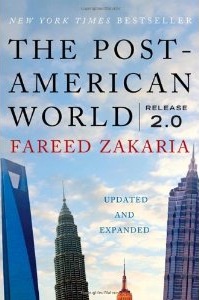
Fareed Zakaria's "The Post-American World 2.0"


This book is a fast read looking at America's relationship with the rest of the world. It focuses on two up-coming competitors, China and India. Zakaria says interesting things. This is a solid book. There are no big surprises and nothing controversial.

He takes the US to task for failing to live up to its ideals in the post-9/11 world. There is too much fear, too much security and too little civil liberties, and too much fear of "the other". He gives some solid advice. Again, pretty mainstream stuff.

Here's a bit to give you a taste of the book:
As it enters the twenty-first century, the United States is not fundamentally a weak economy, or a decadent society. But it has developed a highly dysfunctional politics. An antiquated and overly rigid political system to begin with -- about 225 years old -- has been captured by money, special interests, a sensationalist media, and ideological attack groups. The result is ceaseless, virulent debate about trivia -- politics as theater -- and very little substance, compromise, and action. A "can-do" country is now saddled with a "do-nothing" political process, designed for partisan battle rather than problem solving. By every measure -- the growth of special interests, lobbies, pork-barrel spending the political process has become far more partisan and ineffective over the last three decades.
And this:
To foreigners, American officials seem clueless about the world they are supposed to be running. "There are two sets of conversations, one with Americans in the room and one without," says Kishore Mahbubani, who was formerly Singapore's foreign secretary and ambassador to the United Nations. Because Americans live in a "cocoon," they don't see the "sea change in attitudes toward America throughout the world."
The book is a pleasant read. It won't startle you, but it does give a perspective on America that most Americans don't have. Zakaria was born in India and came to the US for college and never left. As an American with a unique background -- and a day job at Time magazine and CNN that lets him monitor the world and think about politics -- he has some useful things to say which other Americans should listen to.

As a Canadian I find it startling that not only is the average US citizen ignorant of the outside world, they are even poorly educated about their own history and political system. Every American needs to spend more time thinking about the role of America in the world. Turn off the political demagogues and read something thoughtful and get a broader understanding. Zakaria's book is a good place to start.

The Anti-Libertarian Case

Here is a nice bit from Robert Paul Wolff's Credo that captures the complete falsity of a libertarian world view:
All of us eat grain we have not grown, fruit we have not planted, meat we have not killed or dressed. We wear clothes made of wool we have not combed and carded, spun or woven. We live in houses we have not built, take medicines we neither discovered nor produced, read books we have not written, sing songs we did not compose. Each of us is completely dependent on the inherited knowledge, skill, labor, and memory of all who have gone before us, and all who share the earth with us now.

We have a choice. We can acknowledge our interdependence, embracing it as the true human condition; or we can deny it, deluding ourselves into thinking that we are related to one another only as parties to a bargain entered into in a marketplace. We can recognize that we need one another, and owe to one another duties of generosity and loyalty. Or we can pretend to need no one save through the intermediation of the cash nexus.

I choose to embrace our interdependence. I choose to acknowledge that the food I eat, the clothes on my back, and the house in which I live are all collective human products, and that when any one of us has no food or clothing or shelter, I am diminished by that lack.
Sadly it is the crazy right wing libertarian viewpoint that dominates half of America, the half that applauds when a governor recites his "accomplishments" in executing people or a doctor/senator admits that if doesn't get paid he will quietly watch a man die because the only obligations he feels if for the money he makes off you.

Wolff offers up an alternate vision:
There are two images alive in America, competing for our allegiance. The first is the image of the lone horseman who rides across an empty plain, pausing only fleetingly when he comes to a settlement, a man apparently having no need of others, self-sufficient [so long as someone makes the shells he needs for his rifle or the cloth he needs for his blanket], refusing to acknowledge that he owes anything at all to the human race of which he is, nonetheless, a part.
The other is the image of the community that comes together for a barn-raising, working as a group on a task that no one man can do by himself, eating a communal meal when the day is done, returning to their homes knowing that the next time one of their number needs help, they will all turn out to provide it.

These images are simple, iconic, even primitive, but the choice they present us with remains today, when no one rides the plains any more, and only the Amish have barn-raisings. Today, as I write, there are tens of millions of Americans who cannot put a decent meal on the table in the evening for their families, scores of millions threatened with the loss of their homes. And yet, there are hundreds of thousands lavishing unneeded wealth on themselves, heedless of the suffering of their fellow Americans, on whose productivity, inventiveness, and labor they depend for the food they eat, the clothing they wear, the homes they live in, and also for the luxuries they clutch to their breasts.

The foundation of my politics is the recognition of our collective interdependence. In the complex world that we have inherited from our forebears, it is often difficult to see just how to translate that fundamental interdependence into laws or public policies, but we must always begin from the acknowledgement that we are a community of men and women who must care for one another, work with one another, and treat the needs of each as the concern of all.
I'm completely blown away by the cruelty of those who deny social entanglement of empathy and instead claim only the cold hard "money economy" as their only social relationship. I would hate to be the child of such a cruel and calculating parent. What good is a baby? What money can you make off it? I'm surprised that libertarians even bother to raise families because it goes so strongly against this political/social philosophy. But humans are not known for their consistency. They can espouse high ideals and secretly stab you in the back. Conversely, they can claim allegiance to the most vicious authoritarian ideals and still help the weak and defenseless. Humans are a puzzle.

Friday, September 23, 2011

Bad News for Canada

The National Post is not known for its "socialist" message, but they've published an article that would warm the heart of any Marxist. They've printed the truth:
Work hard and you'll get ahead. That's been the mantra of folks who prefer their governments small and their success big.

But as two recent Conference Board of Canada reports show, that mantra is being cast into doubt. According to the voice of Canada's business establishment: "High inequality can diminish economic growth if it means that the country is not fully using the skills and capabilities of all its citizens or if it undermines social cohesion, leading to increased social tensions. . High inequality [also] raises a moral question about fairness and social justice."

Say the word "inequality," and many people automatically assume you're talking about the poor. But a mounting body of research shows that, left unchecked, a growing income gap affects the rich, the poor and everyone in between.

Economic growth used to be touted as the surest ticket to broad-based prosperity. But during the strongest period of economic growth in the past 30 years, between 1997 and 2007, a third of all income gains went to the richest 1% of Canadian tax filers.

Think that's normal? In the 1960s, the most recent comparable period of sustained growth, the richest 1% took only 8% of the gains from growth.

Not since 1920, when Ottawa began to collect income data, have Canada's elites pocketed a larger share of the income gains from economic growth. Top marginal tax rates for millionaires also are at rates last seen in 1920.

...

Canada's top 100 CEOs have seen a 13% year-over-year jump in average pay, rising to an average of $6-million. In contrast, the average earnings of employed Canadians has fallen to $38,500.

...

It's the promise of their own upward mobility that has many Canadians willing to brush aside the handsome gains enjoyed by the rich in the past 20 years. But rising inequality, in good times and bad, makes it increasingly feel like the game is rigged, destabilizing foundational values and expectations.

...

So what can we do to turn this story around?

Some will call for change that doesn't much disturb the status quo: Improvements in productivity, or tax cuts for Canadians with the lowest taxable incomes. But truly reducing inequality requires either increased incomes or lower costs for the majority. That means bosses and owners sharing more of the productivity gains and profits with workers; or paying more tax to expand affordable access to post-secondary education, public transit and child care, thus taking the pinch out of small paycheques.

For those who feel these measures are too costly, they should consider the alternative.

History has shown us, time and again: When too much is controlled by too few, something has to give. Continuously rising inequality is unsustainable.

Everyone has a stake in fixing this. And the fix has no political colour. It is about the future of Canada and where we're heading as an economy, a society, a democracy. That's why even conservatives are worrying about Canada's rising income gap.
I fervently hope the Conservative government listens to this. I pray that the top 1% realize the dark days ahead can't be avoided if they do not listen to this. The social contract in Canada is threatened by runaway elites. They need to be harnessed to the rest of us to ensure that we as a country progress and don't fall apart in some idiotic fight over crumbs off the table of the ultra-rich.

Elizabeth Warren on the Campaign Trail

Here she goes with a wonderful message of social justice...


I sure hope she is the first sprig of green in a new springtime of democracy in America. I hope many more follow her example and take to the hustings to bring the bottom 90% some hope of a better tomorrow, a more just tomorrow, a tomorrow where future generations have a chance at a decent life.

Thursday, September 22, 2011

Paul Krugman Examines "Class Warfare"

From Krugman's latest op-ed in the NY Tims:
This week President Obama said the obvious: that wealthy Americans, many of whom pay remarkably little in taxes, should bear part of the cost of reducing the long-run budget deficit. And Republicans like Representative Paul Ryan responded with shrieks of “class warfare.”

...

Detailed estimates from the Congressional Budget Office — which only go up to 2005, but the basic picture surely hasn’t changed — show that between 1979 and 2005 the inflation-adjusted income of families in the middle of the income distribution rose 21 percent. That’s growth, but it’s slow, especially compared with the 100 percent rise in median income over a generation after World War II.

Meanwhile, over the same period, the income of the very rich, the top 100th of 1 percent of the income distribution, rose by 480 percent. No, that isn’t a misprint. In 2005 dollars, the average annual income of that group rose from $4.2 million to $24.3 million.

So do the wealthy look to you like the victims of class warfare?

...

On one side, we have the claim that the rising share of taxes paid by the rich shows that their burden is rising, not falling. To point out the obvious, the rich are paying more taxes because they’re much richer than they used to be. When middle-class incomes barely grow while the incomes of the wealthiest rise by a factor of six, how could the tax share of the rich not go up, even if their tax rate is falling?

On the other side, we have the claim that the rich have the right to keep their money — which misses the point that all of us live in and benefit from being part of a larger society.

...

Republicans claim to be deeply worried by budget deficits. Indeed, Mr. Ryan has called the deficit an “existential threat” to America. Yet they are insisting that the wealthy — who presumably have as much of a stake as everyone else in the nation’s future — should not be called upon to play any role in warding off that existential threat.

Well, that amounts to a demand that a small number of very lucky people be exempted from the social contract that applies to everyone else. And that, in case you’re wondering, is what real class warfare looks like.
I believe Americans should give the rich what they want: no taxes. Simply take away their citizenship and put them on a boat and tell them "bon voyage". They can then paddle to some place that is willing to coddle them as they demand.

Luckily, the sensible rich, people like Warren Buffet will stay behind, accept higher taxes, and help to build a stronger US society: one where everybody gets enough food, clothing, housing, medical care, education to have a fair chance to rise to a better position in society than their parents.