
Here is a doom-and-gloom view of the world from the Wall Street Journal. They look at the problems in Europe and spin a tale of imminent calamity for the whole world. I, however, see the WSJ as a Cassandra:
The WSJ is like those prophets in mid 1940 wrote off England and proclaimed the end of the world as we know it and the start of a new age of barbarism. On the other hand, I believe in "muddle through". The Brits muddled, Hitler over-reached in Russia, and finally America joined the fray and the world managed to find a way to avoid the obvious bleak tragedy that all the experts foretold.
Showing posts with label World. Show all posts
Showing posts with label World. Show all posts
Tuesday, January 3, 2012

Sunday, December 18, 2011
Third Time is a Charm... maybe
Here is a bit from a NY Times op-ed piece by Paul Krugman:
When I was a kid I heard the so-called "Chinese" curse of "may you live in interesting times". All I knew is that I desperately wanted to live in boring times, but sadly my whole life has been lived in the maelstrom of "interesting" events bringing misery and chaos. That is how the world works. Complete indifference to humans needs or wants.
Consider the following picture: Recent growth has relied on a huge construction boom fueled by surging real estate prices, and exhibiting all the classic signs of a bubble. There was rapid growth in credit — with much of that growth taking place not through traditional banking but rather through unregulated “shadow banking” neither subject to government supervision nor backed by government guarantees. Now the bubble is bursting — and there are real reasons to fear financial and economic crisis.The world doesn't need more bad news. But sadly the world is indifferent to humans, their needs, their wants. While Krugman worries about the effect of China on the world, Kim Jong-il has died in Korea creating an unstable mess that could easily spin out of control.
Am I describing Japan at the end of the 1980s? Or am I describing America in 2007? I could be. But right now I’m talking about China, which is emerging as another danger spot in a world economy that really, really doesn’t need this right now.
I’ve been reluctant to weigh in on the Chinese situation, in part because it’s so hard to know what’s really happening. All economic statistics are best seen as a peculiarly boring form of science fiction, but China’s numbers are more fictional than most. I’d turn to real China experts for guidance, but no two experts seem to be telling the same story.
Still, even the official data are troubling — and recent news is sufficiently dramatic to ring alarm bells.
When I was a kid I heard the so-called "Chinese" curse of "may you live in interesting times". All I knew is that I desperately wanted to live in boring times, but sadly my whole life has been lived in the maelstrom of "interesting" events bringing misery and chaos. That is how the world works. Complete indifference to humans needs or wants.
Thursday, December 15, 2011
Social Protest
Here is a good overview of the protests that are shaking the world and a prediction of more to come. The interview is with Gerald Celente.
My favourite phrase:
While I don't agree with his specific "predictions" (he is no better than most other prognosticators), I do think he has the zeitgeist of the time correct: we are in an era of social upheaval because of a failing economic system with the root cause being a growing economic inequality and a growing marginalization of the bottom 50%.
My favourite phrase:
When the money on the top stops flowing down to the man on the street, the blood starts flowing in the streets.
While I don't agree with his specific "predictions" (he is no better than most other prognosticators), I do think he has the zeitgeist of the time correct: we are in an era of social upheaval because of a failing economic system with the root cause being a growing economic inequality and a growing marginalization of the bottom 50%.
Friday, November 4, 2011
Reich Sees a Global Uprising
The winds of change are blowing. Robert Reich sees today as pivotal like 1968 and 1989. Here is his latest post on his blog:
Washington Pre-OccupiedThe most interesting thing about the future is that nobody really knows what it holds. I certainly hope the 40 year swing of the pendulum to the right is about to be changed and society will swing back toward social justice, greater democracy, a better sharing of the fruits of economic development, and a more positive future for the bottom 99%. But this will only be clear 10 or 20 years from now.
The biggest question in America these days is how to revive the economy.
The biggest question among activists now occupying Wall Street and dozens of other cities is how to strike back against the nation’s almost unprecedented concentration of income, wealth, and political power in the top 1 percent.
The two questions are related. With so much income and wealth concentrated at the top, the vast middle class no longer has the purchasing power to buy what the economy is capable of producing. (People could pretend otherwise as long as they could treat their homes as ATMs, but those days are now gone.) The result is prolonged stagnation and high unemployment as far as the eye can see.
Until we reverse the trend toward inequality, the economy can’t be revived.
But the biggest question in our nation’s capital right now has nothing to do with any of this. It’s whether Congress’s so-called “Supercommittee” – six Democrats and six Republicans charged with coming up with $1.2 trillion in budget savings — will reach agreement in time for the Congressional Budget Office to score its proposal, which must then be approved by Congress before Christmas recess in order to avoid an automatic $1.5 trillion in budget savings requiring major across-the-board cuts starting in 2013.
Have your eyes already glazed over?
Diffident Democrats on the Supercommittee have already signaled a willingness to cut Medicare, Social Security, and much else that Americans depend on. The deal is being held up by Regressive Republicans who won’t raise taxes on the rich – not even a tiny bit.
President Obama, meanwhile, is out on the stump trying to sell his “jobs bill” – which would, by the White House’s own estimate, create fewer than 2 million jobs. Yet 14 million people are out of work, and another 10 million are working part-time who’d rather have full-time jobs.
Republicans have already voted down his jobs bill anyway.
The disconnect between Washington and the rest of the nation hasn’t been this wide since the late 1960s.
The two worlds are on a collision course: Americans who are losing their jobs or their pay and can’t pay their bills are growing increasingly desperate. Washington insiders, deficit hawks, regressive Republicans, diffident Democrats, well-coiffed lobbyists, and the lobbyists’ wealthy patrons on Wall Street and in corporate suites haven’t a clue or couldn’t care less.
I can’t tell you when the collision will occur but I’d guess 2012.
Look elsewhere around the world and you see a similar collision unfolding. The details differ but the larger forces are similar. You see it in Spain, Greece, and Italy, whose citizens are being squeezed by bankers insisting on austerity. You see it in Chile and Israel, whose young people are in revolt. In the Middle East, whose “Arab spring” is becoming a complex Arab fall and winter. Even in China, whose young and hourly workers are demanding more – and whose surge toward inequality in recent years has been as breathtaking as is its surge toward modern capitalism.
Will 2012 go down in history like other years that shook the foundations of the world’s political economy – 1968 and 1989?
I spent part of yesterday in Oakland, California. The Occupier movement is still in its infancy in the United States, but it cannot be stopped. Here, as elsewhere, people are outraged at what feels like a rigged game – an economy that won’t respond, a democracy that won’t listen, and a financial sector that holds all the cards.
Here, as elsewhere, the people are rising.
Thursday, October 20, 2011
Occupy Wall Street Goes Global
Here is a video clip covering Occupy Wall Street around the world. They note that over 1000 cities have spin-off demonstrations.
I like this coverage by the RT network, but I do find it ironic that this is Russian TV and they report "no demonstrations" in Russia.
How odd. Is there no 99% vs 1% split in Putin's autocracy? I can't swallow that. This is an example of one national TV service bashing other countries. RT is free to bash others using its "open" coverage. But they are not free comment on Russia. Putin's censorship keeps the situation in the home country utterly opaque.
What I do know about Russia is that, if you try to be an independent journalist, you will be killed by the KGB (now FSB). Putin supports "glasnost" for the rest of the world, but not for his oppressed people.
I like this coverage by the RT network, but I do find it ironic that this is Russian TV and they report "no demonstrations" in Russia.
How odd. Is there no 99% vs 1% split in Putin's autocracy? I can't swallow that. This is an example of one national TV service bashing other countries. RT is free to bash others using its "open" coverage. But they are not free comment on Russia. Putin's censorship keeps the situation in the home country utterly opaque.
What I do know about Russia is that, if you try to be an independent journalist, you will be killed by the KGB (now FSB). Putin supports "glasnost" for the rest of the world, but not for his oppressed people.
Tuesday, October 11, 2011
A World on Fire
The year 1968 was one of protest and demonstratons worldwide. It now looks like 2011 is another turning point like that. Here's a bit from a Reuters article:
What I would like to see is a spreading protest through Asia. The Chinese need to put pressure on their government to allow the consumer society to blossom. The Japanese need to get their government to get their government to take responsibility for Fukushima and to get their economy growing.
Update 2011oct12: I'm hoping that 2011 will prove to be far more influential than 1968, but only time will tell. We are too close to events.
A book which gives you some understanding of the significance of the year 1968 is Mark Kurlansky's 1968: The Year That Rocked the World

From a review:
Tahrir Square in Cairo, Green Square in Tripoli, Syntagma Square in Athens and now Zuccotti Park in New York -- popular anger against entrenching power elites is spreading around the world.The future always make sense when reviewed in reverse. The really hard task is to look toward the yet-to-be future and make sense of it. I hope 2011 is an axial point in history, but this will be clear in 10 years, not now.
Many have been intrigued by the Occupy Wall Street movement against financial inequality that started in a New York park and expanded across America from Tampa, Florida, to Portland, Oregon, and from Los Angeles to Chicago.
Hundreds of activists gathered a month ago in the Manhattan park two blocks from Wall Street to vent their anger at what they see as the excesses of New York financiers, whom they blame for the economic crisis that has struck countless ordinary Americans and reverberated across the global economy.
In the U.S. movement, Arab nations see echoes of this year's Arab Spring uprisings. Spaniards and Italians see parallels with Indignados (indignant) activists, while voices in Tehran and Beijing with their own anti-American agendas have even said this could portend the meltdown of the United States.
Inspired by the momentum of the U.S. movement, which started small but is now part of U.S. political debate, activists in London will gather to protest outside the London Stock Exchange on October 15 on the same day that Spanish groups will mass on Madrid's Puerta del Sol square in solidarity.
What I would like to see is a spreading protest through Asia. The Chinese need to put pressure on their government to allow the consumer society to blossom. The Japanese need to get their government to get their government to take responsibility for Fukushima and to get their economy growing.
Update 2011oct12: I'm hoping that 2011 will prove to be far more influential than 1968, but only time will tell. We are too close to events.
A book which gives you some understanding of the significance of the year 1968 is Mark Kurlansky's 1968: The Year That Rocked the World

From a review:
In 1968, Mark Kurlansky brings to life the cultural and political history of that world-changing year of social upheaval. To some, it was the year of sex, drugs, and rock and roll. Yet it was also the year of the Martin Luther King, Jr., and Bobby Kennedy assassinations; the riots at the Democratic National Convention in Chicago; Prague Spring; the antiwar movement and the Tet Offensive; Black Power; the generation gap; avant-garde theater; the upsurge of the women's movement; and the beginning of the end for the Soviet Union. From New York, Miami, Berkeley, and Chicago to Paris, Prague, Rome, Berlin, Warsaw, Tokyo, and Mexico City, spontaneous uprisings occurred simultaneously around the globe." "Kurlansky shows how the coming of live television made 1968 the first global year. It was the year that an awestruck world watched the first live telecast from outer space, and that TV brought that day's battle - the Vietnam War's Tet Offensive - into America's living rooms on the evening news. Television also shocked the world with seventeen minutes of police clubbing demonstrators at the Chicago convention, live film of unarmed students facing down Soviet tanks in Czechoslovakia, and a war of starvation in Biafra. The impact was huge, not only on the antiwar movement, but also on the medium of television itself. The fact that one now needed television to make things happen was a cultural revelation with enormous consequences." In many ways, this momentous year led us to where we are today. Whether through youth and music, politics and war, economics and the media, Mark Kurlansky shows how, in 1968, twelve volatile months transformed who we were as a people. But above all, he gives a new insight into the underlying causes of the unique historical phenomenon that was the year 1968.Will 2011 eclipse 1968? What about other key dates of mass uprisings such as 1789 or 1848? Only time will reveal the significance of 2011 to us.
Monday, October 3, 2011
We Need More of This
From Storyful.com:
More political leaders and heads of state need to crawl out from under the thumb of Wall Street and the big banks and join the bottom 90%.
Iceland’s first lady, Dorrit Moussaieff, joined protesters in a bold move to show her sympathy for people hit by the debt crisis. As the Icelandic president and MPs came under fire from angry protesters on Saturday, on their traditional walk to church marking the opening of the parliamentary session, the President’s wife broke away to join the protest. Protesters, demanding that the government do more to help struggling households, had lined the streets in central Reykjavik pelting politicians with eggs and yogurt.She climbs over at 03:00 in the video...
More political leaders and heads of state need to crawl out from under the thumb of Wall Street and the big banks and join the bottom 90%.
Monday, September 26, 2011
The True Heart of Communism
Here's a short but too-the-point posting on the BoingBoing site:
Burying bodies is something that the political extremes of both the left and right love to indulge in. They both beat their chest over their "love of the people" but as best I can tell, they want robots not people and they are only too happy to kill those who don't fit their blinkered view of "the good life". The 20th century was the scourge of history because of political extremists on right and left indulged their fanaticism and left hundreds of millions of dead bodies littering that "stage of history".
China Communist Party official who kept sex slaves in basement loses jobI guess they are going to have to dig up Mao and strip him of his "party membership" since he was guilty of enslaving nearly a billion Chinese and killing 40 million Chinese. Sadly, we know they won't because slavery and killing people is at the heart of Communism. It has been there since the "communism" was founded when a minority split from the Marxist Russian Social Democratic Labor Party and had the audacity to call themselves the "majority" (in Russian "Bolshevik").
By Xeni Jardin at 12:36 pm Monday, Sep 26
A man who is accused of holding six women as sex slaves in a dungeon for two years and killing two of them has been terminated from his government post and stripped of his Communist Party membership.
Burying bodies is something that the political extremes of both the left and right love to indulge in. They both beat their chest over their "love of the people" but as best I can tell, they want robots not people and they are only too happy to kill those who don't fit their blinkered view of "the good life". The 20th century was the scourge of history because of political extremists on right and left indulged their fanaticism and left hundreds of millions of dead bodies littering that "stage of history".
Saturday, September 24, 2011
Fareed Zakaria's "The Post-American World 2.0"
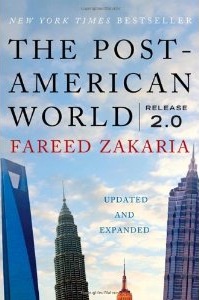
This book is a fast read looking at America's relationship with the rest of the world. It focuses on two up-coming competitors, China and India. Zakaria says interesting things. This is a solid book. There are no big surprises and nothing controversial.
He takes the US to task for failing to live up to its ideals in the post-9/11 world. There is too much fear, too much security and too little civil liberties, and too much fear of "the other". He gives some solid advice. Again, pretty mainstream stuff.
Here's a bit to give you a taste of the book:
As it enters the twenty-first century, the United States is not fundamentally a weak economy, or a decadent society. But it has developed a highly dysfunctional politics. An antiquated and overly rigid political system to begin with -- about 225 years old -- has been captured by money, special interests, a sensationalist media, and ideological attack groups. The result is ceaseless, virulent debate about trivia -- politics as theater -- and very little substance, compromise, and action. A "can-do" country is now saddled with a "do-nothing" political process, designed for partisan battle rather than problem solving. By every measure -- the growth of special interests, lobbies, pork-barrel spending the political process has become far more partisan and ineffective over the last three decades.And this:
To foreigners, American officials seem clueless about the world they are supposed to be running. "There are two sets of conversations, one with Americans in the room and one without," says Kishore Mahbubani, who was formerly Singapore's foreign secretary and ambassador to the United Nations. Because Americans live in a "cocoon," they don't see the "sea change in attitudes toward America throughout the world."The book is a pleasant read. It won't startle you, but it does give a perspective on America that most Americans don't have. Zakaria was born in India and came to the US for college and never left. As an American with a unique background -- and a day job at Time magazine and CNN that lets him monitor the world and think about politics -- he has some useful things to say which other Americans should listen to.
As a Canadian I find it startling that not only is the average US citizen ignorant of the outside world, they are even poorly educated about their own history and political system. Every American needs to spend more time thinking about the role of America in the world. Turn off the political demagogues and read something thoughtful and get a broader understanding. Zakaria's book is a good place to start.
Friday, September 23, 2011
The Insanity of Anti-Technology
Most people are abysmally ignorant of the role of science and technology in today's world. They have wildly romantic images of "organic gardening" and "back to nature" view of life. They are terrified of pesticides and absolutely ignorant of the fact that your veggies are packed with lethal concoctions natural to the plant as its defense against insects and other animals tempted to nibble on it.
These people think they can give up on nuclear power because it is dangerous while not aware of the deaths from traditional energy sources. They don't understand the trade-offs that must be taken in all aspects of our life. Mostly these are the coddled children of middle and upper class families, young adults never responsible for feeding and clothing themselves. But they get sucked up in a "great cause" of anti-science.
One of the most laughable was the "frankenfood" movement based in Europe. These people are convinced that if you transfer genes from one species to another you are upsetting "God's plan" and have created a great sin. They see genetically modified food as both dangerous and sinful. But they are completely ignorant of science and the fact that all life is chock-a-block full of "foreign genes" transported by viruses. This has been happening for a couple of billion years. The genetically modified food is perfectly safe unless the experiment was to move toxin-generating coding into the new species. But no food researcher is interested in poisoning people. They are trying to create stronger, better crops, e.g. move vitamin A into rice crops to fight disease. From Wikipedia:
The madness of anti-science was seen in the Unabomber. He was judge, jury, and executioner for his perceived "wrongs" of scientific researchers. Nobody appointed him. He had to pass no tests or get a license to go on his murderous spree. Rather than work within the system and try to set up regulations for ensuring safe research, he went on a killing spree. This is the "saviour" of mankind. Just as Osama Bin Laden was the "saviour" of a purist Islam. Self-appointed fanatics gone murderous and feeling saintly about their vicious trade.
Now I come to the purpose of this post. You should read about the latest gang of murderous anti-science fanatics and their handiwork. Here is a bit from an article in the Chronicle of Higher Education about attacks on nanotechnology researchers in Mexico by self-appointed "saviours" of humanity:
People need to realize that science is what gives us the comfortable life we have. Those who are anti-science should put their energies into going "back to the land" and living with a "technology-free" lifestyle and quit trying to use murderous plottings to kill of the rest of us that are quite happy to benefit from fire, metal working, the wheel, the agricultural revolution, modern medicine, etc.
Two things astound me about these fanatics:
These people think they can give up on nuclear power because it is dangerous while not aware of the deaths from traditional energy sources. They don't understand the trade-offs that must be taken in all aspects of our life. Mostly these are the coddled children of middle and upper class families, young adults never responsible for feeding and clothing themselves. But they get sucked up in a "great cause" of anti-science.
One of the most laughable was the "frankenfood" movement based in Europe. These people are convinced that if you transfer genes from one species to another you are upsetting "God's plan" and have created a great sin. They see genetically modified food as both dangerous and sinful. But they are completely ignorant of science and the fact that all life is chock-a-block full of "foreign genes" transported by viruses. This has been happening for a couple of billion years. The genetically modified food is perfectly safe unless the experiment was to move toxin-generating coding into the new species. But no food researcher is interested in poisoning people. They are trying to create stronger, better crops, e.g. move vitamin A into rice crops to fight disease. From Wikipedia:
Approximately 250,000–500,000 children in developing countries become blind each year owing to vitamin A deficiency, with the highest prevalence in Southeast Asia and Africa.Again from Wikipedia:
Golden rice is a variety of Oryza sativa rice produced through genetic engineering to biosynthesize beta-carotene, a precursor of pro-vitamin A in the edible parts of rice.This is the horror of "frankenfood"? This is engineered food to save half a million children per year from blindness.
The madness of anti-science was seen in the Unabomber. He was judge, jury, and executioner for his perceived "wrongs" of scientific researchers. Nobody appointed him. He had to pass no tests or get a license to go on his murderous spree. Rather than work within the system and try to set up regulations for ensuring safe research, he went on a killing spree. This is the "saviour" of mankind. Just as Osama Bin Laden was the "saviour" of a purist Islam. Self-appointed fanatics gone murderous and feeling saintly about their vicious trade.
Now I come to the purpose of this post. You should read about the latest gang of murderous anti-science fanatics and their handiwork. Here is a bit from an article in the Chronicle of Higher Education about attacks on nanotechnology researchers in Mexico by self-appointed "saviours" of humanity:
A package bomb that injured two professors at a university here this month is the latest in a string of attacks by a new terror group inspired by the Unabomber. Its violent actions have put campuses across Mexico on alert and caused nanotechnology researchers worldwide to take precautions with their mail.These anti-science fanatics can't be bothered with facts. No researcher that I know of is trying to develop this kind of dystopian technology. Everybody I know is working to make a better world, like the first fellow who rubbed two sticks together to create fire. Sure, I'll bet there were those sitting around the resulting campfire speculating that some mad caveman would use this "new technology" to set afire all the forests of the world and destroy earth. Maybe they even plotted to kill the fire-starter and ensure the knowledge was lost because they saw it as a clear danger to the lovely lifestyle of sitting in the dark and cold eating raw meat and uncooked veggies.
Nanotechnology was singled out as a target for the attacks in manifestos posted on the Web by the group behind the bombs, which calls itself "Individualities Tending Toward Savagery." It has been linked to attacks in France, Spain, and Chile, and to a bomb sent earlier this year to a scientist at another Mexican university who specializes in nanotech. An analyst who helped identify the Unabomber—who turned out to be a former professor—says the posts show signs of someone well-educated who could be affiliated with a college.
The online rants credit the Unabomber as an inspiration. ...
...
In the group's online post (written in Spanish) claiming credit for the latest bombing, the terrorists complained about the growing number of nanotechnology experts in Mexico, which it estimated at 650. "The ever more rapid acceleration of this technology will lead to the creation of nanocyborgs that can self-replicate automatically without the help of a human," it said.
...
Many people in the region are skeptical of science, he adds. "In our country, and in the whole Latin American region, we put more faith in the supernatural than in reason. This poses fatal consequences, making people view researchers in science and technology with suspicion and hate, as inhuman individuals, who work against society and as the exploiters and destroyers of natural resources."
People need to realize that science is what gives us the comfortable life we have. Those who are anti-science should put their energies into going "back to the land" and living with a "technology-free" lifestyle and quit trying to use murderous plottings to kill of the rest of us that are quite happy to benefit from fire, metal working, the wheel, the agricultural revolution, modern medicine, etc.
Two things astound me about these fanatics:
- Their temerity to act on own behalf to bring their twisted vision of the future to reality. Who appointed them? What right have they?
- The abysmal ignorance of these fanatics of the role of science in technology in modern life. Their blind ideology puts ignorance on a pedestal and they worship it. They use religion or just crass stupidity as justification for their evil actions without understanding what they claim to oppose or what the consequences of their actions truly are.
Tuesday, August 9, 2011
Diagnosing the Economy's Ills
Here is a bit from an article by Kenneth Rogoff published by Project Syndicate:
Fighting a depression is much harder than fighting a recession, and as Rogoff points out, it requires a different framework and a different set of tools:
Why is everyone still referring to the recent financial crisis as the “Great Recession”? The term, after all, is predicated on a dangerous misdiagnosis of the problems that confront the United States and other countries, leading to bad forecasts and bad policy.This article has much more material. Go read the full article.
The phrase “Great Recession” creates the impression that the economy is following the contours of a typical recession, only more severe – something like a really bad cold. That is why, throughout this downturn, forecasters and analysts who have tried to make analogies to past post-war US recessions have gotten it so wrong. Moreover, too many policymakers have relied on the belief that, at the end of the day, this is just a deep recession that can be subdued by a generous helping of conventional policy tools, whether fiscal policy or massive bailouts.
But the real problem is that the global economy is badly overleveraged, and there is no quick escape without a scheme to transfer wealth from creditors to debtors, either through defaults, financial repression, or inflation.
A more accurate, if less reassuring, term for the ongoing crisis is the “Second Great Contraction.” Carmen Reinhart and I proposed this moniker in our 2009 book This Time is Different, based on our diagnosis of the crisis as a typical deep financial crisis, not a typical deep recession. The first “Great Contraction” of course, was the Great Depression, as emphasized by Anna Schwarz and the late Milton Friedman. The contraction applies not only to output and employment, as in a normal recession, but to debt and credit, and the deleveraging that typically takes many years to complete.
Why argue about semantics? Well, imagine you have pneumonia, but you think it is only a bad cold. You could easily fail to take the right medicine, and you would certainly expect your life to return to normal much faster than is realistic.
Fighting a depression is much harder than fighting a recession, and as Rogoff points out, it requires a different framework and a different set of tools:
Acknowledging that we have been using the wrong framework is the first step toward finding a solution. History suggests that recessions are often renamed when the smoke clears. Perhaps today the smoke will clear a bit faster if we dump the “Great Recession” label immediately and replace it with something more apt, like “Great Contraction.” It is too late to undo the bad forecasts and mistaken policies that have marked the aftermath of the financial crisis, but it is not too late to do better.Sadly, I don't think Obama is the kind of man who admits mistakes and changes course. FDR was the right leader during the Great Depression because he was willing to try anything and was always willing to admit that he had made a mistake. Obama is too uptight to admit error so he will keep on the current course and prolong this current depression in the US.
Sunday, August 7, 2011
Political Hot Air
I love how politicians can't be honest and bloviate rather than pull up their sleeves and do the hard work required. Here's the "official" statement of this weekends G7 "leaders". From the Wall Street Journal:
Statement of G7 Finance Ministers and Central Bank GovernorsThat "statement" isn't worth the paper it is written on. It says nothing. There are no details. In fact, the message that you can read is that politicians will dither while the economies around the world tremble and shake as the financial winds howl. The idiots at the helm don't know enough and aren't smart enough and don't have the courage to actually lead. They are a bunch of sheep saying "baa, baa, baa". Pitiful.
August 8, 2011
In the face of renewed strains on financial markets, we, the Finance Ministers and Central Bank Governors of the G-7, affirm our commitment to take all necessary measures to support financial stability and growth in a spirit of close cooperation and confidence.
We are committed to addressing the tensions stemming from the current challenges on our fiscal deficits, debt and growth, and welcome the decisive actions taken in the US and Europe. The US has adopted reforms that will deliver substantial deficit reduction over the medium term. In Europe, the Euro area Summit decided on July 21 a comprehensive package to tackle the situation in Greece and other countries facing financial tensions, notably through the flexibilisation of the EFSF. We are now focused on the quick and full implementation of the agreements achieved. We welcome the statement of France and Germany to that effect. We also welcome the statement of the Governing Council of the ECB.
We are committed to taking coordinated action where needed, to ensuring liquidity, and to supporting financial market functioning, financial stability and economic growth.
These actions, together with continuing fiscal discipline efforts will enable long-term fiscal sustainability. No change in fundamentals warrants the recent financial tensions faced by Spain and Italy. We welcome the additional policy measures announced by Italy and Spain to strengthen fiscal discipline and underpin the recovery in economic activity and job creation. The Euro Area Leaders have stated clearly that the involvement of the private sector in Greece is an extraordinary measure due to unique circumstances that will not be applied to any other member states of the euro area.
We reaffirmed our shared interest in a strong and stable international financial system, and our support for market-determined exchange rates. Excess volatility and disorderly movements in exchange rates have adverse implications for economic and financial stability. We will consult closely in regard to actions in exchange markets and will cooperate as appropriate.
We will remain in close contact throughout the coming weeks and cooperate as appropriate, ready to take action to ensure stability and liquidity in financial markets.
Tuesday, August 2, 2011
Social Instability
Paul Krugman is worrying that the Little Depression is giving rise to the irrational forces last seen in the 1930s with the rise of fascism and hard right political parties. Here is the key bit from a post on his NY Times blog:
Think about WWII. It destroyed so much wealth and killed so many people. If political systems had worked and people had worked out their problems, today would be a paradise. But humans seem hell-bent on spoiling their own nest by going beserk with wars and crazy destructiveness. Rather than appreciate what you have and learn to share in order to get a win-win relationship, people would rather take down everything to prevent somebody else from getting a bit more. It is completely irrational, but I've long ago learned that Mother Nature has no love for humans and isn't kind or benevolent. The world is a cruel place and it filled with far too many crazy people.
Just think of the billionaires in the US. Rather than pay a bit more in taxes and help kickstart the economy, they have their goons in Washington fighting tooth and nail to prevent any tax increases while they are fighting to remove the social programs that keep the poor from starving on the street homeless and forgotten. Insane.
...what we’ve witnessed pretty much throughout the western world is a kind of inverse miracle of intellectual failure. Given a crisis that should have been relatively easy to solve — and, more than that, a crisis that anyone who knew macroeconomics 101 should have been well-prepared to deal with — what we actually got was an obsession with problems we didn’t have. We’ve obsessed over the deficit in the face of near-record low interest rates, obsessed over inflation in the face of stagnant wages, and counted on the confidence fairy to make job-destroying policies somehow job-creating.I'm not aware of a surge in 1930s style crazy politics, but Paul Krugman is a much smarter guy than me, he's got a network of friends keeping him abreast of these things, so I suspect he is on to something. I hope we don't repeat the political craziness of the 1930s (that ended in global war). But when I look at the political crazies in the US I'm already pretty frightened by what I see. I don't understand why people are not willing to compromise.
It’s a disaster – and maybe not only an economic disaster.Fears of far-right rise in crisis-hit GreeceGot that 30s feeling, all the way.
ATHENS, Greece — They descended by the hundreds — black-shirted, bat-wielding youths chasing down dark-skinned immigrants through the streets of Athens and beating them senseless in an unprecedented show of force by Greece’s far-right extremists.
In Greece, alarm is rising that the twin crises of financial meltdown and soaring illegal immigration are creating the conditions for a right-wing rise — and the Norway massacre on Monday drove authorities to beef up security.
The move comes amid spiraling social unrest that has unleashed waves of rioting and vigilante thuggery on the streets of Athens. The U.N.’s refugee agency warns that some Athens neighborhoods have become zones where “fascist groups have established an odd lawless regime.”
Think about WWII. It destroyed so much wealth and killed so many people. If political systems had worked and people had worked out their problems, today would be a paradise. But humans seem hell-bent on spoiling their own nest by going beserk with wars and crazy destructiveness. Rather than appreciate what you have and learn to share in order to get a win-win relationship, people would rather take down everything to prevent somebody else from getting a bit more. It is completely irrational, but I've long ago learned that Mother Nature has no love for humans and isn't kind or benevolent. The world is a cruel place and it filled with far too many crazy people.
Just think of the billionaires in the US. Rather than pay a bit more in taxes and help kickstart the economy, they have their goons in Washington fighting tooth and nail to prevent any tax increases while they are fighting to remove the social programs that keep the poor from starving on the street homeless and forgotten. Insane.
Saturday, June 25, 2011
Going Green and the Hand Wringing Apologists
There is a lot of brow-beating of people in the developed world about their "guilt". Guilt for a "colonial" past. Guilt about outrageously self-indulgent lifestyles. Guilt about greedily seizing resources and living the underdeveloped world desperate and without.
Well... I was never a colonialist. I don't live an indulgent lifestyle. And I've never hogged resources. Sure, colonialism was rampant 300 years ago. But if you go back 2000 years you find Romans, Chinese, Persians, Indians, etc. as the great colonialists. Why don't be beat Iranians, Chinese, Indians, etc. about the ears for having "empires". My ancestors were running around half naked in the northern fringe woodlands 2000 years ago.
As for using an "unfair" share of resources:

Click to Enlarge
The above graph is from a post on energy by Ed Yardini in his blog Dr. Ed's Blog.
As the graph makes clear, the rising standard of living in China and India (and more generally in southeast Asia) means that resource consumption there has rapidly surpassed the "developed" world. Sure, the per-capita resource use is still low, but the graph shows the trend. In 30-50 years the overwhelming about of resource consumption will be with the billion+ populations of China and India.
Oil consumption is falling in the "developed" world while it is strongly rising in the "undeveloped" world. But all the anti-technology, "green", guilt-ridden propaganda used to make people in the developed world feel guilty is out-dated. It doesn't reflect the world we now live in. But it always takes time for people to throw off out-dated mental shackles.
Well... I was never a colonialist. I don't live an indulgent lifestyle. And I've never hogged resources. Sure, colonialism was rampant 300 years ago. But if you go back 2000 years you find Romans, Chinese, Persians, Indians, etc. as the great colonialists. Why don't be beat Iranians, Chinese, Indians, etc. about the ears for having "empires". My ancestors were running around half naked in the northern fringe woodlands 2000 years ago.
As for using an "unfair" share of resources:

The above graph is from a post on energy by Ed Yardini in his blog Dr. Ed's Blog.
As the graph makes clear, the rising standard of living in China and India (and more generally in southeast Asia) means that resource consumption there has rapidly surpassed the "developed" world. Sure, the per-capita resource use is still low, but the graph shows the trend. In 30-50 years the overwhelming about of resource consumption will be with the billion+ populations of China and India.
Oil consumption is falling in the "developed" world while it is strongly rising in the "undeveloped" world. But all the anti-technology, "green", guilt-ridden propaganda used to make people in the developed world feel guilty is out-dated. It doesn't reflect the world we now live in. But it always takes time for people to throw off out-dated mental shackles.
Sunday, June 19, 2011
Global Economy Flashing a Yellow Light
Here is an interview with Lakshman Achuthan from ECRI where he lays out what the economic indicators are showing:
When, oh when, will Obama wake up and realize that his pathetic 2009 stimulus was too small? When will he decide to take on the Republicans and get the US economy moving again? Why is he allowing the political right to handcuff him into an impossible position of claiming the economy is in a "Goldilock's state" of recovery where the stimulus was "just enough" and things are slowly but surely "recovering"?
From the Calculated Risk blog, here is the picture of the US recession and how bad it is compared to all the post-WWII recessions:

Click to Enlarge
What is really depressing in Lakshman Achuthan's words is the bit saying that this slowdown isn't just in the US but is worldwide, see 6:00 into the above video. The fact that it is pervasive and worldwide means that the US can't expect help from outside to help pull its economy out of the quagmire.
The U.S. economy is “not yet” headed for a double-dip recession, but a sharp and prolonged downturn is underway and may make jobs growth even tougher to come by.
When, oh when, will Obama wake up and realize that his pathetic 2009 stimulus was too small? When will he decide to take on the Republicans and get the US economy moving again? Why is he allowing the political right to handcuff him into an impossible position of claiming the economy is in a "Goldilock's state" of recovery where the stimulus was "just enough" and things are slowly but surely "recovering"?
From the Calculated Risk blog, here is the picture of the US recession and how bad it is compared to all the post-WWII recessions:

What is really depressing in Lakshman Achuthan's words is the bit saying that this slowdown isn't just in the US but is worldwide, see 6:00 into the above video. The fact that it is pervasive and worldwide means that the US can't expect help from outside to help pull its economy out of the quagmire.
Thursday, May 5, 2011
The Beginning and the End of the Universe
Here's the inside scoop from a guy who is "in the know"...
I find it fully that a huge number of people think they really "understand" the universe from a little book that is a couple of thousand years old. The real story is simply incredible. But the smug fundamentalists couldn't be bothered to listen to what science has discovered.
The world is more amazing and mysterious than any single human being could possibly imagine. Science is the collective labour over centuries which has given us deep insights into the big, big world out there. Science is fact, not morals or art. What is annoying is that moralists think they know more about science than the scientists. They disrespect those tens of thousands of people working over centuries to give us our current state of knowledge. And science is truly humbling because scientists are the first to admit that the story is unfinished. There is yet more to know.
I find it fully that a huge number of people think they really "understand" the universe from a little book that is a couple of thousand years old. The real story is simply incredible. But the smug fundamentalists couldn't be bothered to listen to what science has discovered.
The world is more amazing and mysterious than any single human being could possibly imagine. Science is the collective labour over centuries which has given us deep insights into the big, big world out there. Science is fact, not morals or art. What is annoying is that moralists think they know more about science than the scientists. They disrespect those tens of thousands of people working over centuries to give us our current state of knowledge. And science is truly humbling because scientists are the first to admit that the story is unfinished. There is yet more to know.
Thursday, March 31, 2011
An Inspirational Story
I love stories about underdogs rising up and surprising everybody. Here's a story about a water-logged soccer team and its surprising success:
Wednesday, March 30, 2011
History of Civilization on the Fly
Here's a quick zoom through civilization's impact on native vegetation:
Some see the browning (desertification?) of that lovely green as a horror story. I see it as humans taking charge of their fate through their technology. I don't want to pave over paradise, but I enjoy farmland. I think it looks lovely. And I especially love the fruits of the labour of farmers.
Some see the browning (desertification?) of that lovely green as a horror story. I see it as humans taking charge of their fate through their technology. I don't want to pave over paradise, but I enjoy farmland. I think it looks lovely. And I especially love the fruits of the labour of farmers.
Tuesday, March 15, 2011
Israel: The New Saudi Arabia of Fossil Fuel?
Here's a surprising story that will change power relations in the Middle East. From an article in the Jerusalem Post:
I love surprises! Life is always blindsiding you. Anybody who thinks they can linearly extrapolate the present into the future has his head in the sand.
I always enjoy thinking about the fact that for over 80 years experts have been warning that there is less than 20 years supply of fossil fuel. The favourite theory is "peak oil". A theory first propounded in 1956 to warn people to prepare for the coming "end of oil".
I remember teaching a social studies class in the mid-1970s using material telling those kids that they needed to accept that cars would not be in the future. There just wouldn't be the oil there to allow them the luxury of driving.
But if you look at this Wikipedia page you can see that the major producing areas all have "proven reserves" big enough to supply oil at current rates for more than 50 years.
Notice how that page lists the biggest reserve as a puny 267 billion barrels of oil. But if you look at this page from the Government of Alberta Canada, you can see that just this tar sands of Alberta makes Saudia Arabia look like a piker:
I think everybody should welcome Israel to the oil barons of today! Lots of energy for many, many years.
How Israel could revolutionize the global energy sectorThere is more, go read the whole article.
By DORE GOLD
03/11/2011 17:04
New data suggests Israel may not only have much larger gas resources than believed, but also the 3rd largest deposit of oil shale in the world.
... The implications for Israel of the West’s growing dependence on Middle Eastern oil are troubling, for obvious reasons. Yet there are two new developments in our energy sector that could well offset these trends and eventually alter our standing in the world, especially with respect to Europe.
First, the gas discoveries in the Eastern Mediterranean, which began to produce commercial quantities of natural gas in 2004, are generally well-known. The Tamar field, which should begin production in 2013, is expected to supply all of Israel’s domestic requirements for at least 20 years. The Economist suggested in November 2010 that the recently discovered Leviathan field, which has twice the gas of Tamar, could be completely devoted to exports.
All the undersea gas fields together have about 25 trillion cubic feet of gas, but the potential for further discoveries is considerably greater, given that the US Geological Survey estimates that there are 122 trillion cubic feet of gas in the whole Levant Basin, most of which is within Israel’s jurisdiction.
After the Leviathan discovery these numbers could go up further. Perhaps for that reason, Greece has been talking to Israel about creating a transportation hub for distributing gas throughout Europe from the Eastern Mediterranean that will come from undersea pipelines.
What is less well-known, but even more dramatic, is the work being done on this country’s oil shale. The British-based World Energy Council reported in November 2010 that Israel had oil shale from which it is possible to extract the equivalent of 4 billion barrels of oil. Yet these numbers are currently undergoing a major revision internationally.
A new assessment was released late last year by Dr. Yuval Bartov, chief geologist for Israel Energy Initiatives, at the yearly symposium of the prestigious Colorado School of Mines. He presented data that our oil shale reserves are actually the equivalent of 250 billion barrels (that compares with 260 billion barrels in the proven reserves of Saudi Arabia). ...
I love surprises! Life is always blindsiding you. Anybody who thinks they can linearly extrapolate the present into the future has his head in the sand.
I always enjoy thinking about the fact that for over 80 years experts have been warning that there is less than 20 years supply of fossil fuel. The favourite theory is "peak oil". A theory first propounded in 1956 to warn people to prepare for the coming "end of oil".
I remember teaching a social studies class in the mid-1970s using material telling those kids that they needed to accept that cars would not be in the future. There just wouldn't be the oil there to allow them the luxury of driving.
But if you look at this Wikipedia page you can see that the major producing areas all have "proven reserves" big enough to supply oil at current rates for more than 50 years.
Notice how that page lists the biggest reserve as a puny 267 billion barrels of oil. But if you look at this page from the Government of Alberta Canada, you can see that just this tar sands of Alberta makes Saudia Arabia look like a piker:
Alberta’s oil sands underlie 140,200 square kilometres (km2) (54,132 square miles) of land in the Athabasca, Cold Lake and Peace River areas in northern Alberta. Together these oil sands areas contain an estimated 1.8 trillion barrels (initial volume in place) of crude bitumen. About 10% of this volume (169.9 billion barrels) is recoverable using current technology and is considered to be a proven reserve.Other information on Alberta oil sands can be found here.
I think everybody should welcome Israel to the oil barons of today! Lots of energy for many, many years.
Monday, March 14, 2011
When the Glass is Definitely Half Full
Or maybe it is just plain empty...
Here's a post from Calculated Risk that looks at the "issues" overhanging the world right now and pressing down on governments and economies and even the state of happiness of the world's citizens...
Here's a post from Calculated Risk that looks at the "issues" overhanging the world right now and pressing down on governments and economies and even the state of happiness of the world's citizens...
Sometimes it helps to make a list of issues and hopefully start to check them off. Unfortunately the list has been getting longer, and some of the downside risks will be with us for some time.That's a pretty depressing list. I'm a pessimistic optimist, so I'm not surprised that there are a lot of "issues" out there right now. But my irrepressible optimistic side says "and the good news is that we are overdue for some really good news!" So I'll be out looking for silver linings amongst all these dark and foreboding clouds.
Here is a list - with a few short comments:
• Risks from the earthquake in Japan.
• Higher oil prices and a possible supply shock.
Although U.S. oil prices have fallen under $100 per barrel this morning, prices are still high and a risk to the economy. As Professor Hamilton noted over the weekend, the recent sharp decline in consumer sentiment is probably tied to the high price of gasoline.
In addition to the events in Libya, Saudi Troops Enter Bahrain to Help Put Down Unrest
• U.S. Housing Crisis.
House prices are at new post-bubble lows and still falling.
And there is probably more distressed supply coming with 11.1 million U.S. residential properties with negative equity and about 4.3 million mortgage loans are delinquent or in the foreclosure process.
Although foreclosure activity has slowed - because of foreclosure processing issues - distressed sales are expected to increase again later this year.
• The European financial crisis.
Although an agreement was reached late Friday night on the loans to Greece - to extend the term and lower the interest rate - and also to allow the EFSF to intervene in the primary bond market, this just buys more time.
The Greek ten year yield is down to 12.3%. The Irish ten year yield is at 9.4% - even with no interest rate cut for Ireland.
There was some speculation last week that Portugal would request a bailout over the weekend. That didn't happen. Here are the Portuguese 2 year, 5 year and 10 year bond yields from Bloomberg. All are lower today after rising sharply last week.
Here are the Ten Year yields for Spain, and Belgium. Both lower too.
• State and local government cutbacks.
• Possible Federal government cutbacks (even shutdown).
Although the "debt ceiling" debate is just political grandstanding, you never know what will happen (I doubt the U.S. will default). It sounds like another short term budget deal will be reached, and it is but it is possible that more cuts will be enacted this year - slowing growth in 2011.
• Inflation (a two sided coin).
Although I think core inflation will remain below the Fed's target all year, it is possible that inflation could pick up more - or that policymakers will overreact. I think it is likely the Fed will remove the "the measures of underlying inflation have been trending downward" sentence in the FOMC statement tomorrow (see FOMC Preview), but I think we are still a long ways from tighter policy.
Subscribe to:
Posts (Atom)
