
Amid concern about a Canadian housing bubble, the question of the financial strength of the major Canadian mortgage insurer, CMHC, has come to the forefront. The bottom line is that CMHC is solid. CMHC has very prudent underwriting standards and the quality of its insured mortgage portfolio is strong. The rate of delinquencies is very low and stable, remaining in line with the levels for Canadian banks—under 0.5%, compared to 8% in the U.S.The difference between Canada and America is very simple: Canadians believe in government and our regulators take their job seriously. In the US the people hate government and taxes and the regulators drank the kool-aid of "deregulation". Simply put: Canada believes in civil society while the US is a Hobbesian struggle of all-against-all.
CMHC is governed by a Board of Directors and accountable to Parliament through the Minister of Human Resources and Skills Development. As a Crown corporation, CMHC is also required to meet a number of governance and accountability requirements under the Financial Administration Act and the CMHC Act.
CMHC’s capital is funded by its insurance premiums, fees and investment income on the securitization portfolio of the Canada Housing Trust (CHT). It holds capital at a level nearly three times the mandatory minimum level set by OSFI to protect Canadian taxpayers from the costs arising from the risk of mortgage defaults1. CMHC has an internal (self-imposed) capital target of 150% of the OSFI Minimum Capital Test (MCT) and a capital holding target of 200% of MCT. In addition, they maintain additional capital reserves in retained earnings and unearned premiums and fees.
If CMHC is uncomfortable with the terms of a mortgage loan presented by lenders, then mitigating measures, such as an additional down payment or reduced amortization, would be requested—the minimum standard for the latter was officially reduced in Q1 of last year.
CMHC is also subject to stress testing for extreme circumstances similar to the banks. Even under the most extreme tests, with house prices plunging 30% and the economy going into a deep recession (with spiking interest rates—highly unlikely), CMHC comes through without relying on taxpayer funding.
Indeed, historically, CMHC earns an annual budget surplus that reduces the federal government’s outstanding deficit. Over the last decade, CMHC contributed over $14 billion to the government’s coffers.
Showing posts with label government. Show all posts
Showing posts with label government. Show all posts
Friday, January 27, 2012
Mortgages: Canada vs. US
Here is a bit by Sherry Cooper, chief economist for the Bank of Montreal. From BMO's weekly publication Focus:

Thursday, January 19, 2012
Tilting at Windmills
Here is Robert Reich, ex-Secretary of Labor under Clinton making a call from the political left for people to take back control of their government from the corruption of money and power by corporations and the ultra-rich.
Sadly, it looks like the plutocrats have got things pretty well sewn up and only if there is real revolution with blood in the streets will the clock be turned back to a true republic. The US over the last few decades has passed over the Rubicon and like the age of Imperial Rome, there is a pretense of "republican" government, but the real control is in the hands of very few, very very rich people. There is no going back. There is only collapse and decay in America's future. I've given up any pretense of optimism. Dark days are ahead.
Sadly, it looks like the plutocrats have got things pretty well sewn up and only if there is real revolution with blood in the streets will the clock be turned back to a true republic. The US over the last few decades has passed over the Rubicon and like the age of Imperial Rome, there is a pretense of "republican" government, but the real control is in the hands of very few, very very rich people. There is no going back. There is only collapse and decay in America's future. I've given up any pretense of optimism. Dark days are ahead.
Sunday, January 8, 2012
An Honest Assessment of the US's Federal Reserve
From a post at the Eschaton blog:
If this really is the Fed's view, then they're saying that monetary policy is generally going to be utterly useless in fighting recessions as they won't be willing to do anything. Time to rewrite all the textbooks. As in, instead of the usual "fiscal policy is less likely to be useful during recessions due to lags in recognition, implementation, and impact" claptrap, we should have "monetary policy is unlikely to be useful during recessions due to the fact that modern central bankers are sociopaths whose only concerns are inflation and the economic wellbeing of the creditor class."It is clear that all central banks are more concerned about the creditor class than the debtor class. The tragedy of the 2008 financial crisis is that central bankis have shown themselves more dedicated to ensuring the wealth of the rich than the economic well-being (jobs, houses, retirement, education, etc.) of the bottom 99%. Sad.
Monday, December 26, 2011
How to Know That Your Government is Rotten
Here is a bit from a Washington Post article that points out that while the "representatives" of the people have gotten fabulously wealthy over the last 25 years, the common people are either treading water or slowly sinking:
The Republicans loved to say that "government is the problem, not the solution". That's got it wrong. The problem is that the government politicians are the problem, not the solution. These "elected representatives" have been using their power to feed at the trough of government, taking money from lobbyists, selling their votes, all while they have been telling the ordinary citizens that the problem is "big government", not crooked, greedy politicians.
Rather than pass laws to help their constituents. These pigs have been feasting off tax money while blaming "big government" for everything. They are hypocrites, crooks, and liars. And they and their buddies, the elite 1% are doing this at the expense of the bottom 99%.
Note: From this same article. Here is how the rich view themselves as deserving their wealth. This is what a guy who married into the Phillips petroleum empire says of how "hard work" will make you a billionaire:
Between 1984 and 2009, the median net worth of a member of the House more than doubled, according to the analysis of financial disclosures, from $280,000 to $725,000 in inflation-adjusted 2009 dollars, excluding home equity.When the guardians of the government are stuffing their pockets with money while the people are slowly sinking, things are rotten. There is corruption and incompetence in government.
Over the same period, the wealth of an American family has declined slightly, with the comparable median figure sliding from $20,600 to $20,500, according to the Panel Study of Income Dynamics from the University of Michigan.
The comparisons exclude home equity because it is not included in congressional reporting, and 1984 was chosen because it is the earliest year for which consistent wealth statistics are available.
The growing disparity between the representatives and the represented means that there is a greater distance between the economic experience of Americans and those of lawmakers.
...
The growing financial comfort of Congress relative to most Americans is consistent with the general trends in the United States toward inequality of wealth: Members of Congress have long been wealthier than average Americans, and in recent decades the wealth of the wealthiest Americans has outpaced that of the average.
In 1984, the 90th percentile of U.S. families had holdings worth six times the median family’s; by 2009, the 90th percentile was worth 12 times the median family, according to the University of Michigan study, a longitudinal panel survey. These figures include home equity.
This growing inequality, not surprisingly, is seen in Congress. Not only has the median wealth increased, but the proportion of representatives who have little besides a home has shrunk. In 1984, one in five House members had zero or negative net worth excluding home equity, according to the disclosures; by 2009, that number had dropped to one in 12.
The Republicans loved to say that "government is the problem, not the solution". That's got it wrong. The problem is that the government politicians are the problem, not the solution. These "elected representatives" have been using their power to feed at the trough of government, taking money from lobbyists, selling their votes, all while they have been telling the ordinary citizens that the problem is "big government", not crooked, greedy politicians.
Rather than pass laws to help their constituents. These pigs have been feasting off tax money while blaming "big government" for everything. They are hypocrites, crooks, and liars. And they and their buddies, the elite 1% are doing this at the expense of the bottom 99%.
Note: From this same article. Here is how the rich view themselves as deserving their wealth. This is what a guy who married into the Phillips petroleum empire says of how "hard work" will make you a billionaire:
In 1973, Kelly married Victoria Phillips, an heir to the oil fortune. Kelly’s financial disclosure forms show that among her holdings is stock in Phillips Resources Inc., which is valued at between $5 million and $25 million and which generated more than $100,000 annually in dividends.I don't doubt he worked hard. But tens of millions of people work hard, real hard. A lot of poor people hold down two jobs at minimum wage working incredibly hard. But they don't "build up" car dealerships. This guy Mike Kelly, a Republican, worked hard. I don't doubt it. But he didn't get fabulously wealthy from working hard. His dad owned a car dealership and he bought out his father (probably at a steeply discounted price) and he married an heiress to a fortune. I bet a lot of janitors would me multi-millionaires if their fathers owned car dealerships and they married heiresses. And I bet they would be millionaires if they only put in an "average day" at work. It wasn't the hard work that made Mike Kelly rich. It was his education, his connections, his charm, probably his "flexible" ethics, and certainly some good old fashioned hard work.
Four years out of college in 1974, Mike and Victoria were able to buy a home for $50,000, roughly twice the median value of homes in Pennsylvania at the time, a large, stately house close to downtown.
In 1997, Kelly bought his dad’s business from him, taking out a $1.6 million mortgage to pay for it.
When discussing his wealth and how it came to him, Kelly, who was called “Millionaire Mike” during the 2010 campaign, grows animated.
“The way my dad taught me was pretty basic: You have to kill more than you eat. You gotta wake up every day before anyone else, you better get to work, and you better stay later than everybody else,” he said. “I’m a rich guy because I’ve worked hard. I gotta work every fricking day. Listen, nobody gives it to you. I compete. I’m not the only guy selling hot dogs at the ballpark, okay?”
Sunday, November 27, 2011
Slaying the Same Dragon Again and Again and Again
Here is poor Paul Krugman dealing with a zombie myth of the political right in America: that Obama has "expanded government":
This is how "family values" politicians can be continually caught in affairs with prostitutes or exercising serial polygamy by marrying and divorcing wife after wife while professing a "deep respect" for the family. Or to have the gall that one Republican, Joe Walsh, has of refusing to pay his legally obligated child support while running on "family values". Or pulling the Newt Gingrich stunt of divorcing a wife dying of cancer so that he can marry a pretty young thing while claiming to "respect" family values. So much for the "until death do us part" commitment of a family values man.
... what I’m seeing in comments and reactions, once again, is the claim that Obama has presided over a vast expansion of government — a claim backed not by describing any specific programs, but by pointing to the share of federal spending in GDP. Indeed, federal spending rose from 19.6% of GDP in 2007 to 23.8% in 2010 (it was briefly 25 in 2009, but that was a number distorted by the financial bailouts). So there has been a roughly 4 points of GDP rise in the spending share. What’s that about?When a political party keeps repeating a lie, it is proves a complete disregard for honesty and truth. Only the power mad would repeat a discredited view. They know that the informed will be outraged, but they count on the fact that most people eitehr haven't heard that it is a lie, forgotten that it is a lie, or don't care if it is a lie. In short, they are appealing the ignorance and cynicism of marginal people.
Well, part of the answer is that the ratio is up because the denominator is down. According to CBO estimates, in fiscal 2010 the economy operated about 7 percent below potential. This means that even if what the government was doing hadn’t changed, the federal spending share of GDP would have risen by 1.4 percentage points.
Then, look inside the budget data (pdf), specifically at Table E-10. You’ll see a surge in spending on “income security”; that’s basically unemployment insurance, food stamps, and similar items. In other words, spending on safety-net programs is up because the economy is depressed, and more people are falling into the safety net.
You’ll also see a sharp rise in Medicaid; again, this is because the lousy economy has pushed more people into hardship, making them eligible for the program.
I’ve done a bit of number-crunching, and here’s my allocation of the sources of the rise in federal spending as a share of GDP:Click to Enlarge
So a depressed economy plus safety net programs that have grown as a result of a depressed economy are, overwhelmingly, the real story here.
What’s in that “other” category? Some of it is stimulus spending. Some of it is the leading wave of the baby boomers, who are starting to collect Social Security and enter Medicare. Some of it is rising health care costs.
What isn’t there, no way, nohow, is a massive expansion of government, which is a figment of the right wing’s imagination.

This is how "family values" politicians can be continually caught in affairs with prostitutes or exercising serial polygamy by marrying and divorcing wife after wife while professing a "deep respect" for the family. Or to have the gall that one Republican, Joe Walsh, has of refusing to pay his legally obligated child support while running on "family values". Or pulling the Newt Gingrich stunt of divorcing a wife dying of cancer so that he can marry a pretty young thing while claiming to "respect" family values. So much for the "until death do us part" commitment of a family values man.
Monday, November 14, 2011
"Honest" Graft in the US Congress
Here is a video from CBS News that reviews the corruption and graft among pretty well everybody in Congress. If you can put up with all the intrusive commercials by CBS, watch this:
This video includes all kind of "assurances" by the politicians that they "never traded on any non-public information" while all the details in this financial affairs makes it very clear that they have an extraordinary ability to make financial transations just after their public role gives them access to non-public information. What an odd coincidence. And they all put their hands over their hearts and assure the public that they are as honest as the day is long. And the fact that they make millions while in office off these "lucky" trades is simply beyond credibility. They are corrupt. Thoroughly corrupt.
The CBS report is based on this book by Peter Schweizer:

Click to Enlarge
This video includes all kind of "assurances" by the politicians that they "never traded on any non-public information" while all the details in this financial affairs makes it very clear that they have an extraordinary ability to make financial transations just after their public role gives them access to non-public information. What an odd coincidence. And they all put their hands over their hearts and assure the public that they are as honest as the day is long. And the fact that they make millions while in office off these "lucky" trades is simply beyond credibility. They are corrupt. Thoroughly corrupt.
The CBS report is based on this book by Peter Schweizer:

Friday, October 28, 2011
Keith Olbermann Takes Oakland's Mayor to Task
Olbermann starts out by praising Mayor Jean Quan's previous service to Oakland. It is an impressive list. But then he gets down to the horror that she unleashed by turning her police loose on peaceful protesters and makes it utterly, utterly clear the crime she has perpetrated by her actions. You must watch this video:
For a first person narrative by somebody on the ground in Oakland, read this article by Mike Godwin in reason.com:
If you want to see the sympathy protest in Tahrir Square Egypt for the Occupy Oakland violence, here is a post on BoingBoing with pictures.
Here is political commentary in Wired magazine on the fallout from the police violence at Occupy Oakland:
For a first person narrative by somebody on the ground in Oakland, read this article by Mike Godwin in reason.com:
If you've been following the mainstream media coverage of the Occupy Wall Street protests, odds are that you've heard about events at Occupy Oakland. What you can't tell from the news clips is how the situation has played out for those of us who live here. I can't speak for everyone, but I do know that my reaction, both to the protestors and to the violent police interventions against them, is hardly an uncommon one.Go read the full article.
...
The vibe where I was standing was tense. Occasionally an individual shouted at the arrayed police, “This is America! What are you doing here?” Or, “I can't believe you're doing this! We love you guys but what you're doing is wrong!” I didn't think it was a great idea to shout at the (silent but intent) array of police—it wasn't likely they were going to suddenly relent, and I knew they had been wearing heavy riot gear and carrying weapons (including astonishingly large batons) for six or more hours. My instinct was that it was not particularly safe to shout at tired men and women with weapons, no matter how righteous one's outrage is.
...
One guy passing me on the way downtown warned about tear gas. I spotted New York Times reporter Malia Wollan talking into her mobile—as she walked past I heard her describing the apparent effects of the gas on individuals exposed to it. Her account is available here.
Of the people headed toward me, I first thought a disproportionate number were bicyclists—only a few minutes later did I realize, embarrassingly, that there were other reasons for wearing a bicycle helmet that night. The tension in the crowd was palpably building so I decided it was time to head home. Keeping my distance turned out to have been wise, because this is what I missed getting caught up in:
I was also standing 50-100 feet south from where a police officer appears to have thrown a flash grenade into a crowd of people gathered to help 24-year-old Scott Olsen, who suffered massive head injuries after allegedly being struck by a tear gas canister.
I confess that it breaks my heart to watch this clip. If I had seen someone collapsed in the street, I'd have tried to help that person too. These people were apparently punished for their impulse to help.
...
I don’t know how to interpret everything I saw, and I can’t state with any authority what Occupy Oakland or any of the other protests ultimately mean. But I do know this: The millions of dollars California just spent on this crackdown did nothing to dispel or discourage the protestors. In fact, the police intervention has echoed around the world. Occupy Wall Street committed to sending $20,000 to Occupy Oakland and protestors as far away as Tahrir Square in Egypt have expressed their solidarity with the Oakland protestors.
History tends to happen when you least expect it, and my new neighbors have taken their first steps into its pages.
If you want to see the sympathy protest in Tahrir Square Egypt for the Occupy Oakland violence, here is a post on BoingBoing with pictures.
Here is political commentary in Wired magazine on the fallout from the police violence at Occupy Oakland:
But the police forces’ violent tactics worked only temporarily, and have, for the moment at least, handed the Occupy movement a moral and political victory so big that not even Occupy protestors seem to recognize it.
The nation, and even much of the world, seemed to recoil in shock from the images coming out of Oakland Tuesday night, where police used tear gas and rubber bullets to disperse unarmed protestors, who built a camp in the city as part of the nationwide protest against an unfair political and economic system.
Critically wounded Marine veteran Scott Olsen became a rallying point for Occupy, following widely seen footage of protestors trying to carry him to safety in the midst of a tear gas assault. There were other pictures and videos: streets littered with rubber bullets, people in wheelchairs trapped in the tear gas, and bloodied faces and bruised bodies of unarmed protestors.
On Wednesday, OccupyOakland’s fortunes reversed.
Oakland Mayor Jean Quan announced that people could reoccupy Frank Ogawa plaza, renamed Oscar Grant plaza by the occupiers in honor of a black Oakland man shot to death by transit police in 2009. When people arrived for the General Assembly, the occupation’s standard open meeting, the grassy area of the plaza was fenced off. But through the course of the evening, and not without violent conflict among the occupiers, the fences came down.
People fought each other over the fences, pulling at each other, some linking arms to protect the fence, and screaming, all while the GA went on in the distance. Despite the fears of those attempting to protect the fence, no police moved in after it went down. The GA proceeded through the evening undisturbed by anything but news choppers overhead and a turn-out too big for the sound system to cover.
But word came in that an attack was imminent on OccupySF across the bay, and a large contingent moved to get on the BART transit to join San Francisco’s Occupiers in Justin Herman Plaza. But when they arrived at the station they found it closed; BART wasn’t letting the occupation on in Oakland, or letting people off at Embarcadero, the station closest to OccupySF.
The roused crowd took to the streets, marching down Broadway towards the police station. They met no resistance. The police stayed a block away on all sides, and melted back in front of the path of the crowd, directing traffic away from the protestor-filled streets of Downtown Oakland. Many protestors were looking for a confrontation with police, but found none — staying peaceful and well behaved, if boisterous and peripatetic. The only property damage I observed were a couple incidents of graffiti-tagging, of which only one was definitely attributable to the OccupyOakland march. There were no broken windows or even overturned trash bins, and police stayed largely out of sight for the evening.
...
During the slow, tweeted protestor pursuit of police, OccupySF drilled for a police raid, practicing locking arms around their camp and removing vital gear from the site. As the hours wore on, many tired occupiers became paranoid, and every bus or van that went by startled people and sent them into conspiratorial speculations. Some occupiers went around writing the National Lawyer’s guild phone number on the arms of occupiers who didn’t already have a lawyer.
Five members of the San Francisco Board of Supervisors, several running for mayor, arrived and used the people’s mic to address the occupiers. They stayed put for hours, and many occupiers credited them for preventing the police raid.
On Thursday, the SFPD stretched credulity by telling ABC Channel 7 that the whole thing was a training exercise, resulting in a sarcastic local news report regarding the whole event. At the same time, OccupySF posted a picture of a notice given to businesses around the occupation warning of “…increased activity by the SFPD in the immediate vicinity of One Market Plaza starting around this evening’s commute.”
In Oakland the occupation was returning Thursday, growing from one tent in the reclaimed area Wednesday night to eight tents. OccupyOakland is rebuilding against the background of a campaign to recall Mayor Quan, calls for OPD to be disciplined, solidarity marches around the country and the world, and the New York City GA’s consensus to devote 100 sleeping bags and $20,000 for legal and medical expenses to OccupyOakland.
...
Sheamus Collins, a bartender from Dublin, showed off his rubber bullet wound.Click to Enlarge
...
No one seemed aware of how crushing their political victory in the last 24 hours had really been.

Monday, October 10, 2011
The Buying and Selling of the US Government
Read and weep. The bribes to control the new "super committee" are already in place. Money has already greased palms to make sure that big corporate interests are "looked after" while the 99% at the bottom are ignored. This is government "of the people, by the people, and for the people updated for 2011 where the US Supreme Court has affirmed that corporations are 'people' too"...

Click to Enlarge
And this:

Click to Enlarge
And this:

Click to Enlarge
The political action committees of Lockheed Martin, the National Association of Realtors, Pfizer and Chevron all reported making contributions to members of the Joint Select Committee on Deficit Reduction--better known as the super committee--in the roughly 20 days of August after House and Senate leadership appointed them to the panel.When you have corrupt government, you get an economy that looks like this:
PACs for 19 of the biggest political donors in the country, as determined by Center for Responsive Politics, have reported contributing more than $83,000 to 10 of the 12 members of the super committee or their leadership PACs, Federal Eelection Commission filings show. It's the first glimpse available of fundraising by super committee members as they wrestle with their mandate to recommend at least $1.2 trillion in cuts to the debt, increased revenues, or a combination of both.
...
Most members of the super committee have continued to hold fundraising events while it considers various proposals that could affect corporate and individual income tax rates, defense, healthcare and other spending. Check our sister site, Party Time, for the latest updates.
The committee had its first public meeting on Sept. 8, 2011.

And this:

And this:

US "Justice" Ascends to a New Height of Idiocy
Most Americans do not realize that they belong to a rogue state. Not only does the US indulge in "extraordinary rendition", it also has secret courts with secret decisions and secret measures which individuals can't talk about.
Here is a bit from a Wall Street Journal article mentioning the unmentionable:
From Wikipedia:
If you wish to read about the abysmal trampling on human rights by the US government, read the Wikipedia entry for Maher Arar. Just one of many Canadian citizens subjected to state terror, torture, and high-handed illegal treatment by the US. The Canadian government has publicly apologized to Maher Arar and given him C$10.5 million to compensate for the severe trauma and injuries he suffered at the hands of the US and its third-party torturers. An innocent man was whisked off a flight and held in secret for 374 days. So much for "justice" from the US. The courts are a mockery in the US since Maher Arar can't get his case heard in the US. The US refuses to give him "standing" before the courts to even hear his case!
Here is a bit from a Wall Street Journal article mentioning the unmentionable:
The U.S. government has obtained a controversial type of secret court order to force Google Inc. and small Internet provider Sonic.net Inc. to turn over information from the email accounts of WikiLeaks volunteer Jacob Appelbaum, according to documents reviewed by The Wall Street Journal.Jacob Appelbaum's case demonstrates that in the US one can be deemed "innocent" but still be subjected to arbitrary detention at the pleasure of the government. Worse, there can be secret restrictions on the mentioning of any "measures" taken against this innocent person by the security organs of the state. Such are the black arts of "legalized" by the US's Patriot Act.
Sonic said it fought the government's order and lost, and was forced to turn over information. Challenging the order was "rather expensive, but we felt it was the right thing to do," said Sonic's chief executive, Dane Jasper. The government's request included the email addresses of people Mr. Appelbaum corresponded with the past two years, but not the full emails.
Both Google and Sonic pressed for the right to inform Mr. Appelbaum of the secret court orders, according to people familiar with the investigation. Google declined to comment. Mr. Appelbaum, 28 years old, hasn't been charged with wrongdoing.
The court clashes in the WikiLeaks case provide a rare public window into the growing debate over a federal law that lets the government secretly obtain information from people's email and cellphones without a search warrant. Several court decisions have questioned whether the law, the Electronic Communications Privacy Act, violates the U.S. Constitution's Fourth Amendment protections against unreasonable searches and seizures.
From Wikipedia:
- In a resolution passed on June 29, 2005, they stated that "Section 215 of the USA PATRIOT Act allows the government to secretly request and obtain library records for large numbers of individuals without any reason to believe they are involved in illegal activity."
- Secret Service jurisdiction was extended to investigate computer fraud, access device frauds, false identification documents or devices, or any fraudulent activities against U.S. financial institutions. [Funny, the $13 trillion fraud by US financial institutions isn't covered and the US Justice department has shown no interest in investigating those frauds despite the fact that it has deprive life, liberty, and pursuit of happiness from 25 million unemployed, 8 million foreclosures that removed homes from people, and the whole ugly mess of banks "managing" property titles outside the law and getting them so messed up that people without mortgages are being foreclosed by banks and have to fight to save their homes from seizure by banks with no rights to the homes!]
- In 2004, FBI agents used this provision to search and secretly examine the home of Brandon Mayfield, who was wrongfully jailed for two weeks on suspicion of involvement in the Madrid train bombings. While the U.S. Government did publicly apologize to Mayfield and his family, Mayfield took it further through the courts. On September 26, 2007, judge Ann Aiken found the law was, in fact, unconstitutional as the search was an unreasonable imposition on Mayfield and thus violated the Fourth Amendment.
- In 2005, Library Connection, a nonprofit consortium of 27 libraries in Connecticut, received a National Security Letter (NSL) from the FBI, along with its accompanying perpetual gag order, demanding library patrons’ records. George Christian, executive director of Library Connection, and three members of the executive committee of the board engaged the ACLU to file suit to challenge the constitutional validity of the NSL. Because Section 505 of the USA PATRIOT Act, which authorizes the FBI to demand records without prior court approval, also forbids, or gags, anyone who receives an NSL from telling anyone else about receiving it, they also challenged the validity of the gag order. For almost a year the ACLU fought to lift the gag order, challenging the government’s power under Section 505 to silence four citizens who wished to contribute to public debate on the PATRIOT Act. In May 2006, the government finally gave up its legal battle to maintain the gag order. On June 26, 2006, the ACLU announced that, after dropping its defense of the gag provision accompanying the NSL request, the FBI abandoned the lawsuit entirely. The Connecticut Four were honored by the ALA with the 2007 Paul Howard Award for Courage for their challenge to the National Security Letter and gag order provision of the USA PATRIOT Act. The Connecticut Four are: 1. George Christian, executive director of Library Connection 2. Peter Chase, vice president of Library Connection, director of the Plainville (CT) Public Library, and chairman of the Connecticut Library Association’s Intellectual Freedom Committee 3. Barbara Bailey, president of Library Connection and director of the Welles- Turner Memorial Library in Glastonbury, Connecticut 4. Jan Nocek, secretary of Library Connection and director of the Portland (CT) Library. In a summary of the actions of the Connecticut Four and their challenge to the USA PATRIOT Act, Jones (2009: 223) notes: “Librarians need to understand their country’s legal balance between the protection of freedom of expression and the protection of national security. Many librarians believe that the interests of national security, important as they are, have become an excuse for chilling the freedom to read.”
- Another controversial aspect of the USA PATRIOT Act is the immigration provisions that allow for the indefinite detention of any alien whom the Attorney General believes may cause a terrorist act. Before the USA PATRIOT Act was passed, Anita Ramasastry, an associate professor of law and a director of the Shidler Center for Law, Commerce, & Technology at the University of Washington School of Law in Seattle, Washington, accused the Act of depriving basic rights for immigrants to America, including legal permanent residents. She warned that "Indefinite detention upon secret evidence — which the USA PATRIOT Act allows — sounds more like Taliban justice than ours. Our claim that we are attempting to build an international coalition against terrorism will be severely undermined if we pass legislation allowing even citizens of our allies to be incarcerated without basic U.S. guarantees of fairness and justice."
If you wish to read about the abysmal trampling on human rights by the US government, read the Wikipedia entry for Maher Arar. Just one of many Canadian citizens subjected to state terror, torture, and high-handed illegal treatment by the US. The Canadian government has publicly apologized to Maher Arar and given him C$10.5 million to compensate for the severe trauma and injuries he suffered at the hands of the US and its third-party torturers. An innocent man was whisked off a flight and held in secret for 374 days. So much for "justice" from the US. The courts are a mockery in the US since Maher Arar can't get his case heard in the US. The US refuses to give him "standing" before the courts to even hear his case!
Tuesday, October 4, 2011
The Voices of Protest
The mainstream media loves to mumble over-and-over that the Occupy Wall Street protest is a disorganized mess with no real message and something that should be ignored because it is only a tiny number of "agitators" who have no political program.
If you want to see the most compelling "political program" today. Go to this site and view the pictures.

Click to Enlarge

Click to Enlarge
The Russian aristocracy and their financial elite partied until the day when people in the street demonstrated for "bread and freedom" and were cut down by Cossacks with their sabres. This rabble won a revolution but were stabbed in the back by the scheming Communists. Between the indifferent greedy rich and the cruel commies, the poor discovered that they would get neither bread nor freedom.
The French elites partied until the starving masses from Paris came to the gates of Versailles and demanded "bread" but were chased away as a shiftless mob, a rabble. But the mob returned and seized Versailles. The "let them eat cake" crowd discovered that the rabble without an agenda or a political party could overturn a powerful modern state.
What lies ahead for the US? Certainly the Republicans have no answer. They are pawns of the ultra-rich who are only interested in more "tax cuts" for the "job creators". Obama has proven that he can't hear the voices in the street. What lies in store for America?
That ignorable rabble on Wall Street has grown. It is now the spearhead of:

Click to Enlarge
More disorganized rabble with their incoherent message that the mainstream media deems unworthy of reporting can be found on this site.
Here is one academic's interpretation of this "incoherent unruly mob" and what it means. From Umair Haque's blog at the Harvard Business Review:
If you want to see the most compelling "political program" today. Go to this site and view the pictures.


The Russian aristocracy and their financial elite partied until the day when people in the street demonstrated for "bread and freedom" and were cut down by Cossacks with their sabres. This rabble won a revolution but were stabbed in the back by the scheming Communists. Between the indifferent greedy rich and the cruel commies, the poor discovered that they would get neither bread nor freedom.
The French elites partied until the starving masses from Paris came to the gates of Versailles and demanded "bread" but were chased away as a shiftless mob, a rabble. But the mob returned and seized Versailles. The "let them eat cake" crowd discovered that the rabble without an agenda or a political party could overturn a powerful modern state.
What lies ahead for the US? Certainly the Republicans have no answer. They are pawns of the ultra-rich who are only interested in more "tax cuts" for the "job creators". Obama has proven that he can't hear the voices in the street. What lies in store for America?
That ignorable rabble on Wall Street has grown. It is now the spearhead of:
Together we will protest this great injustice. We stand in solidarity with the honest workers of:Will it take pitchforks and torches, and a mob crying with bloodlust for the media to notice what is happening right under their noses in NY and now spreading across all of America? Will the elites keep "partying on" trusting that the garrison state that they have bought and paid for will keep them safe from this unruly mob?AFL-CIO (AFSCME)And:
United NY
Strong Economy for All Coalition
Working Families Party
TWU Local 100
SEIU 1199
CWA 1109
RWDSU
Communications Workers of America
CWA Local 1180
United Auto Workers
United Federation of Teachers
Professional Staff Congress - CUNY
National Nurses United
Writers Guild EastVOCAL-NYTogether we will voice our belief that the American dream will live again, that the American way is to help one another succeed. Our voice, our values, will be heard.
Community Voices Heard
Alliance for Quality Education
New York Communities for Change
Coalition for the Homeless
Neighborhood Economic Development Advocacy Project (NEDAP)
The Job Party
NYC Coalition for Educational Justice
The Mirabal Sisters Cultural and Community Center
The New Deal for New York Campaign
National People's Action
ALIGN
Human Services Council
Labor-Religion Coalition of New York State
Citizen Action of NY
MoveOn.org
Common Cause NY
New Bottom Line
350.org
Tenants & Neighbors
Democracy for NYC
Resource Generation
Tenants PAC
Teachers Unite

More disorganized rabble with their incoherent message that the mainstream media deems unworthy of reporting can be found on this site.
Here is one academic's interpretation of this "incoherent unruly mob" and what it means. From Umair Haque's blog at the Harvard Business Review:
Across the globe, protests are rippling out like vectors in an epidemic.The mainstream media has decided for you there is "nothing to see here" and that you should "keep moving". Go watch the situation comedies on TV. Watch "reality" TV. Don't waste your time viewing these unorganized people with an incoherent message and no "organized political party". You have better ways to waste your time with mindless entertainment while 25 million are unemployed, tens of millions go to bed hungry at night, millions have lost or are losing their homes. Obama has told you that he has plenty of "hope" for you and lots of "change you can believe in". And the right wing nuts tell you that after 30 years of tax cuts, it just requires a few more tax cuts for the ultra-rich for all those "job creators" to suddenly shower you with jobs, jobs, jobs.
I believe that we're witnessing the rise of a global Metamovement.
The Metamovement is a movement of movements. Not all these movements are similar, and no two are exactly like. The Arab Spring is part of the Metamovement; the London Riots were part of the Metamovement; India's nationwide anti-corruption protests were part of the Metamovement, just like Israel's massive demonstrations were; protests spreading across America, under the banner of Occupy Wall Street, are all part of the Metamovement.
Where did this virus erupt? The simplest answer is: in Sidi Bouzid, where Mohamed Bouazizi set himself alight in protest. What sent Bouazizi over the edge of sanity — or, depending on your perspective, into the arms of a kind of hyperrational embrace of a singular act of revolt?"Twenty-six year old Mohamed Bouazizi had been the sole income earner in his extended family of eight. He operated a purportedly unlicensed vegetable cart for seven years in Sidi Bouzid190 miles (300 km) south of Tunis. On 17 December 2010 a policewoman confiscated his cart and produce. Bouazizi, who had such an event happen to him before, tried to pay the 10-dinar fine (a day's wages, equivalent to 7USD). In response the policewoman slapped him, spat in his face, and insulted his deceased father. A humiliated Bouazizi then went to the provincial headquarters in an attempt to complain to local municipality officials. He was refused an audience."Got that? Bouazizi was not just systematically, structurally denied the opportunity to prosper, but also punished for having daring to try to do so. Instead of inalienable rights — rights not to riches, but to the tools with which to build for himself a meaningfully good life — Bouazizi was wronged. Think of a "wrong" as the negation of a "right": time after time, a monolithic set of institutions not only failed to deliver the economic and social goods, but also forced him to stomach and swallow bitter "bads" (unemployment, poverty, undereducation).
For the privileged and powerful, these institutions have turned fortune into excess — but for Bouazizi, they turned misfortune into a literal slap in the face, wresting from him the chance to be author of his own destiny, stripping away his agency and finally his dignity.
In a sense, that sentiment is the common thread behind each and every movement in the Metamovement — a sense of grievous injustice, not merely at the rich getting richer, but at the loss of human agency and sovereignty over one's own fate that is the deeper human price of it.
It's one thing for institutions to fail — as in fail to deliver the goods — but for them to punish people for attempting to pursue prosperity reaches beyond failure. To get a visceral feel for this, please stop for a second and visit We Are The 99 Percent. This is not merely nonfunction, but malfunction.
The Metamovement isn't just a faint, transient echo, but the increasingly resonant reverberation of people challenging this brutal state of malfunction, this Great Splintering of institutions and social contracts. Their truth, I suspect, might be this: there's no one left to turn to — and so the Metamovement has turned to each other. Not for yesterday's notions of "solidarity", or the corporatist ideal of "inspiration, "but as nodes in a pulsing network whose coherence defines it: to demand institutions which can literally deliver the goods of enlightened social contracts. That enshrine in the people, first and foremost, the inalienable right to be authors of their own destinies — instead of condemning them to be mute puppets.
It is, of course, this sense of autonomy that is the cornerstone of eudaimonia, the belief that a good life is a life lived meaningfully, and that it ought to be possible to both live meaningfully and make a living. And in that foundational sense, I'd say the Metamovement is the first glimmering of a larger revolution that will burn over the globe like Bouazizi's fire. No, not every revolt ends in revolution — but every revolution begins with revolt.
And make no mistake, this is revolt — an insurrection against a monstrous status quo that's failed too many, too deserving, for too long, while serving too few, too undeserving, far too well. It is not in the nature of man or beast to stay yoked to the gleaming machines of their own economic, social, and moral annihilation. Better — as perhaps Bouazizi thought — to commit the ultimate act; to choose. To choose to let loose a brutally human cry, one whose echoes might come to define a defining decade.
Saturday, October 1, 2011
Corruption and Economic Growth
Here is a bit from an interesting post by Tim Harford in his blog:
I'm not big on the "solution" to greed and corruption that Harford points out as the system at work in South Korea:
An old joke: a bureaucrat from Sani Abacha’s Nigeria visits a bureaucrat in Suharto’s Indonesia and is impressed that his Indonesian counterpart lives in a nice house and drives a Mercedes. “Do you see that road? Ten per cent,” the Indonesian explains.What the world needs now is a more intelligent criminal class, parasites with preferences, and official who limit their offensive behaviour to pilfering and not plunder. We need to throw out the current bums and try to set up a "better world". Be we all know you can't get rid of the grifters and cheats. So our only hope is to put rules in place to keep corruption under control. Out with the insanity of the "Reagan revolution" with its "deregulate, deregulate, deregulate" and back in with "good government" and rules to control corruption.
A couple of years later the visit is reciprocated. Suharto’s man finds the Nigerian civil servant in a palace with a pair of Ferraris. “Do you see that road?” says the Nigerian, gesturing at virgin rainforest. “One hundred per cent.”
There is more to the joke than meets the eye, of course: Indonesia managed to combine severe corruption with many years of strong growth, while Nigeria stagnated over a similar period. Corruption matters, but so does the type of corruption.
And here is a conundrum. Technocrats have long offered economic policy advice to powerful people in developing countries, yet powerful people may have much more to gain by ignoring the advice and lining their own pockets. The problem is so severe it is a wonder that economies ever develop at all. But the situation is not hopeless, because contrary to the joke, it may be better to get 10 per cent of a booming economy than 100 per cent of a stagnating one.
I'm not big on the "solution" to greed and corruption that Harford points out as the system at work in South Korea:
Perhaps this is why export markets have proved such an important element in the success of many Asian economies: domestic markets may be sewn up in corrupt deals, but the government can still insist on export success as a precondition for political favours. Only productive firms are allowed to join the corrupt club – with export markets a good test of genuine productivity. For a case study, consider decades of South Korean growth.Instead, I vote for honest government agents tied to a healthy middle class that feels an ownership for their communities and government. This is exactly what the Republicans have been busily working to destroy in America for the last 30 years with their message of "government is not the solution to our problem; government is the problem" and "reduce it [government] to the size where I can drag it into the bathroom and drown it in the bathtub".
Tuesday, September 27, 2011
Big Government
The political right in the US keeps repeating the lie that "big government" has gotten onerous in the US and is growing larger by the day. They want to cut taxes and shrink government.
But this graph shows that government has been shrinking for at least 15 years in the US:

Click to Enlarge
The above is from a post by Brad DeLong entitled "Atrios Tells Us That Paul Krugman Addresses David Brooks's Zombie Lies".
But this graph shows that government has been shrinking for at least 15 years in the US:

The above is from a post by Brad DeLong entitled "Atrios Tells Us That Paul Krugman Addresses David Brooks's Zombie Lies".
Here in the U.S. we had a tax-and-transfer stimulus--we put more cash into the hands of households (and banks!). But we did not try an expansionary spending stimulus. Put together localities, states, and the federal government, and our government did not purchase a larger share of the economy's productive potential in 2009 than it had in 2008, and in 2010 and 2011 we cut government purchases as a share of potential GDP--in 2011 sharply.Sadly the political right is not interested in facts and they drown out the facts so almost nobody in the US understands that their "heavy hand" of government has been getting lighter all the time and that over the last 2 years spending by government has shrunk by 1% of GDP.
Monday, September 26, 2011
What Government Could & Should Do
The political right in the US keeps wanting to shrink government to a size where it can be drowned in a bathtub, but most people realize that government is critical to getting us out of the recession/depression we are living through.
Here is an interview with Michael Spence, a Nobel-prize winning economist:
He is dead right that government should focus on:
Here is an interview with Michael Spence, a Nobel-prize winning economist:
He is dead right that government should focus on:
- Fiscal stabilization
- Growth
- Employment
Saturday, September 24, 2011
Fareed Zakaria's "The Post-American World 2.0"
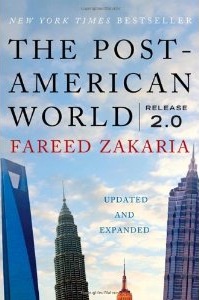
This book is a fast read looking at America's relationship with the rest of the world. It focuses on two up-coming competitors, China and India. Zakaria says interesting things. This is a solid book. There are no big surprises and nothing controversial.
He takes the US to task for failing to live up to its ideals in the post-9/11 world. There is too much fear, too much security and too little civil liberties, and too much fear of "the other". He gives some solid advice. Again, pretty mainstream stuff.
Here's a bit to give you a taste of the book:
As it enters the twenty-first century, the United States is not fundamentally a weak economy, or a decadent society. But it has developed a highly dysfunctional politics. An antiquated and overly rigid political system to begin with -- about 225 years old -- has been captured by money, special interests, a sensationalist media, and ideological attack groups. The result is ceaseless, virulent debate about trivia -- politics as theater -- and very little substance, compromise, and action. A "can-do" country is now saddled with a "do-nothing" political process, designed for partisan battle rather than problem solving. By every measure -- the growth of special interests, lobbies, pork-barrel spending the political process has become far more partisan and ineffective over the last three decades.And this:
To foreigners, American officials seem clueless about the world they are supposed to be running. "There are two sets of conversations, one with Americans in the room and one without," says Kishore Mahbubani, who was formerly Singapore's foreign secretary and ambassador to the United Nations. Because Americans live in a "cocoon," they don't see the "sea change in attitudes toward America throughout the world."The book is a pleasant read. It won't startle you, but it does give a perspective on America that most Americans don't have. Zakaria was born in India and came to the US for college and never left. As an American with a unique background -- and a day job at Time magazine and CNN that lets him monitor the world and think about politics -- he has some useful things to say which other Americans should listen to.
As a Canadian I find it startling that not only is the average US citizen ignorant of the outside world, they are even poorly educated about their own history and political system. Every American needs to spend more time thinking about the role of America in the world. Turn off the political demagogues and read something thoughtful and get a broader understanding. Zakaria's book is a good place to start.
Monday, September 19, 2011
Internet Service and US Infrastructure
Government makes a difference. The political right in the US argues that government should be shrunk to fit in a bathtub where it can be strangled. But government provides the rules and the infrastructure for a civilized society. Thanks to the Republicans, the US standard of living is falling fast.
Here is the state of Internet service in the US. From a post by CommonDreams.org:
Here is the state of Internet service in the US. From a post by CommonDreams.org:
The New York Times reported on Wednesday that the U.S. has sunk to 25th in a global ranking of Internet speeds, just behind Romania.Sadly, the right has whipped up propaganda that has taken a large proportion of the mind share in the US. In amongst the "hooray!" screams for Rick Perry's record of executions, there is a constant drum of propaganda for tax cuts and loosened regulations to "let the job creators" grow the economy. Funny. They've been unleashed for 30 years and the state of the US economy is now worse than it was in the 1960s and 1970s. So much for "job creators", a slick nickname for "fat cats sucking the life blood out of the economy".
Why? Because our nation's regulators abandoned an earlier commitment to foster competition in the marketplace for Internet access providers.
In the years that followed the signing of the 1996 Telecommunications Act, lobbyists working for powerful providers like AT&T, Comcast and Verizon pressured a compliant FCC to tear down all of the important safeguards established by Congress.
Under the Bush administration, the FCC tossed out competitive broadband safeguards such as open-access requirements, which opened lines to other providers. In 2002 the agency declared that high-speed cable Internet access would no longer be considered a telecommunications service that opened the network to competitors, but rather an “information service” that did not. Following a 2005 court decision, the FCC also reclassified broadband delivered by the phone companies as an “information service.”
These were radical policy shifts that went against the long-held assumption that open communications in competitive markets were essential to economic growth and innovation.
Friday, September 16, 2011
The American Theory of Government
Funny... Americans will chew your ear off over their Constitution and their liberties. But the actual embodiment of those ideas, their government, they hate it!
Here's a bit from a post by Robert Reich on his blog:
For a country that started on the theory "if we don't all hang together we shall certainly all hang separately" to come to now "understanding" their Constitution as a radical libertarian doctrine of "each man for himself" and "there is no society except the contract you sign with another". The fact that families exist, the the US still has large numbers of volunteer organizations is solid proof that Americans understand that society is not a pure cash transaction. But they've been so bullied by right wing propaganda, that they mouth it and tell pollsters that they don't trust anybody and that it is a dog-eat-dog world and that's exactly what the Constitution called for: minimal government, small enough to drown in a bathtub. It is really hard to understand how people have been sold this right wing nonsense when the very Constitution begins with...
Here's a bit from a post by Robert Reich on his blog:
But the truly remarkable thing is how little faith Americans have in government to set things right. This cynicism poses an even bigger challenge to Obama and the Democrats – and perhaps to all of us.Pathetic.
When I worked in Robert Kennedy’s senate office in the summer of 1967, America also seemed off track. Our inner cities were burning. The Vietnam War was escalating.
Yet most Americans still held government in high regard. A whopping 66 percent of the public told pollsters that year that they trusted government to do the right thing all or most of the time.
Now 30 percent of Americans say they trust government to do the right thing.
What’s responsible for this erosion? Not the Great Recession or the government’s response to it. Most of the decline in public trust occurred years before.
While 66 percent trusted government in 1967, by 1973 that percent had eroded to only 52 percent. By 1976, barely 32 percent of Americans said they trusted government to do the right thing. By 1992, 28 percent. Trust bounced up during the Clinton administration (I’m happy to report) but cratered again during the George W. Bush’s presidency, ending at 30 percent, and hasn’t recovered since.
Call it the Republican Weapon of Mass Cynicism.
...
Decades of Republican rhetorical scorn – Reagan’s repeated admonition, for example, that government is the problem rather than the solution – have contributed. But the most powerful sources of cynicism have been actions rather than words.
One has been the misuse of public authority. Consider Nixon’s Watergate, the Reagan White House’s secret sale of arms to Iran while it was subject to an arms embargo and illegal slush fund for the Nicaraguan Contras, Tom DeLay’s extensive system of bribery, and the Republican House’s audacious impeachment of Bill Clinton. To the extent these abuses generated public scandal and outrage, so much the better for the Weapon. The scandals fueled even more public cynicism.
Another source has been a flood of money pouring into government from big corporations, Wall Street, and the super rich – in return for public subsidies, bailouts, tax breaks, and a steady lowering of tax rates. Democrats aren’t innocent, but Republicans have been in the forefront. (As governor, Rick Perry has raised more money than any politician in Texas history, rewarding his major funders with generous grants, contracts, and appointments.)
The GOP has pioneered new ways to circumvent campaign finance laws, blocked all attempts at reform, and appointed and confirmed Supreme Court justices who believe corporations have First Amendment rights to spend whatever they want to corrupt our politics.
A third source has been regulatory agencies staffed by industry cronies more interested in protecting their industries than the public. Here again Republican administrations have led the way: the failure of financial regulators to prevent the Savings & Loans implosion; corporate looting at Enron, WorldCom, Adelphia other big companies; and then the biggest speculative bubble since 1929, bursting in ways that hurt almost everyone except the financiers who created it. A Mineral’s Management Service that turned a blind eye to disastrous oil spills from the Exxon-Valdez to BP; mine Safety regulators whose nonfeasance lead to the Massey mine disaster; an FDA that allowed in tainted meds from China.
Democrats have had their share of political hacks and cronies, but Republicans have made an art of cashing in on government service through sweetheart deals for their former companies (think of Dick Cheney’s stock options with Halliburton), and cushy jobs and lobbying gigs when they leave office. And the GOP has taken the lead in resisting all attempts to prevent such conflicts of interest.
The cynicism has been fueled, finally, by repeated Republican threats to bring the whole government to a grinding halt – from Newt Gingrich and fellow House Republicans’ shutdowns in the 1990s to John Boehner and companies’ near assault on the full faith and credit of the United States government months ago. When the whole process of governing becomes bitterly partisan and rancorous – when common ground is unreachable because one side won’t budge – government looks like a cruel game.
...
Back to that summer more than four decades ago when I worked in Robert Kennedy’s senate office. There was no doubt in my mind I’d devote part of my adult life to public service. It wasn’t so much that I trusted government – the Vietnam War had already tapped a cynical vein – as that I looked to government as the major instrument of positive social change in America.
I was not alone. The Civil Rights and Voting Rights acts, Medicare, an American landing on the moon – and before that an interstate highway system, expansion of higher education, GI Bill – and before that, The New Deal and World War II – all had engraved in the public’s mind the sense that government was something to be proud of, an entity that we could rely on when times got tough.
Times are tough again, but the Weapon of Mass Cynicism has convinced most Americans they can’t rely on government to help them out now. The nation is even entertaining the possibility of cutting Medicare and Medicaid, college aid, food stamps, Head Start. Perry calls Social Security a Ponzi scheme, and many are ready to believe him.
But if we can’t trust government at a time like this, whom can we trust? Corporations? Wall Street? Bill Gates and Warren Buffett?
Or is each of us now simply on our own?
For a country that started on the theory "if we don't all hang together we shall certainly all hang separately" to come to now "understanding" their Constitution as a radical libertarian doctrine of "each man for himself" and "there is no society except the contract you sign with another". The fact that families exist, the the US still has large numbers of volunteer organizations is solid proof that Americans understand that society is not a pure cash transaction. But they've been so bullied by right wing propaganda, that they mouth it and tell pollsters that they don't trust anybody and that it is a dog-eat-dog world and that's exactly what the Constitution called for: minimal government, small enough to drown in a bathtub. It is really hard to understand how people have been sold this right wing nonsense when the very Constitution begins with...
We the People of the United States, in Order to form a more perfect Union, establish Justice, insure domestic Tranquility, provide for the common defence, promote the general Welfare, and secure the Blessings of Liberty to ourselves and our Posterity, do ordain and establish this Constitution for the United States of America.Nothing in there about the right to carry AK-47s with 100 round clips, that the rich have the right to watch the poor starve by the side of the street, that life is so precious that you save embryos but let the teenagers starve and underfund schools until they are simply prisons, that corporations are full-fledged citizens with full rights to buy any election they want, etc., etc.
James K. Galbraith's "The Predator State"

This was a surprisingly good review of the current mess the US is in. The book came from a challenge by James Galbraith's father, John Kenneth Galbraith, to his son to write on this theme saying that such a book would iconic for the age. This book hasn't become the defining book of our time, but it has clearly set out the liberal response to 40 years of right wing lies about economics and policy options for the US. I only wish that the key decision-makers in the US read this book to understand how we got here and what the way out is.
This book is a careful review of policies and ideology that has created the mess the US now finds itself in. It looks back to the Great Depression era to see clearly the role of government in getting a society out of this kind of mess. And it points out the key players and "wisdom" that has unleashed a "predator state" that is turning so many people's lives into such a mess. This is a "must read" for anybody wanting to understand the Lessor Depression and the fumbling pretense at "fixing" the current problems.
The book starts with a clarion call:
This book got under way right after Hurricane Katrina, the destruction of New Orleans, and the dispersion of several hundred thousand refugees across the American South, including to my hometown of Austin, Texas. It seemed clear immediately that Katrina had been the Chernobyl of the American system. That is, beyond the natural calamity and the human tragedy, it was -- like the Soviet reactor meltdown of nineteen years before -- a disaster that exposed and laid bare the fallacies of an entire governing creed.Here is Galbraith taking on the 1980s voodoo economics:
Recall that the entire supply-side argument rests on perfectly functioning markets, including a "rational" response to tax cuts experienced by a handful of very rich people -- the marvelous marketplace that is supposed to operate in their minds. But if the markets do indeed work perfectly, we are compelled toward the following conclusion: public policy should not care at all about the supply of saving.Galbraith is quite good at cutting through the underbrush and explaining the broad strokes of the economy. Here is a bit from his look at the engine of inequality.
To see this, consider how the market for savings is supposed to work. To whom do our noble wealthy supply their saving? In the accepted story, they supply it to something we call the "capital market." To put it in concrete terms, lets us say a bank, or a broker, or perhaps a mutual fund. The capital market is an efficient mechanism for the allocation of resources: it transfers the funds from the saver to the investment project with the highest achievable rate of return (after taking account of risk) -- that is, from the capitalist to the entrepreneur. In a seamless process, there is first a necessary reward to the risk taker -- the big prize for seeing and taking a chance. And after that, the saver is rewarded: she earns the return associated with the investment and justified by her thrift.
But if a market is "efficient," it must allocate returns exactly. It must allocate them in full in relation to the quality of effort expended, the risk assumed, and the astuteness of investment judgement. The private saver -- the capitalist -- must get the entire return that is due to capital provided. Meanwhile the person executing the project -- the entrepreneur -- gets the entire return to risk. Between the two, they must get the entire return. That is what market efficiency means, if it means anything at all.
So what is left over for society? What do workers, or anyone else, get out of the process of accumulation? In the simplest, clearest, purest form of the market model, there can be only one answer to this question. Nothing.
Thus, much of the mystery surrounding our understanding of "inequality" goes away once we recognize that the word covers two quite different aspects of the economy -- and neither of them is well explained by "supply and demand for skills." One of them is the inequality of pay: the major force affecting the larger working population. This form of inequality is substantially tied to employment and unemployment, and while it is increased dramatically in the 1970s and early 1980s, it also fell quite dramatically in the late 1990s. Higher demand for labor reduces inequality, while pay compression, aided by unions or minimum wage laws, also helps to reduce unemployment.He goes on the explain the large forces of history, the choices of Nixon to deal with the gold crisis, and the Reagan era Federal Reserve moving interest rates to near 20%, distorted the US economy, destroyed the manufacturing base of the Midwest, and set the US on the path to being a predatory state.
The other process is not about working people at all. It is about funds flowing from the financial markets through banks and brokers into technology and other hot sectors. This is source, rather than sink, for demand. In the tech boom, working people benefited because there were more jobs. But income inequality also went up because the incomes generated by the stock bubble flowed to a tiny handful of people, in a tiny handful of places. And the same was true in the next expansion, although driven by entirely different policies and favoring a different group.
...
What the information technology boom showed, and what the Bush Beltway Bubble has against shown, is taht public policy can move wealth around in spectacular ways. It can create oligarchs, and it can destroy. That being so, one can only expect that the beneficiaries, and potential beneficiaries, would pay close attention to the behavior of the state. They will even devote themselves to using and abusing the state, turning its instruments to their own purposes if they can. If the state is sufficiently large and sufficiently powerful, it may be that working those levers for the creation and consolidation of wealth is more tempting, and a better investment, than the complicated, tedious work of preparing products for consumption by the public at large, still less that of innovating new technologies for world markets.
This is the Predator State. It is a coalition of relentless opponents of the regulatory framework on which public purpose depends, with enterprises whose major lines of business compete with or encroach on the principal public functions of the enduring New Deal. It is a coalition, in other words, that seeks to control the state partly in order to prevent the assertion of public purpose and partly to poach on the lines of activity that past public purpose has established. They are firms that have no intrinsic loyalty to any country.Here is Galbraith's assessment of how the political left in the US lost its way:
Marxism used to be the hard-boiled left-wing dissident's creed, a doctrine founded on class conflict and the romance of working-class revolution. Unfortunately there were actual Marxist countries; "real existing socialism" took care of the romance. Meanwhile, Keynes and his allies in the progressive movement offered ways to reconcile the capitalists and the workers to avoid the calamity of revolution and the tyrannies that follow, through regulation and the management of total demand. But the price of progressive Keynesianism was big government: establishing countervailing power against the authority of private business. Free-market conservatives, once they recovered from the Great Depression, were inclined to reject that gift, preferring to take their chances with class conflict, and Keynesianism lost its leverage when the threat of Marxism disappeared.He then goes on to show that "markets" simply can't allot outcomes in a fair or reasonable way. They have a role to play in guiding business but not in social goals like education, welfare, employment, etc. He carefully shows that the idea of a "labor market" is a myth. Then says:
Now we have a new liberalism, something called the Third Way, which consists of hewing as closely as possible to market solutions. If the presumption of modern conservatives is simple -- that markets work best when left alone -- this new breed of domesticated liberals puts a simple gloss on it: government can help. But the well-brought up modern liberal cautiously insists that in making the omelette, no eggs need be broken. The government should work unobtrusively, distorting as little as possible the outcomes that markets would otherwise achieve. Grand schemes for employment, distribution, infrastructure, or the environment are off the table; nothing is possible or permitted that would undermine the authority of the market in a fundamental way.
But if labor is not bought or sold in a "market for skills," how about, say, health care? What is "health care," and is it bought and sold in a market? Obviously not: health care is not any specific thing, but a label covering a class of goods and services, an enormously diverse class, adapted to the specific health condition of each individual patient. There is no unit of health care; if you draw a supply-and-demand diagram, there is no quantity to put on the horizontal axis and no price to record on the vertical axis. Health care is therefore not a commodity that is bought and sold at a given price on an open market. Nor is any medical procedure. In the overwhelming majority of cases, these are prescribed in one-on-one discussions between a medical professional following the norms and standards of the profession and a patient with extremely limited capacity to evaluate either the recommendations or the alternatives. ... There is not only no market in health care, there are no markets within health care either. The suggestion that "market forces" might be usefully deployed to regulate prices and quantities in this area runs into the basic difficulty that no such markets either do exist or could exist.His prescription is to update Keynes and his father's view, published in The New Industrial State in the 1960s, i.e. use government to ensure a more prosperous and equitable society. He uses the Scandinavian countries as an example and discusses their policies that ensure an open economy but one that leads to widespread prosperity and a reasonable equality.
This book is a refreshing change from the "more of the same" (deregulation, cut taxes, shrink government) of the right and the hand wringing incompetence on the left. This book should be read by everybody. It lays the foundation for a saner, more prosperous future.
Saturday, August 27, 2011
How to Present "Facts" to Change Opinions
Here is a post from Geoffrey Styles on his Energy Outlook blog that looks at how environmental crazies are trying to pitch the downsizing of the Marcellus shale deposit in a way that would minimize it and allow them to successfully shut down the exploitation of this resource:
If you remove 14.5 billion barrels of oil, that is only 609 billion gallons of oil or roughly 2,000 gallons for every man, woman, and child in America. Who is going to miss that? Sure, shut it down so we can "save the environment"!
If production of the Marcellus field was a true danger, I would agree, shut it down! But it isn't. With proper regulation, production can be safely executed. But it requires a belief in government and a willingness to put regulators, rules, and inspectors in place to ensure safe production. You are no more likely to get "safe" production from fracking wells than you are to get "safe" banking from Wall Street where regulators ignore the slice-and-dice free-for-all of mortgage securitization and the liar's loans given by mortgage brokers, and the under the table payola and not-so-subtle threats used by Wall Street banks to get the ratings agency to find AAA gold in all those sub-prime and alt-A mortgages.
I put the environmental nuts in the same camp as the right wing nuts. They are extremists. They aren't open to reason. They have their "cause" and they see the world through their prejudices and are not open to argument or to be influenced by facts. Sadly, the world is overpopulated with fanatics these days. I want desperately to go back to the simpler days when people were decent to each other, willing to live-and-let-live, and were open to simple democracy to come to agreements to run a civil society.
I see in The Hill that some critics of shale gas drilling are pointing to a revised estimate of the shale gas resources in the Marcellus formation as evidence that there's not enough gas to justify any risk from hydraulic fracturing. Earlier this week the US Geological Survey updated its previous estimate to 84 trillion cubic feet (TCF) of natural gas, a figure substantially less than the estimate of 410 TCF from the Department of Energy. Now, I'd have thought that even without doing the math on this, 84 TCF would still sound like a heck of a lot of gas, even if trillions have become the new billions in another context.I could use the same argument for agriculture. Farmers only produce enough food to put about about 3000 calories of food per person on your plate. But who is going to miss 3000 calories? There is plenty of food. So let's shut down the farms! The only problem is that if you multiply 3000 calories by the whole population, that is a lot of food and sure enough people will miss it.
Perhaps cubic feet of gas don't convey quite the same degree of familiarity as barrels of oil, which most people can visualize, so it might be useful to think of this gas in its oil-equivalent terms. Using standard conversion factors, that 84 TCF in the Marcellus equates to roughly 14.5 billion barrels of oil. For comparison, that's half again as big as the original estimate of 9.6 billion barrels for the Prudhoe Bay field on the Alaskan North Slope. (FYI, Prudhoe Bay had produced a cumulative 11.5 billion barrels as of the end of 2007 and was still estimated to have a few billion barrels to go.) In that light, does anyone still want to argue that the Marcellus resource is inconsequential?
If you remove 14.5 billion barrels of oil, that is only 609 billion gallons of oil or roughly 2,000 gallons for every man, woman, and child in America. Who is going to miss that? Sure, shut it down so we can "save the environment"!
If production of the Marcellus field was a true danger, I would agree, shut it down! But it isn't. With proper regulation, production can be safely executed. But it requires a belief in government and a willingness to put regulators, rules, and inspectors in place to ensure safe production. You are no more likely to get "safe" production from fracking wells than you are to get "safe" banking from Wall Street where regulators ignore the slice-and-dice free-for-all of mortgage securitization and the liar's loans given by mortgage brokers, and the under the table payola and not-so-subtle threats used by Wall Street banks to get the ratings agency to find AAA gold in all those sub-prime and alt-A mortgages.
I put the environmental nuts in the same camp as the right wing nuts. They are extremists. They aren't open to reason. They have their "cause" and they see the world through their prejudices and are not open to argument or to be influenced by facts. Sadly, the world is overpopulated with fanatics these days. I want desperately to go back to the simpler days when people were decent to each other, willing to live-and-let-live, and were open to simple democracy to come to agreements to run a civil society.
Visions of the Future
Here is one perspective on where the political right in the US is heading. This is from a post on the Washington's Blog:
"Shrinking government" in American political discourse has, for decades now, meant the following. We enlarge the government's budget through taxation and penalties on working people and through borrowing and printing money. We not only tax the wealthy and corporations less, but we massively subsidize them with public funds. We move away from taxes and fees meant to limit the damage greed can do to the world, and we defund regulation of and law enforcement against the oligarchy. We transfer an ever greater share of the budget to the military. We expand the domestic and international surveillance-police states while merging the two. This, again, we call "shrinking government."That's an awfully dyspeptic dystopia, but from my perspective it seems pretty accurate in triangulating where the US is headed.
"Shrinking government" means a larger and more oppressive but less representative and less useful government. The military gets the money and gets privatized (employs non-competitive corporations working exclusively for the government). Education and public services get slashed and get privatized. Vote counting gets privatized. The privatized money gets to flow into election campaigns. The districts are re-gerrymandered with the latest modern technology. The media conglomerates get a monopoly and the monopoly limits electoral possibilities. "Shrinking government" means shrinking popular influence on government while government grows. But it grows in its ability to wage wars, occupy territories, and subsidize coal, oil, nuclear, and gas. It shrinks in its ability to give people anything in return for their taxes and fees. If this process continues it must result in ever greater repression or in revolt.
... a good portion of this movement wants to shrink everything except the military-police state, which is the most difficult thing to shrink. And the Republican politicians who co-opt this movement want to enlarge the military and police.
Friday, August 26, 2011
The Death of the "Live Free or Die" America
Funny. Americans claim to hate big government. They rage at Washington. They elect right wing conservative governors, and what happens. The state governments become "big brother" and crush the little people.
Here's an example from Gov. Swartzenegger's California:
I love the quote from the video at 1:40 where the state government tells him:
Why do Americans vote in right wing governors (and county supervisors) who trample on their rights? Why do Americans mouth a "love of freedom" and allow right wing governments to trample on their rights? Why don't Americans understand that a left wing government would actually protect their rights rather than the property rights of the rich and powerful?
Here's an example from Gov. Swartzenegger's California:
I love the quote from the video at 1:40 where the state government tells him:
You can't live here. You can keep the land, but won't be allowed to live on it.So much for "property rights". The above is a lot like the famous quote by Anatole France on the glory of French law:
The law, in its majestic equality, forbids the rich and the poor alike to sleep under bridges, to beg in the streets, and to steal bread.At 5:00 into the video, the real villain is named as Mike Antonovich, Republican head of the Board of Supervisors for Los Angeles county.
Why do Americans vote in right wing governors (and county supervisors) who trample on their rights? Why do Americans mouth a "love of freedom" and allow right wing governments to trample on their rights? Why don't Americans understand that a left wing government would actually protect their rights rather than the property rights of the rich and powerful?
Subscribe to:
Posts (Atom)
