Showing posts with label limits to growth. Show all posts

Monday, November 7, 2011

Technological Optimism

I'm a big fan of technology. I buy into the Julian Simon view that any "limits to growth" are wrong-headed because it ignores the fact that the ultimate resource is human ingenuity.

Here are some bits out of Paul Krugman's latest NY Times op-ed looking at the upcoming future for solar energy:
For decades the story of technology has been dominated, in the popular mind and to a large extent in reality, by computing and the things you can do with it. Moore’s Law — in which the price of computing power falls roughly 50 percent every 18 months — has powered an ever-expanding range of applications, from faxes to Facebook.

Our mastery of the material world, on the other hand, has advanced much more slowly. The sources of energy, the way we move stuff around, are much the same as they were a generation ago.

But that may be about to change. We are, or at least we should be, on the cusp of an energy transformation, driven by the rapidly falling cost of solar power. That’s right, solar power.

...

These days, mention solar power and you’ll probably hear cries of “Solyndra!” Republicans have tried to make the failed solar panel company both a symbol of government waste — although claims of a major scandal are nonsense — and a stick with which to beat renewable energy.

But Solyndra’s failure was actually caused by technological success: the price of solar panels is dropping fast, and Solyndra couldn’t keep up with the competition. In fact, progress in solar panels has been so dramatic and sustained that, as a blog post at Scientific American put it, “there’s now frequent talk of a ‘Moore’s law’ in solar energy,” with prices adjusted for inflation falling around 7 percent a year.

This has already led to rapid growth in solar installations, but even more change may be just around the corner. If the downward trend continues — and if anything it seems to be accelerating — we’re just a few years from the point at which electricity from solar panels becomes cheaper than electricity generated by burning coal.

And if we priced coal-fired power right, taking into account the huge health and other costs it imposes, it’s likely that we would already have passed that tipping point.

But will our political system delay the energy transformation now within reach?

Let’s face it: a large part of our political class, including essentially the entire G.O.P., is deeply invested in an energy sector dominated by fossil fuels, and actively hostile to alternatives. This political class will do everything it can to ensure subsidies for the extraction and use of fossil fuels, directly with taxpayers’ money and indirectly by letting the industry off the hook for environmental costs, while ridiculing technologies like solar.
Krugman is making the point that the upcoming 2012 elections are going to be important for many reasons. A big one is that they will decide whether the political right gets to continue blocking technological advance in the energy area. The sad fact is that China is quickly becoming a leader in this area (along with Germany) and the US, which used to lead the world, will soon be a "has been" and utterly negligible. All thanks to the Neanderthal thinking of the Republican party that favours the rich and corruption over the American people and a better future.

Monday, October 10, 2011

The Missing US Energy Policy

I remember teaching high school social studies classes from materials stating that "the end of oil" was at hand. I had to tell them that they would have to give up the idea of owning cars and heating their homes.

Needless to say, that doom-and-gloom scenario never came true. Instead I discovered that my father in the 1930s had been told about "the end of oil" while he was in school. Oh, and over the last 20 or 30 years the idea of "peak oil" has been very popular.

Here is a bit from an article in the Wall Street Journal pointing out that the Bakken formation in North Dakota and Montana puts America back into the same league as Saudia Arabia with oil reserves:
Harold Hamm, the Oklahoma-based founder and CEO of Continental Resources, the 14th-largest oil company in America, is a man who thinks big. He came to Washington last month to spread a needed message of economic optimism: With the right set of national energy policies, the United States could be "completely energy independent by the end of the decade. We can be the Saudi Arabia of oil and natural gas in the 21st century."

"President Obama is riding the wrong horse on energy," he adds. We can't come anywhere near the scale of energy production to achieve energy independence by pouring tax dollars into "green energy" sources like wind and solar, he argues. It has to come from oil and gas.

You'd expect an oilman to make the "drill, baby, drill" pitch. But since 2005 America truly has been in the midst of a revolution in oil and natural gas, which is the nation's fastest-growing manufacturing sector. No one is more responsible for that resurgence than Mr. Hamm. He was the original discoverer of the gigantic and prolific Bakken oil fields of Montana and North Dakota that have already helped move the U.S. into third place among world oil producers.

How much oil does Bakken have? The official estimate of the U.S. Geological Survey a few years ago was between four and five billion barrels. Mr. Hamm disagrees: "No way. We estimate that the entire field, fully developed, in Bakken is 24 billion barrels."

If he's right, that'll double America's proven oil reserves. "Bakken is almost twice as big as the oil reserve in Prudhoe Bay, Alaska," he continues. According to Department of Energy data, North Dakota is on pace to surpass California in oil production in the next few years. Mr. Hamm explains over lunch in Washington, D.C., that the more his company drills, the more oil it finds. Continental Resources has seen its "proved reserves" of oil and natural gas (mostly in North Dakota) skyrocket to 421 million barrels this summer from 118 million barrels in 2006.

"We expect our reserves and production to triple over the next five years." And for those who think this oil find is only making Mr. Hamm rich, he notes that today in America "there are 10 million royalty owners across the country" who receive payments for the oil drilled on their land. "The wealth is being widely shared."
The actual estimating of "reserves" is tricky. The lesson I learned is that governments don't estimate oil reserves. They rely on oil companies. And oil companies have no incentive to find oil for more than a 20 year window into the future, so they will always be predicting the "coming end of oil". Here's the Wikipedia estimate of oil reserves.

Another fundamental lesson to learn from the ridiculous history of decade after decade "end of oil" proclamations: modeling is hard. The conclusions follow very closely from your assumptions. The infamous Club of Rome made ridiculous assumption that "most of the exploitable oil has already been found" and that "energy use will rise exponentially". Both of these are wrong. The amount of reserves is a function of need and ingenuity. The use of energy is tied to technological innovation. Cars today normally get three times and could easily get five times the mileage of cars 50 years ago. As a society matures, infrastructure expenditures fall relative to other consumption, so energy use falls. Oil use has been declining for over a decade in the US. It isn't growing exponentially.

Tuesday, October 4, 2011

Peak Oil

For the doomsday crowd that follows regular predictions of gloom-and-doom, the "peak oil" story has been a good one.

The typical "picture of doom" is something like this from Wikipedia:

Click to Enlarge

That picture is pretty convincing. We are on the slide to perdition. Only a bleak and hopeless future awaits us...

But wait a second. Here is a more recent graph from an article in the Houston Chronicle:

Click to Enlarge

The article goes on to report a "new peak" in production:
North America appears headed for an oil renaissance, with crude production expected to hit an all-time high by 2016, given the current pace of drilling in the U.S. and Canada, according to a study released by an energy research firm this week.

U.S. oil production in areas including West Texas' Permian Basin, South Texas' Eagle Ford shale, and North Dakota's Bakken shale will record a rise of a little over 2 million barrels per day from 2010 to 2016, according to data compiled by Bentek Energy, a Colorado firm that tracks energy infrastructure and production projects.

Canadian crude production is expected to grow by 971,000 barrels per day during the same period, with much of the oil headed for the U.S.

Combined, the U.S. and Canadian oil output will top 11.5 million barrels per day, which is even more than their combined peak in 1972.

Goldman Sachs has estimated the U.S. could move from being the No. 3 oil producer behind Saudi Arabia and Russia to the No. 1 spot by 2017.


It's a reversal of the steady downward production trend that started after 1971, when U.S. oil production peaked around 9.5 million barrels per day.
I know this is a shock and disappointment to the end-of-days crowd. But this is an old story. If you followed the Club of Rome with its best seller in the early 1970s, the book "Limits to Growth" you've seen this tale before. It is so convincing. The end is nigh! Repent!

But human ingenuity keeps foiling that tale of gloom and despair. It is so seductive to believe that there is no hope and we must give up our sinful "modern ways" and go back to our pastoral past when we were disease ravaged and lived an average of 34 years. But those pesky scientists and technologists keep ruining out return to a "golden age" by creating new techniques or helping us conserve or producing a new substitute. This story is older than civilization. But the siren call of "repent! the end is nigh!" keeps winning because it appeals to our dark side that expects us to be punished for "having it too good".

The Club of Rome pessimists are still in business and no doubt still selling their siren song of "the end is nigh!". But you are better off reading "The Ultimate Resource" by Julian Simon. Unlike the Club of Rome, Simon has been right more than wrong. But unlike the Club of Rome, Simon is ignored by the press. It is so much easier to sell papers with the story of doom-and-gloom. Nobody wants to hear that we will "muddle through" or that we can count on "human ingenuity". We want morality plays. We want punishment for sinful ways, the excesses of the past. Nobody wants dull fact, reasoned judgement, and a scientific attitude. It doesn't sell.

Wednesday, September 28, 2011

Oil and Technology Opening the Door to Energy Self-Sufficiency for the US

Here is a bit from a press release by the American Chemical Society:
New technology that combines production of electricity with capture of carbon dioxide could make billions of barrels of oil shale — now regarded as off-limits because of the huge amounts of carbon dioxide released in its production — available as an energy source. That’s the topic of the latest episode in the American Chemical Society’s (ACS) award-winning “Global Challenges/Chemistry Solutions” podcast series.

Adam Brandt, Ph.D., notes in the podcast that almost 3 trillion barrels of oil are trapped in the world’s deposits of oil-shale, a dark-colored rock laden with petroleum-like material. Brandt and colleague Hiren Mulchandani are at Stanford University.

The United States has by far the world’s largest deposits in the Green River Formation, which covers parts of Colorado, Utah and Wyoming. The domestic oil shale resource could provide 1.2 trillion to 1.8 trillion barrels. But concerns over the large amounts of greenhouse gases — mainly carbon dioxide — released by current methods prevent many companies from trying to extract oil from shale.

Brandt’s answer is EPICC — a self-fueled method that generates electricity, as well as the heat needed to produce that electricity from shale. The report, which appears in ACS’ journal Energy & Fuels, describes how EPICC could generate large amounts of electricity without releasing into the atmosphere carbon dioxide from burning the shale. That carbon would be captured and stored underground as part of the production process.

The new podcast is available without charge at iTunes and from www.acs.org/globalchallenges.
The gloom & doom crowd is going to be seriously disappointed. It reminds me of those in the 15th century gnashing their teeth about the disappearance of old oak forest just as Britain was rising to be the world's sea power. Or those doom & gloomsters who have been rushing about for the last 50 years warning about "peak oil". It is always very popular to linearly extrapolate from the past and discover doom awaits us. But their requires a steadfast ignorance about human ingenuity and technological change. The doom & gloom crowd always ignore "the ultimate resource" as they weave their tales of resource shortages and the doom that awaits us.

Saturday, June 25, 2011

Going Green and the Hand Wringing Apologists

There is a lot of brow-beating of people in the developed world about their "guilt". Guilt for a "colonial" past. Guilt about outrageously self-indulgent lifestyles. Guilt about greedily seizing resources and living the underdeveloped world desperate and without.

Well... I was never a colonialist. I don't live an indulgent lifestyle. And I've never hogged resources. Sure, colonialism was rampant 300 years ago. But if you go back 2000 years you find Romans, Chinese, Persians, Indians, etc. as the great colonialists. Why don't be beat Iranians, Chinese, Indians, etc. about the ears for having "empires". My ancestors were running around half naked in the northern fringe woodlands 2000 years ago.

As for using an "unfair" share of resources:

Click to Enlarge

The above graph is from a post on energy by Ed Yardini in his blog Dr. Ed's Blog.

As the graph makes clear, the rising standard of living in China and India (and more generally in southeast Asia) means that resource consumption there has rapidly surpassed the "developed" world. Sure, the per-capita resource use is still low, but the graph shows the trend. In 30-50 years the overwhelming about of resource consumption will be with the billion+ populations of China and India.

Oil consumption is falling in the "developed" world while it is strongly rising in the "undeveloped" world. But all the anti-technology, "green", guilt-ridden propaganda used to make people in the developed world feel guilty is out-dated. It doesn't reflect the world we now live in. But it always takes time for people to throw off out-dated mental shackles.

Wednesday, April 27, 2011

The Latest Entrant into the Renewable Energy Armory

Would you believe that petroleum and natural gas are now thought to be "renewable energy sources"? Here's a bit from a post on Geoffrey Styles' Energy Outlook blog:
However, there's another, more controversial theory of the origins of at least some oil and gas, suggesting that they were formed by chemical or biological activity much deeper in the earth, and then migrated long distances before being trapped. If correct, that would mean that not only aren't these fuels truly fossils--and thus essentially static and finite--but that they might actually be continuously regenerated by natural processes in much shorter time spans. A number of academics appear to hold this view, and it was a common theory of petroleum origin among Soviet scientists. Much of this is explored in a lengthy white paper on the Deep Carbon Observatory site, including the shortcomings of current analytical techniques in determining definitively whether a given sample of methane originated from organic material in sedimentary rock or from some other source.

Finding gas or oil in deposits much deeper than those we already know about, or in places that aren't consistent with our present understanding of petroleum geology, would represent an even bigger potential energy revolution than the one begun by the recent development of the means of unlocking shale gas resources. It would also shift our perspective on the nature and required speed of the energy transition on which we've embarked. If oil and gas weren't finite--at least in human terms--it might alter the urgency of deploying some of the alternative energy technologies now in our repertoire. At the same time, it would have enormous implications for climate change, by greatly increasing the ultimate quantity of carbon we could eventually emit to the atmosphere.
I enjoy stories like this because they show that all the "sure thing" thinking that most people have never acknowledges how little we really know and how much science can revolutionize our thinking.

Monday, April 25, 2011

Oil's Future

Here are some bits from a WSJ interview with the CEO of Chevron:
The Chevron CEO is a rare breed these days: an unapologetic oil man. For decades—going back to Jimmy Carter—politicians have been peddling an America free of fossil fuels. Mr. Obama has taken that to an unprecedented level, closing off more acreage to drilling, pouring money into green energy, pushing new oil company taxes, instituting anticarbon regulations. America is going backward on affordable energy, even as oil hits $110 a barrel.

Enter the tall, bespectacled Mr. Watson, who a little more than a year ago stepped into the shoes of longtime CEO David O'Reilly. An economist by training, soft-spoken by nature, the 53-year-old Mr. Watson is hardly some swaggering wildcatter. Yet in a year of speeches, he has emerged as one of the industry's foremost energy realists. No "Beyond Petroleum" (BP) for him. On energy, he says, America "has a lot to learn."

Starting with the argument—so popular among greens and Democrats—that we are running out of oil. "Peak oil"—the theory that global oil production will soon hit maximum levels and begin to decline—is a favorite among this crowd, and it is one basis for their call for more biofuels and solar power. Mr. Watson doesn't dismiss the idea but explains why it remains largely irrelevant.

In theory, he says, "we've been running out of oil and gas for a long time," yet technology creates new opportunities. Mr. Watson cites a Chevron field long in decline down the road in Bakersfield—to the point that for every 100 barrels of oil "in place," the company was extracting only 10 or 20. But thanks to a new technology called steam flooding, Chevron is now getting 70 to 80 barrels. "Price creates incentive, and energy will be developed if there's demand for it at the price you can develop it," Mr. Watson says. In that sense, "oil and gas are plentiful."

Don't believe it? Over the past 30 years, even as "peak oil" was a trendy theme, the world's proven reserves of oil and natural gas increased 130%, to 2.5 trillion barrels.

Or consider America's latest energy innovation: hydrofracking for abundant and cheap natural gas. This advance, says Mr. Watson, took even the industry "by surprise"—as evidenced by the many U.S. ports to import liquid natural gas that are now "sitting idle." Chevron last year paid $3.2 billion to buy natural-gas producer Atlas Energy as its foray into this new market.

Mr. Watson has little time for the Beltway fiction that America will soon be able to do without, or nearly without, fossil fuels. Yes, "we need all forms of energy." But the world consumes 250 million barrels of energy equivalent today, only a "tiny fraction of which" is wind and solar—and even those "are not affordable at scale," he says.

As for biofuels, "we would need to consume land the size of states" to hit the country's current ethanol targets. Chevron is investigating biofuels, but Mr. Watson says the "economics aren't there" yet. Unlike many CEOs, Mr. Watson insists on products that can prosper without federal subsidies, which he believes are costly and lacking in transparency when "consumer pockets are tight, government pockets are tight."

Bottom line: "We're going to need oil and gas and coal for a long time if America wants to keep the lights on."

...

But what about the BP Gulf spill? Mr. Watson blames the "cultural aspects and behavioral aspects" of the particular drilling rig that exploded. He roundly disagrees with the finding of Mr. Obama's spill commission that the "root causes" of the spill were "systemic" to the industry.

"There is no evidence to support that. I don't know how that conclusion was reached. I know the industry has drilled 14,000 deep water wells without having this sort of problem." As for the moratorium, "I can understand taking a pause. I can't understand shutting down a whole industry for a better part of a year."

Chevron has three deep water rigs in the Gulf, so the ban cost it millions of dollars in idle rigs and lost jobs. For the country, says Mr. Watson, it means "less oil." Offshore drilling takes years of lead time. Mr. Watson cites Chevron's Gulf "Tahiti" project, which started producing about 18 months ago. It has taken "the better part of a decade to do the seismic work, drill the exploratory wells, evaluate those wells, drill other development wells, to delineate it, to build the facilities and to place the oil wells online," he explains.

The endless moratorium has already meant that "if you go out to the middle of the decade, there are already 200,000 to 300,000 barrels a day of oil that aren't going to be produced that year. . . . That won't be retrieved." And the lost production number is getting larger, since the new Bureau of Ocean and Energy Management is still dallying on permits—and those primarily for backlogged projects, not new leases.

Democrats are now arguing, as Mr. Obama did in his speech, that the oil industry already "holds tens of millions of acres of leases where it's not producing a drop." Some are advocating "use it or lose it," calling for the government to strip oil companies of their leases if they don't immediately start producing.

Mr. Watson explains why this is bogus. Only one-third of Chevron's offshore leases are classified as "producing" oil and gas today. The other two-thirds either are "unsuccessful" (they don't hold viable oil or gas) or "are in varying stages of development—seismic work, drilling wells, constructing facilities." Mr. Watson says companies would be crazy to sit on productive lands, since leases require costly bonus payments and annual rental payments to the government.

If Washington institutes Mr. Obama's "use it or lose it" policy, Mr. Watson says, it will mean less U.S. oil production. And how does this help Mr. Obama with his goal of reducing imported oil?

As for soaring oil prices, Mr. Watson blames growing demand, tighter supply, Mideast uncertainty and inflation. He doesn't predict future price trends, though during a recent analyst call he warned that the drilling moratorium would only make them higher. Lost production in the Gulf is "going to represent a sizable chunk of the spare capacity that the industry expects to see. And that will impact prices, and that will retard economic growth."

The economy is also why Mr. Watson won't pay the usual energy CEO lip service to new carbon regulations. The cap-and-trade bill the House passed in 2009 was "poorly conceived and it collapsed under its own weight for good reason," he notes.

The EPA move to regulate carbon is no better: "It's not why the Clean Air Act was put in place, and it doesn't seem to be the right way to attack concerns about greenhouse gas emissions," he says. The EPA is "placing huge new regulatory burdens on industries that are import sensitive." The regulations will place burdens on refineries, putting "their competitiveness at risk, and ultimately we'll produce less gasoline here and end up importing it from refineries that are less energy efficient overseas."
There is more material in the WSJ article. Go read the whole thing.

I got a chuckle out of my father who during the 1970s "oil shortage" told me that when he was a kid in the 1920s the schools taught him that America would "soon run out of oil". It will. But not in my lifetime and probably not during the 21st century. Definitely by the early 22nd century oil will be mostly gone, but there will still be lots of coal and lots of methane clathrate waiting to be "produced" and used as an energy source. The CEO of Chevron said there was 2.5 trillion of known oil reserves. I think he is undercounting. Canada alone has over 1 trillion barrels of oil sands. The far north of Canada has not been explored and the Russians are getting very nationalistic and aggressive in the Arctic ocean because there will probably be several trillion barrels of oil there waiting to be produced.

Since I think the "dangers" of global warming are based on bad models that over-estimate the greenhouse effect of CO2 and under-estimate the other feedback loops in dynamic weather, I'm not as concerned as most with the exploitation of all this oil. But it if does prove to be a problem, within a decade a crash program could shift 80% of energy over to nuclear reactors with all personal transportation shifted to electricity and not fossil fuel (saving the fossil fuel for long haul transportation).

I'm a pessimistic optimist. I think technology holds lots of promise. But I'm realistic enough to know that humans will mostly try to dodge the tough choices as long and hard as possible and create all kinds of crises before the every "solve" the energy crisis or get on top of "global warming". It is like democracy. Democracy is well understood to be the worst possible form of government, except that all the other choices are in fact far worse. Humanity will muddle through. That's my pessimistic optimism speaking.

Friday, January 21, 2011

Thoughts on The Limits to Growth and Doom & Gloomsters

I was teaching a high school social studies class in the mid-1970s and we had materials on the "oil crisis". Most of the material was gloomy and predicted that oil would soon run out and that it would be so expensive that the only choice was to cut down our expectations of the future. This was completely in tune with the Club of Rome which published an infamous book called The Limits to Growth. I passed on the sad news to the students because that was the teaching material I had. I hadn't yet realized that doomsters have always been around and they are constantly thinking up new worries that get lots of attention (and big bucks) for them.

The end of oil, the so-called Hubbert's peak oil theory, has been trotted out over the years to sell more gloom and doom. Only when my father pointed out to me that when in was in high school in the early 1930s he was being told that there was only 20 years of oil left did it ding on me... it will always be the case that we will soon run out of any given resource because governments don't go out and find resources, they rely on resource companies to tell them what kind of reserves they know about. And it doesn't pay a resource company to go and find resources that won't be used within a reasonable period of time. So there will always be a problem of "running out of resources in about 20 years".

I've grown much more cynical over time. And I've been convinced by the arguments of Julian Simon and his book The Ultimate Resource. Humanity has always been running out of resources, but we will always find ways around the problem. Sure if you multiplied the current population 5 fold we would be at each other's throats fighting over food. But the Zero Population Growth people who wanted forcible sterilzation and predicted tens of millions if not hundreds of millions would stave in the 1980s were proved wrong by the Green Revolution. Norman Borlaug has been the greatest humanitarian the world has ever seen. He didn't sell "limits to growth" or "population explosion" or "global warming". Nope. He rolled his sleeves up and did research to expand the food supply. Of course the doom & gloom crowd has labeled all this "frankenfood" and spend their effort trying to convince people to not eat the food!

The doom & gloom crowd never look for a silver lining in a cloud. They take a paradise an worry themselves silly trying to find flaws in it, turn up potentially, hypothetically possible future problems with paradise.

As for running out of oil. We haven't hit "peak oil" yet as it continues to be slid out into the indefinite future. I'm sure it will happen some day. But in the meantime, we have a sufeit of riches. Here's a news story about how recent technological advances mean we now have 250 years supply of natural gas!
Supplies of natural gas could last more than 250 years if Asian and European economies follow the U.S. unconventional reserves, the IEA said.

The abundance of shale gas and other forms of so-called unconventional gas discovered in the United States prompted a global rush to explore for the new resource.

The International Energy Agency said Australia is taking the lead in the push toward unconventional gas, though China, India and Indonesia are close behind. European companies are taking preliminary steps to unlock unconventional gas as are other regions.

"Production of 'unconventional' gas in the U.S. has rocketed in the past few years, going beyond even the most optimistic forecasts," said Anne-Sophie Corbeau, a gas analyst at the IEA. "It is no wonder that its success has sparked such international interest."

Shale gas production in the United States is booming and the IEA estimates that unconventional gas makes up around 12 percent of the global supply.

Global supplies of natural gas could last for another 130 years at current consumption rates. That time frame could double with unconventional gas, the IEA said.
I guess the doom & gloom crowd can run around wailing and gnashing their teeth telling us that there is "only" 250 years supply so we need to cut back consumption now because it will all run out far too soon! They will find some way to use this to tell us we can't live a happy life. They will find a way to tell us that this means we have to abandon industrial society and go back to walking behind ox carts. They will only be happy when we get back to the "truly good old days" when 95% of th population was illiterate, most were starving, and pretty well everybody died in the early 40s. Yep... those "good old days"!

The reality is that technology changes the landscape under our feet. Here is a nice graph from a BP study "BP Energy Outlook 2030" that shows how various countries have shifted in the dependence on energy for GDP growth:

Click to Enlarge


And, as you can see, this report predicts that US dependence of imported oil & gas will fall:

Click to Enlarge

Monday, January 3, 2011

What Does the Future Hold?

You can either be a pessimist (very popular, very profitable in selling swill to the gullible) or an optimist (deeply unpopular, profitable but only at rates that reflect real effort and real risk).

Here is another classic example of this truism by John Tierny in an article for the NY Times:
Five years ago, Matthew R. Simmons and I bet $5,000. It was a wager about the future of energy supplies — a Malthusian pessimist versus a Cornucopian optimist — and now the day of reckoning is nigh: Jan. 1, 2011.

The bet was occasioned by a cover article in August 2005 in The New York Times Magazine titled “The Breaking Point.” It featured predictions of soaring oil prices from Mr. Simmons, who was a member of the Council on Foreign Relations, the head of a Houston investment bank specializing in the energy industry, and the author of “Twilight in the Desert: The Coming Saudi Oil Shock and the World Economy.”

I called Mr. Simmons to discuss a bet. To his credit — and unlike some other Malthusians — he was eager to back his predictions with cash. He expected the price of oil, then about $65 a barrel, to more than triple in the next five years, even after adjusting for inflation. He offered to bet $5,000 that the average price of oil over the course of 2010 would be at least $200 a barrel in 2005 dollars.

I took him up on it, not because I knew much about Saudi oil production or the other “peak oil” arguments that global production was headed downward. I was just following a rule learned from a mentor and a friend, the economist Julian L. Simon.

As the leader of the Cornucopians, the optimists who believed there would always be abundant supplies of energy and other resources, Julian figured that betting was the best way to make his argument. Optimism, he found, didn’t make for cover stories and front-page headlines.

No matter how many cheery long-term statistics he produced, he couldn’t get as much attention as the gloomy Malthusians like Paul Ehrlich, the best-selling ecologist. Their forecasts of energy crises and resource shortages seemed not only newsier but also more intuitively correct. In a finite world with a growing population, wasn’t it logical to expect resources to become scarcer and more expensive?

As an alternative to arguing, Julian offered to bet that the price of any natural resource chosen by a Malthusian wouldn’t rise in the future. Dr. Ehrlich accepted and formed a consortium with two colleagues at Berkeley, John P. Holdren and John Harte, who were supposed to be experts in natural resources. In 1980, they picked five metals and bet that the prices would rise during the next 10 years.

By 1990, the prices were lower, and the Malthusians paid up, although they didn’t seem to suffer any professional consequences. Dr. Ehrlich and Dr. Holdren both won MacArthur “genius awards” (Julian never did). Dr. Holdren went on to lead the American Association for the Advancement of Science, and today he serves as President Obama’s science adviser.

Julian, who died in 1998, never managed to persuade Dr. Ehrlich or Dr. Holdren or other prominent doomsayers to take his bets again.
For those who have been kept in the dark by all the noise from the sky-is-falling crowd, Julian Simon is the economist who wrote the seminal book on how human ingenuity is consistently ignored by the linear extrapolationists known as "the knowledgeable pundit class" and/or "the doomsayers". You can read Julian Simon's text The Ultimate Resource on-line. Go ahead, dare to be different and embrace life and the possibility of a better tomorrow. Dare to be an optimist!

Sadly, an economist I respect, Brad DeLong at UC Berkeley denounces the NY Times and John Tierney for publishing what he views as wrong-headed optimism. Might I suggest that DeLong put his money where his mouth is and make a bet with Tierney for say $50,000 due on Jan 1, 2030 that fossil fuel derived energy for the average consumer will be taking a bigger bit out of the household budget than it now does? Notice, I'm not willing to bet that oil won't go higher, but if you really believe in ingenuity, you expect that some energy equivalent will be discovered or engineered to replace any "expired" oil. But... oil may just surprise us. Take a look here where I report that there are 2 TRILLION BARRELS of oil in the Canadian oil sands. At current rates of use which are well under 100 million barrel per day, that is 20,000 days worth of oil, or roughly 50 years worth of oil. And I happen to know that there has been very little exploration in Canada's North. Who knows what energy resource lie up there. (A more conservative estimate is on Wikipedia. As well as a near 2 trillion estimate here on Wikipedia. Remember, it is not in the interests of the oil companies to find more oil than they can produce in the relatively near future, so there will always be a chronic estimate of "only a few years" of supply available.)

Wednesday, September 22, 2010

Steward Brand Revisits His Views

Here is an interesting video statement from Stewart Brand, a figure in the environmental movement of the late 1960s/1970s. He is pushing CO2-based global warming (which I don't agree with), but he is also admitting to past mistakes. That is good. More media figures need to get in front of the cameras and admit that they have been wrong in the past. That will help people to see that they can't rely on "leader" to solve their problems for them. It will take everyone engaged in an honest discussion to find ways forward. I also like the fact that the is unhappy with the anti-science, anti-government stance of the environmental right and left. I also like that the now admits that opposing nuclear power was wrong but I think he is now overselling it as a "wonderful solution" with no downside. His big hope for space-based energy strike me as idealistic nonsense in the foreseeable future. His admission that solar and wind have "unforeseen downsides" is healthy but it is funny because these downsides have always been obvious except to him and his green buddies. The one thing I agree with him is that "we have to work on everything including what we are uncertain about because no one thing is going to fix the energy problem".


My only problem with Stewart Brand is that he is still selling himself as "holding the answer". Funny. He admits he was wrong in the past, but now presents himself have having latched onto the truth. My view is that he is as likely to be wrong now as he was in the past. My biggest bugbear with him is that he still is selling one-cause problems and simplistic solutions. Life is complex, nothing is simple, and the idea of selling "solutions" is a part of the problem. We need more science, we need more discussion. The nice thing about science is that they discover that nothing is as simple as it appears and that the further they dig the more complex things are. With more science we will have more options with dealing with the future.

My fundamental complaint against these "saviours of the world" is that they usually come up with solutions that will leave the poor poor. They are always issuing prescriptions for others. For example, they will say "you need to use less energy" but as I gaze at Stewart Brand in his house, I see lots of fancy stuff and I see extravagant energy use compared to the bottom 4 billion of the world's population. How dare he tell others how to "fix" their problem? Stewart Brand is constantly jetting around to address groups and advocate "solutions". He uses more energy in one year than I will use in my whole life. But he is telling me to cut back. Worse, he is telling the poor that they have to cut back. Nuts to that! The only solution I will countenance is a science-based solution that will produce more for everybody while safeguarding the environment. Until these "spokesmen of cutting back" all start wearing sackcloth and ashes and lead by example, I will rant at them and point out they are hypocrites.

Sunday, August 8, 2010

Matt Ridley's "The Rational Optimist"


This is an excellent book. It is a wonderful romp through history and technology to justify Ridley's claim that we should be optimistic about the future. I especially admire his Chapter 10 where he shreds the idiotic doomsday "predictions" of the last 50 years. He's a bit younger than me, so his list pretty well covers the list of outrageous claims that got publicity and public dollars wasted during my lifetime. As well, we both got sucked into some of these "causes" in our youth but came to realize that these doomsday "prophets" were essentially in business to collect donations and extort public monies to support their "message". So we are now innoculated to the common human illusion that there was a "golden age" in the past, the current generation is going to the dogs, and that all new technology is a dangerous threat.

He examines the idea of human progress and asks what causes it. After examining and rejecting a number of the standard explanations, he puts forth his favoured explanation: humans share ideas, this gives us the ability to "progress" that no other species has. He dresses this up as "when ideas have sex" but that's just his journalistic urge to make ideas lively and memorable. By the way, he is an excellent writer with a very readable style. I've read most of his earlier books and enjoyed them all.

Here's a snippet to give a taste of his writing style:
Like biological evolution, the market is a bottom-up world with nobody in charge. As the Australian economist Peter Saunders argues, 'Nobody planned the global capitalist system, nobody runs it, and nobody really comprehends it. This particularly offends intellectuals, for capitalism renders them redundant. It gets on perfectly well without them.' There is nothing new about this. The intelligentsia has disdained commerce throughout Western history. Homer and Isaiah despised traders. St Paul, St Thomas Aquinas and Martin Luther all considered usury a sin. Shakespeare could not bring himself to make the persecuted Shylock a hero. ... Economists like Thorstein Veblen longed to replace the profit motive with a combination of public-spiritedness and centralised government decision-taking. In the 1880s Arnold Toynbee, lecturing working men on the English industrial revolution which had so enriched them, castigated free enterprise capitalism as a 'world of gold=seeking animals, stripped of every human affection' and 'less real than the island of Lilliput'.
You can learn a remarkable amount of history from reading this book. He mines the past to understand why progress has happened and where it went off the rails. He covers standard history but he also shines light on some corners that were new to me. Excellent.

The only two drawbacks in this book. This is the first book where he lets some of his prejudices shine through. His earlier books were on biology and the personal opinions didn't protrude into his writing. But here he shows his right wing bias with his occasional taunts that governments are bureaucracies all gone bad. That is foolish. He knows it in the better passages of this book. I will accept that citizens must ever be vigilant against lapses by government, but he overdraws the picture because of his libertarian bias. The other problem is in the preface where he decides to discuss the 2008 financial crisis and gets the facts all wrong. He should know better. He was a director the the English bank Northern Rock that went backrupt. He should know that it was not:
"Markets in assets are so automatically prone to bubbles and crashes that it is hard to design them so they work at all. ... But what made the bubble of the 2000s so much worse than most was government housing and monetary policy."
No! This is the Republican party propaganda that ACORN and the GSEs (the Government Sponsored Enterprises Fannie Mae and Freddie Mac) caused the problem. That is a lie. The big surge in subprime loans came when Wall Street decided to securitize mortgages creating a flim-flam operation of "tranches" that supposedly turned subprime debt in to AAA debt which was sold to unsuspecting investors around the world. It was purely a case of banks taking excessive risk using a new fangled "financial engineering" trick based on "financial risk models" that were in fact flagrantly inadequate as models of reality. These Wall Street banks colluded with ratings agencies to create AAA ratings for junk mortagages. That's what caused the crash, not "the government housing and monetary policy". Ridley is showing his libertarian prejudice in blaming government and not blaming his rich banker buddies who in fact engaged in securities fraud to create an inflated housing bubble by turning subprime mortgages into supposedly "AAA mortgage bonds".

If you ignore his idiotic libertarian politics and his prejudices against civil government, this book is an excellent read with a great deal of wonderful bits of information that sell the point that it is indeed rational to be optimistic about the future.

Saturday, January 23, 2010

Finding a Temperature Trend

The global warming fanatics would tell you that we are caught up in a "runaway" global warming that is going to slowly cook us to death.

Here's a 120 year record of temperatures recorded in the US. I don't see any obvious "trend" in this data:


What bothers me is that fanatics can sell an idea if it is superficially "reasonable". Back in the mid 1970s I taught high school and had materials telling the kids that they had to face a world with shrinking oil supplies and ever higher oil prices. This was triggered by a short term run up in oil prices as OPEC flexed its muscle. But the fanatics did a linear extrapolation into a doomsday scenario. The book Limits to Growth was really popular in the 1970s and helped to reinforce the doomsday thinking in that decade. This fraud was perpetrated by those who sold people on a "peak oil" theory.

I have no doubt that oil production will peak, my quibble is over the doomsters saying it is immanent and the reality that it keeps fading into the future because reserves keep increasing. The doomsters don't let you see that we will always be "within 20 years of running out of oil" because oil companies have no financial incentive to find more than a 20 year supply. The fact that we are not really near the limit can be seen by this BBC report that points out that Venezuela has 513 billion barrels of recoverable oil, enough to supply the entire world's needs for nearly 20 years.

Back to climate fanaticism... For the last decade or so, apocalyptic fanatics have once again seized the public's imagination and sold everybody on the story of "global warming" and the doom we face. But since the Hadley CRU e-mails were released, it is now obvious that this was a hyped up story fed by the same fanaticism that created doomsday scenarios in the 1970s.

I have no doubt that humans are having an effect on the climate. My quibble is over how much of the "change" is human-induced and how much is natural. They have pushed climate models as a "science" but this confidence in models isn't justified. I think the "global warming" fanatics have indulged their need for an apocalyptic scare story. It appears to me that human activity has only modest effects on climate and it isn't clear to me that the natural reduction of dependence on fossil fuels which will come as our technology progresses and gets "greener" over the next 50 years won't "solve" the problem without the need for hysteria.

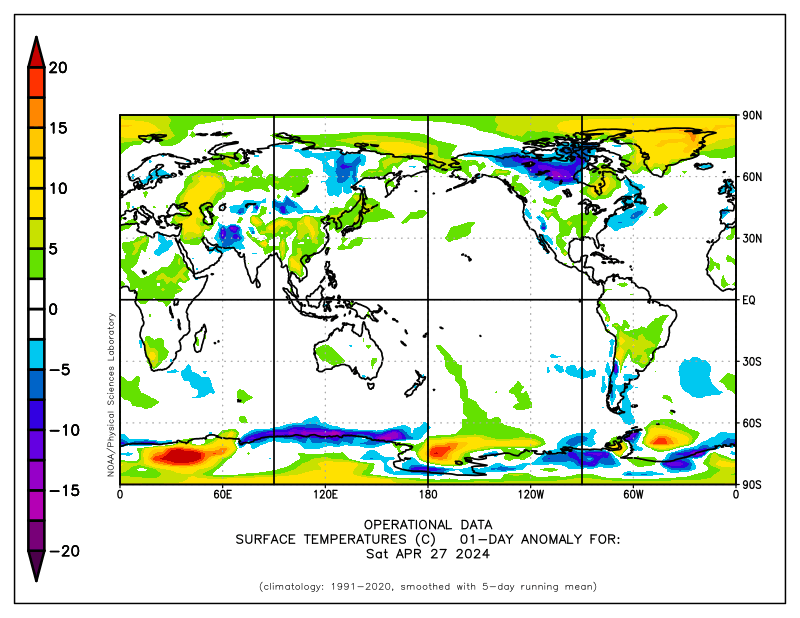
From a posting using NOAA data, here is a snapshot of the earth this week. Notice how both poles are colder than normal. The global warming fanatics have told us that as the earth warms it will show up first and strongest in the highest latitudes. Well... this picture doesn't show the story that the global warming fanatics are trying to sell:

Friday, December 25, 2009

Projecting the Future

I got a kick out of reading this bit in a posting by Anthony Watts in his Watts Up With That? blog:
World oil reserves are over 20 times greater now than they were when record-keeping began in the 1940s; world gas reserves are almost four times greater than they were in the 1960s; world coal reserves have risen fourfold since 1950. Political events can drive supply down and prices up, but the raw mineral resource base is prolific—and expanding in economic terms thanks to an inexhaustible supply of human ingenuity and exploratory capital.

Record energy consumption has been accompanied by improving air quality. Urban air quality is significantly better today than in the 1970s in the United States.

...

There is much to be thankful for this holiday season with our energy economy. But thoughts about the less fortunate should be with us too. An estimated 1.5 billion people do not have electricity for lighting, heating, cooling, cooking, or water purification. A Christmas tree for us is likely to be firewood for those living in energy poverty. For these people, there could be no greater holiday gift than affordable electricity itself, explaining why the developing world has flatly rejected proposals from environmental elites to forsake future energy usage in the quixotic quest to “stabilize climate.”
This reminds me of a book I read many years ago, Julian Simon's The Ultimate Resource. The second edition of this book is available on line and is worth reading. The message is simple: humans are clever and will find ways to cope with looming resource shortages. The doomsters who claim that the world is coming to a "point of no return" just haven't looked at humanity's history. There have always been looming shortages and reason to be gloomy. But there have always been clever people who found new ways of doing things, new resources, and new technologies that get around the seemingly impassible hurdles.

My father was taught in the 1930s that we were coming to "the end of oil". I remember teaching a social studies class in a secondary school in the 1970s that we were coming to "the end of oil". At the time I didn't know that the gloomy prediction had been around for 40 years and that it was based on a simple-minded, but wrong, reading of the facts. The oil companies generally report a potential of 20 years of oil because they don't explore for the sake of exploring. They only find enough oil to satisfy markets for the near term future. Therefore, there is alway "just twenty year's supply before we run out" as the gloomster tell us. But the doom-and-gloom crowd doesn't understand that there never will be more than 20 years supply in the ground because it doesn't pay for oil companies to explore beyond that amount.

So the "peak oil" crowd keep projecting exhausing just around the corner. But I wouldn't bet on it. It is already pretty clear that we will wean ourselves off carbon-based energy over the next 30-40 years. The new energy technologies are blossoming all around. They will displace the old fossil fuel energy suppliers except in special industries, e.g. transportation will always need something like oil, but I'm willing to bet that it will be supplied by algae in 2050 and not by punching more holes in the ground.

I can't pass up a chance to tweak the nose of the "global warming" crowd. They are hysterics who are closely related to the "peak oil" crowd, i.e. they are linear extrapolators of the present into the future. They have no sense of technology and change. Their "solution" is to stop growth. That is crazy unless you are already rich (like most of the leadership of these 'environmental' groups). The future will be green, and it will be greener sooner if we invest in science and technology and not into rules and regulation and lots of busy bodies going around making sure that nobody is using more than their allotment of fossil fuel.

Saturday, September 12, 2009

Doom and Gloom

For some reason people are attracted more to a doom-and-gloom view of the future than one of a bright-and-promising-new-day vision of the future. The former makes you want to hunker down and distrust others, to want to say "I've got mine Jack, you bug off". Whereas the second makes people optimistic and hopeful and willing to share. I favour the latter. But so many people want to be pessimistic. That disheartens me.

Here are some key bits from an article by Peter Foster in the Financial Post:
The great petroleum geologist Wallace Pratt famously said that “Oil is found in the minds of men.” Discoveries depend on visionary theory, technical innovation and commitment to risky drilling. Plus luck. Peak Oil theory, by contrast – which asserts that global oil production has, or soon will, peak, and that this has powerful policy implications — is found in the limitations of the minds of men. It is less geological theory than unevolved intellectual shortcoming, although it certainly has its political uses.

The fruits of the “greatest resource,” as economist Julian Simon dubbed the human mind, appeared yet again this week with the announcement by BP that it had found a “giant” field at unprecedented depth in the Gulf of Mexico, an area that twenty years ago was regarded as played out. By contrast, the limitations and conceits that characterize Peak Oil were nicely summed up by a report on BP’s find in the leftist British newspaper, The Guardian.

According to that report, BP’s Tiber well, and another recent huge find in Iran, “have encouraged skeptics of theories which say that peak production has been reached, or soon will be, to hail a new golden age of exploration and supply.”

Note how the use of the term “skeptics” suggests that Peak Oil is the mainstream view, which it is not. The word also links unbelievers to beyond-the-pale climate change “skeptics.” Finally, the report suggests that these people are suggesting a “golden age of exploration and supply” although in fact the only relevant quote is from Peter Odell, professor emeritus of international energy studies at Erasmus University in Rotterdam, who merely says, “It’s an amazing turnaround from the gloom of the last 10 years. All these finds will take a long time to bring on stream, but it shows the industry is capable of finding more oil than it uses and shows we have not come to any peak.”

...

Debate between economists and Peak Oilsters tends to be a dialogue of the deaf. Economists often seem to imagine that they are explaining a technical issue. They note that the alleged failure to “replace” production is in fact due to the way reserves are reported. They stress that startling new technologies -- such as the ability to drill in thousands of metres of water to depths of more than 10,000 metres (as at Tiber), or 3-D computer seismic imaging, or horizontal drilling -- are constantly finding new oil and gas, and producing more from old reservoirs.

Again, citing how often alarms over “the end of oil” have been sounded since 1880 holds no sway with Peaksters. Since they see oil supply as essentially “fixed” and economists as deluded and morally deficient, delays in the projected “crunch” will only make it all the more painful when it — inevitably — comes.

Peak Oilsters do not so much refute economics and history as simply ignore them. They are victims of the “psychology of taboo,” which prevents them from assessing markets objectively.

For example, leading Peakster Matt Simmons has described the market as a “500-pound wrecking ball” and Adam Smith’s invisible hand as an instrument of strangulation!

...

The oil industry, by contrast, is constantly producing new wonders. In a piece in the latest Foreign Policy magazine, oil historian and consultant Daniel Yergin notes that, “Again and again, in researching oil’s history, I was struck by how seemingly insurmountable barriers and obstacles were overcome by technological progress, often unanticipated.”

With regard to Peak Oil, Mr. Yergin points out that his own firm’s analysis of 800 of the world’s largest oil fields “indicates that the resource endowment of the planet is sufficient to keep up with demand for decades to come.”

Only governments can stand in the way. Supported by our misconceptions.
If you want to revel in your gloom-and-doom, then go read the Wikipedia's list of gloomy "peak oil" forecasts. Squirrel those predictions away and look at them in ten years time. You will laugh yourself silly.

I had a similar experience with IPCC over global warming. When I bought my house in 1983 I pulled out the IPCC forecasts and discovered that according to their predictions by 2000 I could expect the sea to rise by a meter and top the dykes and I would own swampland and not a house. Well... it is nearly 30 years later and the sea has risen maybe 3 centimeters. So I'm not sweating "global warming". I've learned by watching their ever-receding doom-and-gloom forecasts that they are more religious believers than scientists. They cling to their "coming" of global warming as tightly as any Christian clings to what Paul said was Christ's return "within our lifetime". Well, that was 2000 years ago and as far as I know the oldest human lifetime is about 130 years. So that "prediction" didn't stand up to the test of time, just like "global warming" won't, and "peak oil" won't.

Don't get me wrong. I know the earth is finite. The oil will end one day. But it won't disappear overnight. It will simply get more and more expensive and human ingenuity will move us to other energy sources. So I don't lose any sleep over "peak oil".

Friday, September 4, 2009

When Will It All End?

The doom-and-gloom crowd always sees a problem:
  • Malthus foresaw us outrunning our food resources and all starving. Solution: control the poor to prevent them from breeding.

  • The Eugenics crowd saw us breeding ourselves into imbecility. Solution: control the genetically inferior to keep them from breeding.

  • Oswald Spengler saw the West in decline. Solution: bring in a strong leader, a guy like Hitler, to shake things up.

  • The Population Bomb people told us we were breeding ourselves into a global disaster: let the government impose a one-child policy and of course give the rich and famous an exemption because they are naturally superior. (OK, the last bit wasn't explicit in the policy, but this is typically the thinking of this crowd, i.e. they write rules for others but not themselves.)

  • The Club of Rome people yelled that resources would soon run out and we would all descend into brutes fighting over scraps. Solution: go back to the presumed golden age when we lived in harmony with nature by doing hunting and gathering so that we would not be a burden on Mother Earth.

  • The Global Warming crowd sees the heat death of earth as we load up so many greenhouse gases that we cook ourselves in our own waste heat. Solution: give up carbon-based energy and live only using renewable resources and, of course, force a cutback on carbon emissions even if this guts the economy. (There is an implicit assumption that technology is the enemy and not part of the solution.)
The Peak Oil people are disappointed today. There is a big new Tiber oil field discovery in the Gulf of Mexico, 3 billion barrels of oil. The doom-and-gloom crowd see it as more evidence that the end is near. The glass-is-half-full crowd see it as proof that ingenuity will continue to allow goodies to rain down on us.

Here's a bit from Geoffrey Styles' blog posting:
  1. There's still life in the old dog. While the US has been drilled like a pincushion for 150 years, we have still not found every barrel of oil that nature provided us. Don't be misled by proved reserves data that seem to show that we have less than 12 years of oil left at current production rates. In point of fact, the US has produced a cumulative 200 billion barrels of oil from reserves that never exceeded 40 billion barrels. Not only do we continue to find new resources in the manner of Tiber-1, but we continually learn how to extract more oil from the reservoirs we've already found, revising their reserves steadily upward over time.

  2. A discovery like Tiber doesn't mean we've merely added two weeks worth of production to reserves. US oil production, like global production, is comprised of the contributions from thousands of oil fields and hundreds of thousands of oil wells, with the most productive 20% or so accounting for roughly 87% of output. If initial guesses of recoverable oil are right, then the Tiber field could yield on the order of 100,000 bbl/day of oil for 20 years--2% of US production for a generation. If we turn up our noses at that, then we surely ought to think twice about wind power. In 2008 all the wind turbines in the US generated 52 billion kilowatt-hours, backing out natural gas power generation equivalent to just 245,000 bbl/day of oil, or 5% of US oil output.
Geoffrey Styles will not be popular with the gloom-and-doomsters. He tries to thread a middle way through the contending factions:
Although finding more oil may look problematic from a greenhouse gas perspective, oil is not our worst fuel, and it remains the hardest to displace, because of its unique combination of energy density and portability. I share the vision of many for a future made up of electrified cars and low- or no-emission power plants, but we're going to burn hundreds of billions of barrels of oil getting there. For reasons including national security, national pride, and our balance of trade, it matters whose oil it will be, as we make the long transition to a more sustainable energy economy. If we ignore that principle, we're likely to end up even more reliant on unstable foreign suppliers, before we arrive at the elusive promised land of energy independence.

Sunday, July 26, 2009

Exponential Growth

Kevin Kelly has a very interesting and very extensive discussion of Moore's Law and a number of other laws of technical growth. He was an editor for Wired magazine and is a prolific author. My favourite book by him is Out of Control.

Here are some key bits from Kevin Kelly's article "Was Moore's Law Inevitable":

Secondly, even a cursory glance reveals the astounding regularity of Moore's line. From the earliest points its progress has been eerily mechanical. Without interruption for 50 years, chips improve exponentially at the same speed of acceleration, neither more nor less. It could not be more straight if it had been engineered by a technological tyrant. Yet, we are to believe that this strict nonwavering trajectory came about via the chaos of the global marketplace and uncoordinated ruthless scientific competition. The line is so straight and unambiguous that it seems curious anyone would need convincing by Moore and Mead to "believe" in it. The question of faith lies in whether one believes the force of this "law" lies within the technology itself, or in a self-fulfilling social prophecy. Is Moore's law inevitable, a direction pushed forward by the nature of matter and computation, and independent of the society it was born into, or is it an artifact of self-organized scientific and economic ambition?

In any case, at some point on our planet, or any planet, the curve will plateau out. Moore's law will not continue forever. Any specific exponential growth will inevitably smooth out into a typical S-shaped curve. This is the archetypical pattern of growth: after a slow ramp up, gains takeoff straight up like a rocket, and then after a long run level out slowly. Back in 1830 only 37 kilometers of railroad track had been laid in the US. That count doubled in the next ten years, and then doubled in the decade after that, and kept doubling every decade for 60 years. In 1890 any reasonable railroad buff would have predicted that the US would have hundreds of millions of kilometers of railroad by a hundred years later. There would be railroad to everyone's house. Instead there were fewer than 400,000 kilometers. However, Americans did not cease to be mobile. We merely shifted our mobility and transportation to other species of invention. We built automobile highways, and airports. The miles we travel keep expanding, but the exponential growth of that particular technology peaked and plateau.

Much of the churn in the technium is due to our tendency to shift what we care about. Mastering one technology engenders new technological desires. A recent example: The first digital cameras had very rough picture resolution. Then scientists began cramming more and more pixels onto one sensor to increase photo quality. Before they knew it, the number of pixels possible per array was on an exponential curve, heading into megapixel territory and beyond. But after a decade of acceleration, consumers shrugged off the increasing number of pixels; the current resolution was sufficient. Their concern shifted to the speed of the pixel sensors, or the response in low light -- things no one cared about before. So a new metric is born, and a new curve started, and the exponential curve of ever-more pixels per array will gradually abate.

Moore's Law is headed to a similar fate. When, no one knows. "Moore's Law, which has held as the benchmark for IC scaling for more than 40 years, will cease to drive semiconductor manufacturing after 2014," Len Jelinek, the director of a major semiconductor manufacturer, claimed in 2009. Carl Anderson, an IBM Fellow, announced at an industry conference in April, 2009 that the end of Moore's Law was at hand: "There was exponential growth in the railroad industry in the 1800s; there was exponential growth in the automobile industry in the 1930s and 1940s; and there was exponential growth in the performance of aircraft until they reached the speed of sound. But eventually exponential growth always comes to an end." But IBM has been wrong several times before. In 1978, IBM scientists predicted Moore's Law had only 10 years left. Whoops. In 1988, they again said it would end in 10 years. Ooops, again. Gordon Moore himself predicted his law would end when it reach 250 nanometer manufacturing, which it passed in 1997. Today the industry is aiming for 20 nanometers. In 2009, Intel CEO Craig Barrett said "We can scale it down another 10 to 15 years. Nothing touches the economics of it."

...

I suspect Moore's Law is something we don't have much sway over, other than its doubling period. Moore's Law is the Moira of our age. In Greek mythology the Moira were the three Fates. Usually depicted as dour spinsters, one Moira spun the thread of a newborn's life. The other Moira counted out the thread's length. And the third Moira cut the thread at death. A person's beginning and end were predetermined. But what happened in between was not inevitable. Humans and gods could work within the confines of one's ultimate destiny.
Go read the whole article. It is absolutely fascinating!

Wednesday, July 22, 2009

The Tragedy of the Commons

Over-fishing is a serious problem. It is a resource with no "ownership" so the incentive is for each individual to exploit it to the fullest. There is no reward for being responsible and limiting your catch. So you push stocks to extinction. That is what happened to cod off the Canadian east coast. The local fishermen and big international trawlers (mostly from Europe) overfished and caused a collapse in the stock. The fishery was closed in the early 1990s and the cod stocks still have not made a comeback! This is a classic instance of the general truth of "the tragedy of the commons".

Here is a story about overfishing tuna in Wired magazine:
News of breeding success comes with the three bluefin species — Northern, Southern and Pacific — speeding towards extinction, the victim of something close to a marine version of the 19th century buffalo slaughter. In the last 30 years, bluefin populations around the world have collapsed. Fishing fleets with spotter planes have chased ever-smaller, ever-younger fish, catching them at sea and hauling them to shoreline pens to be fattened and killed before they’re even old enough to reproduce.

That’s left the seas nearly barren of breeding-age bluefin. In April, the World Wildlife Federation declared that current overfishing rates would cause an irreversible collapse of Northern bluefin within three years. The Southern is considered critically endangered, and it’s thought that any increase in fishing pressure will put the Pacific on a track to oblivion.

Despite alarm among scientists, however, overfishing has continued. Two years ago, researchers from the International Commission for the Conservation of Atlantic Tunas, or ICCAT — the regulators of Northern bluefin fishing — recommended a global quota of 15,000 tons. ICCAT officials ignored them, setting the limit at twice that number. They’ve since dropped it to 22,500 tons, but their scientists now say just 7,500 tons is sustainable. The fishing industry has ignored all those numbers, hauling in some 60,000 tons of Northern bluefin yearly. An independent review panel called ICCAT an “international disgrace,” a phrase that could just as easily apply to the management of Southern and Pacific stocks.

Ending the disgrace, however, is far easier said than done. Prized for their tender, fat-laced meat, bluefin tuna are a $7.2 billion global industry. In January, a 440-pound bluefin sold for $173,000 at a Tokyo market. It was the highest price ever paid for a single fish, and an object lesson in how, in the absence of sane regulation, impending extinction increases incentives for further exploitation. (It’s not for nothing that the Italian mafia is now linked to the bluefin trade; one conservation-minded ICCAT official famously found a white lily at her seat before a 2006 meeting.) Companies from Japan, which consumes three-quarters of all bluefin and effectively controls the global trade, have put an estimated 30,000 tons of the fish, worth between $10 billion and $20 billion, in frozen storage. Overfishing will only raise their price.

Compared with such profits, objections by conservationists, or even pledged bluefin boycotts by France and Spain and the United Kingdom, are relatively meaningless. The most realistic possibility for bluefin survival may be fish farms: If they can be raised in captivity, at-sea fishing should become less important, and wild bluefin might finally be protected.
Right wing nuts may rant about "government is not the solution, it is the problem" but the reality is that people follow incentives. For a resource with no ownership, the incentive is to grab as much as you can before some other guy grabs his share. On the other hand, if you "farm" something, then it is in your interest to cultivate and nurture it so that you can crop it year after year. (OK, there can be short term wrong-headed incentives such as there is a drought happening now and your family is starving. In that case you will eat your seed corn in a desperate attempt to stave off death. It is a desperate gamble that nearly always results in death even if the rains come.)

Civilization requires rules. Crazy right wingers who think that the only value is "freedom" fail to realize that if we are all "free" to run around armed to the teeth and "free" to deal with a situation in whatever way we feel fit, this is a call to descend into a "state of nature" which is a war of all against all.

Friday, July 17, 2009

What is Technically Possible

There was a fuel crisis in England in the late Renaissance. Trees were disappearing up in smoke and the king realized that a critical resource was disappearing. He mandated that the big oaks be saved for the fleet. So people shifted to the new fuel coal.

Technology is our ace in the hole. When things look dire, ingenuity rather than austerity is the right move. There will always be fanatics who urge people give up their "sinful" ways and renounce worldy things and walk/bicycle to work, eat no meat, be a locovore, etc. But the sensible solution, especially for the poor, is science and technology. The patron saint of this approach was Julian Simon and his classic text, The Ultimate Resource (follow the external link to the open on-line version of the book).

Here's an example on the energy front. This is from the Energy Outlook web site:

Going Farther on Oil

by Geoffrey Styles

As I was perusing my UC Davis alumni magazine last night I ran across a short article mentioning a new book from a professor, Dan Sperling, who directs Davis's well-regarded Institute of Transportation Studies. I know him slightly from his participation as in invited expert in a scenario workshop many years ago, so this caught my eye. His book, which I haven't read yet, examines the impact and implications of the rapidly growing global vehicle population, which he sees reaching the two billion mark within the next 20 years. In the article he suggested that this would require an entirely new transportation energy mix, made up of hydrogen, electricity, and advanced biofuels. That certainly fit my own long-standing expectations, as well. However, it occurred to me to wonder just how far we might be able to stretch the transportation fuels we get from oil, and just how far short they would fall as the global car-park expands. To my surprise, it doesn't require very aggressive assumptions concerning improvements in fuel economy, reductions in vehicle miles traveled, and additional oil supplies to cover the needs of a significantly larger number of cars in the world.

The starting point for such an analysis is current oil supplies and the way we process them. Global oil output in 2008 reached 86.5 million barrels per day (MBD), including crude oil, natural gas liquids, and the volumetric gain that occurs when you run them through a modern refinery. Roughly 60% of that input is currently turned into gasoline, diesel and jet fuel. Improvements in refining technology should make it possible to push that fraction to perhaps 70%, at the expense of heavy fuel oil displaced from power generation and shipping. So even if global oil output plateaued at only 90 MBD, a scenario that would probably seem optimistic to the adherents of Peak Oil and pessimistic to some industry experts, it could still yield 63 MBD of liquid transportation fuels. Set aside 7 MBD of that for jet fuel and kerosene and another 26 MBD for trucking and home heating oil, and we're left with 30 MBD of gasoline and diesel for passenger cars. That's roughly 25% more than current global consumption in light-duty vehicles, including the couple of MBD of diesel fuel that power Europe's popular diesel cars.

That doesn't seem to get us nearly far enough, until we consider that in the near future, cars will become much more efficient than they have been, particularly in the US, where an improvement from the current notional average of 25 mpg to the required 35.5 should eventually reduce average fuel consumption per mile by 30%. If the recent reversal in annual vehicle miles traveled persists after the recession ends, that would compound future fuel savings. When we consider that new cars in Europe currently average about 35 mpg and are required to reach approximately 43 mpg by 2015, based on a standard of 130 grams of CO2 emitted per kilometer, and that China has also introduced stricter fuel economy standards, it's not hard to imagine the average world car getting 40 mpg by 2020. That doesn't even require the majority of cars to be hybrids, let alone plug-in hybrids. If that average car drove 9,000 miles per year, it would consume 225 gallons of fuel annually. Following this back-of-the-envelope calculation to its conclusion, our 30 MBD of petroleum-based fuel for light-duty vehicles would be sufficient to cover Dr. Sperling's 2 billion cars with a little bit left over.

I'm not for a moment suggesting that this is the likeliest scenario, or that it means we don't need any of the advanced biofuels or electric vehicle technology currently under development. As I've pointed out frequently, fleet turnover in the developed world has slowed, thanks to the recession, and we can expect a long "tail" of older vehicles to persist for some time. However, the results of this simple exercise surprised me; I had expected the final number of cars that could be supplied by oil to be much lower. So while our transportation energy mix in the next couple of decades is still likely to include a much greater variety of fuels and an increasing penetration of electricity, we should not lose sight of the potential for realistically-achievable fuel economy improvements and non-efficiency conservation--driving personal cars less and relying more on mass transit and electronic trip substitution--to be the most important "transition fuel" in our arsenal, as we reduce our present reliance on oil, in order to tackle energy security and climate change.

Thursday, April 23, 2009

K. Eric Drexler, the visionary behind nanotechnology has written a short autobiographical sketch tracing worries about Earth Day and the Club of Rome's Limits to Growth through to his work on nanotechnology. While the biographical sketch is interesting and leads him to envision a nano-tech future, I come away with a different lesson. Take this snippet:
I read The Limits to Growth soon after its publication early in 1972. It made a big impression on me. The authors used system dynamics models with broad, aggregate variables like population, economic growth, natural resources, and pollution to explore the outlines of a range of future scenarios. The scenarios without strict controls on growth all came to a bad end. Some of those scenarios resemble the world we’re in today.

The book scared me and helped crystallize my resolve to work toward a future outside the range of those scenarios — not toward an impossible future of unlimited exponential growth, but toward a future in which Earth’s forests and seas would be compatible with a prosperous human race for centuries to come. I was, and am, persuaded that this will require a profound change in the basis of our industrial civilization. This aim set the course of my life.
The lesson I learn from this is how scare mongering deeply effects us. Even very bright people can get caught up in these doomsday visions and deeply alter the course of their life. Most people get involved but after a short time lose interest and drop out. Others, like Drexler, have their whole life changed by the fear mongering.

I was caught up in the following apocalyptic dramas during my lifespan...
  • Rachel Carson's Silent Spring, we poison our environment and then ourselves leaving a dead landscape

  • Paul Ehrlich's The Population Bomb, we all die in a Malthusian overpopulation

  • Club of Rome's The Limits to Growth, we outrun the resources of earth (oil, metals, etc.)

  • The IPCC's Global Warming, the human injected greenhouse gases will cause the heat death of mother Earth

  • Laurie Garrett's The Coming Plague: Newly Emerging Diseases in a World Out of Balance, warning that human incursion into tropical spaces will let loose pathogens like Ebola that will wipe us out

  • The World Health Organization's The Bird Flu, the H1N5 strain of influenza would jump species boundaries and wipe us out in a mass epidemic

  • The Bush admin's War on Terrorism, the idea that the Moslem world was rife with suicidal maniacs bent on destroying the West and therefore justifying preemptive wars, "selling" WMD as a technique to mobilize a country for war, torture, and extraordinary rendition
Do you see the pattern here? It is a combination of a "likely story" promoted (sold by) a group or organization using apocalyptic fear mongering to achieve their end such as stopping some activity they dislike or, in the case of scientific groups, to get funding to pursue their interest in the area.

They all paint a horrible future and spread fear. And not a single one has developed as the most radical adherents would have us believe. In short, it is too easy to be caught up in cult-like fear mongering. It is hard to keep a balance and do enough without going over the edge. Each of the above is a real problem and deserved public attention and political action, but the mad adherents couldn't resist turning them into doomsday scenarios.

Saturday, March 7, 2009

A Lecture from the Haves to the Have Nots

I'm always amazed how people who have so much love to go around lecturing those who have very little that "we" all need to "tighten our belts". Here's Thomas L. Friedman in his latest op-ed in the NY Times telling us that we have to learn to live with an economy that just won't produce as much in the future...
What if the crisis of 2008 represents something much more fundamental than a deep recession? What if it’s telling us that the whole growth model we created over the last 50 years is simply unsustainable economically and ecologically and that 2008 was when we hit the wall — when Mother Nature and the market both said: “No more.”

...

“Just as a few lonely economists warned us we were living beyond our financial means and overdrawing our financial assets, scientists are warning us that we’re living beyond our ecological means and overdrawing our natural assets,” argues Glenn Prickett, senior vice president at Conservation International. But, he cautioned, as environmentalists have pointed out: “Mother Nature doesn’t do bailouts.”
This is a lot like the barons of the Middle Ages feasting at the high table looking out at the thin-as-rails servants and serfs and announcing that "everybody has to go on a diet". And what makes it so bittersweet is that of course the baron considers a diet where he gives up the butter tart in favour of the chocolate cake, but the serfs & servants are expected to give up one of their bowls of gruel each day and make do with only one.

The rich are excellent at telling everybody else that they "have too much" or that they need to "diet". But the just never seem to apply these wonderous notions to themselves.

The truth is that the economy will recover. Growth will come back. It won't be by penny pinching or cutting back that more will be made available to those without. It will be done by new technology that permits us to get more from less and that lowers costs so the poor can enjoy the good life as well. You won't get there by listening to fat cats telling you to tighten your belt. Friedman must think we are fools. His path is one that keeps the rich very rich and makes the poor much much poorer.