Showing posts with label risk. Show all posts

Thursday, October 6, 2011

Death & Physics

I enjoy Jenifer Ouillette's Cocktail Physics blog. Here is a bit out of piece she has written on Robert Wilson:
... nobody forgot that the work they were doing at Los Alamos was both vital to national defense, and highly dangerous due to the radioactive substances involved. Wilson recalled his own brush with death while assisting a physicist in the Critical Assemblies Group with another experiment to determine when criticality was reached as one stacked a series of enriched uranium hydride cubes. He was surprised, and a bit dismayed, to find that the group didn't rely on the usual elaborate safety devices commonly used at cyclotron facilities at the time. Instead, the physicist arrived with a simple set-up involving a wooden table, a single neutron counter to monitor criticality, and a whole bunch of cubes of enriched uranium hydride.

Wilson watched, rapt, as the physicist started stacking uranium cubes, and then noticed with alarm that the neutron counter wasn't, well, counting. Upon inspection, he discovered that the voltage supply was burnt out. When the counter was turned back on, it lit up immediately, to Wilson's horror. "A few more cubes and the stack would have exceeded criticality and could well have become lethal," he recalled. Furious, Wilson chewed out the physicist, his division leader, and even raged about it to Oppenheimer himself, but he had to leave for Trinity the very next day, so he let the incident drop. Had he stayed and pursued the matter, Wilson believed, "I might have saved the lives of two people. To this day, the incident is on my conscience."

Those two people were Harry K. Daghlian, Jr. and Louis Slotin, both of whom died of radiation sickness after accidents that occurred while conducting critical experiments with a plutonium core -- known as "tickling the dragon."
More on Louis Slotin from Wikipedia:
On May 21, 1946, with seven other colleagues watching, Slotin performed an experiment that involved the creation of one of the first steps of a fission reaction by placing two half-spheres of beryllium (a neutron reflector) around a plutonium core. The experiment used the same 6.2-kilogram (13.7 lb) plutonium core that had irradiated Harry K. Daghlian, Jr., later called the "Demon core" for its role in the two accidents. Slotin grasped the upper beryllium hemisphere with his left hand through a thumb hole at the top while he maintained the separation of the half-spheres using the blade of a screwdriver with his right hand, having removed the shims normally used. Using a screwdriver was not a normal part of the experimental protocol.

At 3:20 p.m., the screwdriver slipped and the upper beryllium hemisphere fell, causing a "prompt critical" reaction and a burst of hard radiation. At the time, the scientists in the room observed the "blue glow" of air ionization and felt a "heat wave". In addition, Slotin experienced a sour taste in his mouth and an intense burning sensation in his left hand. Slotin instinctively jerked his left hand upward, lifting the upper beryllium hemisphere and dropping it to the floor, ending the reaction. However, he had already been exposed to a lethal dose (around 2100 rems, or 21 Sv) of neutron and gamma radiation. Slotin's radiation dose was about four times the lethal dose, equivalent to the amount that he would have been exposed to by being 1500 m (4800 ft) away from the detonation of an atomic bomb.

As soon as Slotin left the building, he vomited, a common reaction from exposure to extremely intense ionizing radiation. Slotin's colleagues rushed him to the hospital, but irreversible damage had already been done. His parents were informed of their son's inevitable death and a number of volunteers donated blood for transfusions, but the efforts proved futile. Louis Slotin died nine days later on May 30, in the presence of his parents. He was buried in Winnipeg on June 2, 1946.

At first, the incident was classified and not made known even within the laboratory; Robert Oppenheimer and other colleagues later reported severe emotional distress at having to carry on with normal work and social activities while they secretly knew that their colleague lay dying.

The core involved was subject to a number of experiments shortly after the end of the war and was used in the ABLE detonation, during the Crossroads series of nuclear weapon testing. Slotin's experiment was set to be the last conducted before the core's detonation and was intended to be the final demonstration of its ability to go critical.

The accident ended all hands-on critical assembly work at Los Alamos. Future criticality testing of fissile cores was done with special remotely controlled machines, such as the "Godiva" series, with the operator located a safe distance away in case of accidents.
One of the jobs I had was software safety for the detrous manipulator being built for the Space Station. It was hard to get the engineers to think hard about "what could go wrong". We are all optimists by nature. We love to extrapolate the upside. It is really hard, however, to think about failure modes, the "what if" when things go wrong. It helps if you've had previous experience to guide you. But the problem with new technology is that it is "new". We all love to see the wonderful new possibilities of the new, but few like to muck around with the grim downside. Worse, when people do consider what can go wrong, they tend to overshoot and come up with real gloom-and-doom scenarios (e.g. gray goo or the singularity) rather than the more mundane cascade of of unlikely faults that have hidden connections that lead you into a major disaster.

Thursday, July 7, 2011

Tim Harford Talks About His New Book

Here is an interview by the Economist magazine with Tim Harford about his new book Adapt: Why Success Always Starts With Failure:


The part of the interview about H. R. McMaster is fascinating. Sadly I'm not familiar with his book Dereliction of Duty but it sounds like it might be worth tracking down and reading.

Wednesday, April 6, 2011

PBS's 2009 Document "The Warming"

Here is the first of six chapters in PBS's documentary The Warning which was first shown in October 2009.

Watch the full episode. See more FRONTLINE.


This is an excellent review of how major players like Alan Greenspan, Lawrence Summers, Robert Rubin, and Arthur Levitt blocked the attempt by Brooksley Born to regulate the derivatives market, a market that rose to $60 trillion and burst in 2008 to create The Great Recession. AIG went bust because it backed so many derivatives and had no cash to cover them when the bet went wrong. The whole mess was a prefect example of why the right wing mantra of "deregulate, deregulate, deregulate" was dangerous. It also showed that the economic philosophy, so-called rational choice, is a utopian academic construction with no real relevance in the real world. It is a fine theory with wonderful math and allows for elegant models, but it is useless -- worse, it is misleading -- when applied to the real world.

I like the past in Chapter 2 which first establishes that Alan Greenspan had no interest in regulating and believed there could be no fraud because Wall Street and the banks are "big boys" who can look after themselves and handle risk. But the documentary shows how even in the early 1990s this blew up with derivatives at Bankers Trust. Despite this, the Clinton and Bush administrations allowed the bubble to grow bigger and to demolish even more regulations in their push to "deregulate, deregulate, deregulate".

This PBS documentary does a marvelous job of walking through the various bits of evidence that things were out of control and the economy was heading for rocky shoals of 2008. Watch all six of the chapters the PBS documentary The Warning.

Sunday, March 27, 2011

Radiation Leakage from Fukujima

Here are some interesting bits from an article in the magazine New Scientist talking about the nuclear radiation released by the meltdown at Fukujima:
Japan's damaged nuclear plant in Fukushima has been emitting radioactive iodine and caesium at levels approaching those seen in the aftermath of the Chernobyl accident in 1986. Austrian researchers have used a worldwide network of radiation detectors – designed to spot clandestine nuclear bomb tests – to show that iodine-131 is being released at daily levels 73 per cent of those seen after the 1986 disaster. The daily amount of caesium-137 released from Fukushima Daiichi is around 60 per cent of the amount released from Chernobyl.

The difference between this accident and Chernobyl, they say, is that at Chernobyl a huge fire released large amounts of many radioactive materials, including fuel particles, in smoke. At Fukushima Daiichi, only the volatile elements, such as iodine and caesium, are bubbling off the damaged fuel. But these substances could nevertheless pose a significant health risk outside the plant.

...

In the 10 days it burned, Chernobyl put out 1.76 × 10¹⁸ becquerels of iodine-131, which amounts to only 50 per cent more per day than has been calculated for Fukushima Daiichi. It is not yet clear how long emissions from the Japanese plant will continue.

Similarly, says Wotawa, caesium-137 emissions are on the same order of magnitude as at Chernobyl. The Sacramento readings suggest it has emitted 5 × 10¹⁵ becquerels of caesium-137 per day; Chernobyl put out 8.5 × 10¹⁶ in total – around 70 per cent more per day.

"This is not surprising," says Wotawa. "When the fuel is damaged there is no reason for the volatile elements not to escape," and the measured caesium and iodine are in the right ratios for the fuel used by the Fukushima Daiichi reactors. Also, the Fukushima plant has around 1760 tonnes of fresh and used nuclear fuel on site, and an unknown amount has been damaged. The Chernobyl reactor had only 180 tonnes.

The amounts being released, he says, are "entirely consistent" with the relatively low amounts of caesium and iodine being measured in soil, plants and water in Japan, because so much has blown out to sea. The amounts crossing the Pacific to places like Sacramento are vanishingly small – they were detected there because the CTBT network is designed to sniff out the tiniest traces.

...

The Chernobyl accident emitted much more radioactivity and a wider diversity of radioactive elements than Fukushima Daiichi has so far, but it was iodine and caesium that caused most of the health risk – especially outside the immediate area of the Chernobyl plant, says Malcolm Crick, secretary of a United Nations body that has just reviewed the health effects of Chernobyl. Unlike other elements, he says, they were carried far and wide by the wind.
I'm losing confidence in Japan as well as the US since this disaster hasn't been brought under control and the information we are getting is through third parties and not official government sources. The promise to bring power to the plant dragged on for over a week and when power arrived suddenly we were told that you couldn't just start up the cooling system. There is no information about the scope & scale of the disaster and now authoritative statement of what has to be done and the expected time it will take. Worst of all, there is no guidance on the radioactive release stating what has been released, when it is expected to be under control, and what we can expect over the coming weeks and months.

I'm starting to get very cynical about this situation and the competence of the authorities. I'm now wondering why they didn't just bury the site under a hundred feet of water impervious concrete to prevent these weeks and weeks of radiation leakage. It is obvious that Tepco is incompetent and has lied about safety in the past, so why are these clowns still "in charge" of the cleanup?

Wednesday, March 23, 2011

The Fukushima Fifty

From an article in the UK's Daily Mail:
Five are believed to have already died and 15 are injured while others have said they know the radiation will kill them.

The original 50 brave souls were later joined by 150 colleagues and rotated in teams to limit their exposure to the radiation spewing from over-heating spent fuel rods after a series of explosions at the site. They were today joined by scores more workers.

Japan has rallied behind the workers with relatives telling of heart-breaking messages sent at the height of the crisis.

...

But it is becoming even more pressing that the Fukushima succeed after it was revealed today that Tokyo's tap water has been contaminated by unusual levels of radiation.

The government have issued a warning to all mothers urging them not to let babies drink the tap water.

...

Nearly two weeks after the twin March 11 disasters, nuclear officials were still struggling to stabilise the damaged and overheated Fukushima Dai-Ichi plant, which has been leaking radiation since the disasters knocked out the plant's cooling systems.

Radiation has seeped into vegetables, raw milk, the water supply and even seawater in the areas surrounding the plant.
All energy sources carry a risk. Nuclear is no different except that it is a newer technology and consequently it scares a lot of people who fear anything new. The lessons to be learned from this crisis is good and bad. The reactor was hit by an incredible disaster but didn't completely fail and the radiation is still limited compared to the worst case possible. This means that some will die, but not the large numbers in a Chernobyl-size disaster. But the death toll is still small compared to mine disasters. The good news is that more safety can be engineered into these nuclear plants.

Putting Risk into Perspective

Here's a nice visual along with some text to put the risk of nuclear power into perspective:
Death Rate Per Watt Produced

Posted on March 22, 2011 by Michael Froomkin


Seth Godin has the dramatic chart.


The little tiny box is “nuclear.”

I knew this, and the chart still is effective. And my kids were at first very skeptical last week when I tried to tell them that so far coal had killed far more people than nuclear power. (Of course the very worst case scenario for a nuclear plant is much worse than the very worst case scenario for any coal-fired plant; but the very worst case scenario for coal plants aggregated is…global warming.)
In the news today German has "speeded up" the closure of its nuclear reactors. Lemmings to the sea!

If you want to be ruled by fear, then worry about the heat death of the universe, worry about the coming transformation of the sun into a red giant which will swallow earth in its fiery maw, worry about an asteroid bringing life to an end, worry that yet another virulent bug will jump the species barrier and spread a billion plus deaths around the earth... There is so much to fear and so little time left in an average person's life to savour the delightful frisson of fear!

Tuesday, March 22, 2011

Buy Signal for Houses

When Wall Street puts up talking heads to tell you that "owning a house is a bad idea" is the best signal I can imagine for indicating the bottom of the house price slide and the best time to get into the housing market.

If you listen to James Altucher it is pretty clear he was never a happy home owner and that has coloured his view of the advisability of owning versus renting. His points are sound, but he over-emotionalizes them and over-sells them. My best investment was my house. It did better than the stock market over the last 30 years.


I've learned to distrust everything I hear from the "business TV" programs. These guys are out to manipulate you and it is to your disadvantage. They are making money in the market and from their perspective you are just one of the money trees to be "harvested" by selling you some idea.

Sunday, March 20, 2011

Fukushima Risks Explained

Here is a slide show that gives an excellent presentation of the radiation risk from the Japanese reactor meltdown and the fires in the uncovered stored spent fuel...


Click on "View on Slideshare" to get a window that lets you rescale the slides to whatever size you desire.

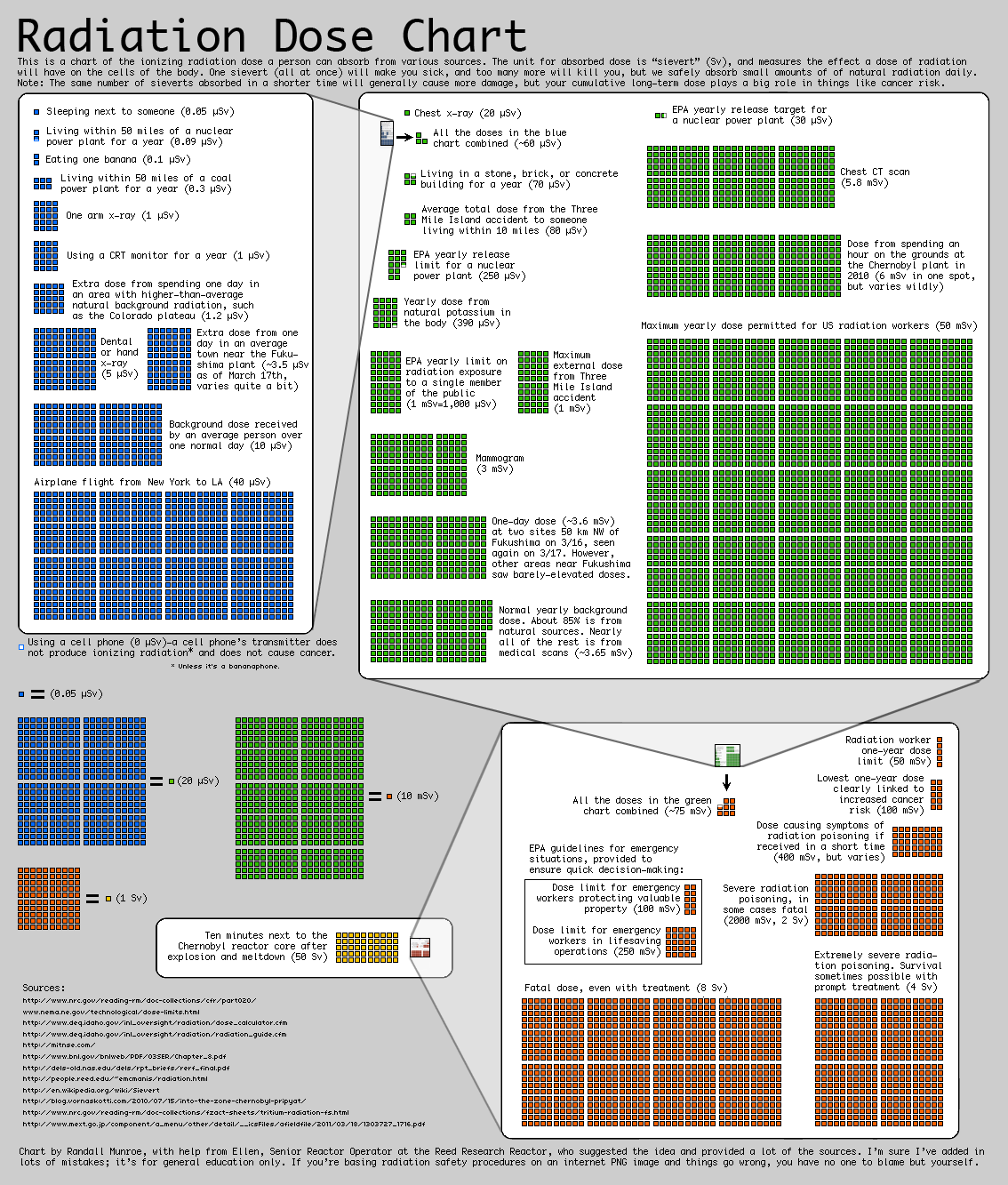
And here is a useful radiation dosage chart.

And the following is meant to put some fear into you...


I believe that nuclear reactors can be safe, but you have to engineer the safety into it. (I was a software safety engineer years ago.) But you only get safety if you take it seriously and do the necessary safety analysis before the design and do safety audits during construction and during operation. So fear isn't the right message.

The lesson to be learned is to build in safety. The problem at Fukushima was that they didn't take the "worst case" seriously enough. My obvious question: why build a reactor at sea level when you know you can have a tsunami? Without the tsunami, Fukushima would have been a story of safe shutdown after suffering an earthquake beyond the design limits for the reactor.

Update 2011mar21 Here is a slide show from the IAEA quantifying the amount of radiation.

Sunday, December 26, 2010

TSA and Your Safety

I don't trust what TSA tells you about its scanning machines. This, which is from James Fallows' blog -- a snippet in which he quotes a physicist -- is something that I do believe:
There is no such thing as a risk-free dose of ionizing radiation. The federal government studied this using beagles right after World War II and found no safe dosage level. And for good reason.

The reason Albert Einstein won the Nobel Prize was for explaining the photoelectric effect, not for relativity. His explanation involved the discovery that light is absorbed and emitted in discrete energy packets called photons, like a stream of particle. Photons are only absorbed or emitted one at a time, and their energy depends on their frequency.

We learn two things relevant to current news from this:

1. All microwave photons are far too weak to cause damage to molecules through their absorption. The energy level of a microwave photon is sufficient to cause a molecule to rotate or vibrate (this is how microwave ovens work) but not to cause it to disintegrate or modify its structure, and those are essential requirements for causing a DNA molecule to mutate into a malignant strand. Epidemiology cannot answer this question because its methods are not aware of physical laws. They can place a statistical limit on mutagenicity, but physics actually rules it out as physically impossible. Lesson? Cell phones do not cause cancer. Period.

2. On the other hand, X-rays cause molecular damage very easily because they are extremely energetic. In fact, this is the reason why they permit you to see inside things. Anything further up the spectrum than the near-UV is capable of causing cancer. But UV is not energetic enough to penetrate. It is absorbed in the outer layers of the skin, and so can cause skin cancer but not, say, lung cancer. X-rays penetrate. They cause cancer everywhere. And dosage is cumulative over your entire lifetime. Every time you have an X-ray, you slightly increase your chances of contracting cancer. This is why the radiologist always goes into another (shielded) room and puts a lead blanket over parts of you that they aren't interested in. Now each additional dose is a small risk increase, to be sure, and the benefits of medical treatment are generally worth the risk (though I am frequently irritated by the tendency of dentists to X-ray my head with wild abandon).

So I will not go into the naked scanner under any circumstances. It is only for PR purposes, and I don't give a shit about helping Obama or Pistole or anyone else primp their public image. Millimeter wave is safe, X-ray is not, but you never know which one you're getting. TSA workers should be up in arms since they're standing around the machines unshielded all day long. This will eventually come back to bite the government.

You can take that from a physicist.

Oh, and by the way, being afraid of irradiated breast milk is idiotic. That radiation is not entering your body and so can't damage it. On the other hand, so long as the TSA has a policy [of treating breast milk as a "medical fluid'] , they need to honor it.
The part about "this will come back to bite the government" is something I would take very, very seriously.

Saturday, November 13, 2010

Freedom of the Press in Russia

Journalists in Mexico are being killed by drug lords.

And here's a story from Yahoo about a journalist in Russia:
A leading Russian journalist was in a coma on Saturday after two men broke his legs, jaw and fingers in an attack which his editor said was likely to be linked to his coverage of banned opposition groups.

Rights groups have criticized the Kremlin for doing too little to solve a string of journalists' murders that have made Russia one of the most dangerous places in the world for reporters.

Police said they had opened a criminal case over the attempted murder of Oleg Kashin, 30, a political reporter with Kommersant, Russia's best respected general daily newspaper.

"They didn't just rough him up. To make their point they broke the fingers of a journalist," Kommersant editor Mikhail Mikhailin told Reuters. "I'm stunned."

Mikhailin said the motive was unclear, but likely to be linked to Kashin's recent investigations into extremist youth groups, including banned opposition group the National Bolshevik Party.

"He undertook investigations into various informal organizations. I feel something he wrote might have upset someone who decided to take these vicious measures," he said.
Meanwhile in America... can you compare these journalists who risk their lives to tell the truth with the sold-out, paid-for pretend journalists of Fox "News"? Real journalists report about the bad guys. At Fox they are the paid lap dogs of the bad guys. At Fox they aren't journalists, they are paid mouthpieces whose job it is to shape "the news" to sell the interests of the rich and powerful at the expense of the broad public.

Here's what a Tulane University political scientist has to say about US "news" coverage:
So why are Americans so fearful, so conscious of threats? He blames, in part, the manipulative nature of current television news. "Fear is an essential component of the business model of both CNN and Fox News, a necessary tool to keep fingers away from remote controls during commercial breaks. Voices of reason tend to spoil the fun, and may inspire people to see excitement elsewhere. News outlets win by presenting stories that are more frightening, angry and simple than those of their competitors. … "

One of the victims of this system, he goes on to argue, is poor old reasonable President Obama: "Only in a deeply pathological society is reason a synonym for weakness."

Friday, October 1, 2010

Black Swans & Financial Risk

Here is a short interview of Nassim Nicholas Taleb at The Atlantic magazine. The source of the video is here:


I like some of what Nassim Nicholas Taleb says, but there is a lot I don't like. Yes, risk was behind the collapse. But his view that the Federal Reserve should be abolished and that Keynesian economics doesn't apply "this time" and that Paul Krugman has got things wrong are all things I disagree with him about. His love of the UK's new prime minister, David Cameron, is misplaced. I believe the austerity policies of Cameron will be a disaster. As Krugman has pointed out many times, the austerity approach is a "race to the bottom". The Republic of Ireland took the austerity approach early and its economy continues to collapse in a death spiral. Taleb's economics is just plain unhelpful. He doesn't appreciate the Keynesian economics is the only way to get out of the rut quickly and with minimal damage. Taleb focuses on the debt and worries that it is a burden for the grandchildren while ignoring the millions unemployed now and the children suffering because their parents have lost their home, don't have jobs, and can't feed them.

Wednesday, August 25, 2010

Bubble-ology

Here's a blog post by Paul Krugman on the NY Times site which is well worth reading:
There Are Bubbles, And Then There Are Bubbles

On the whole, I find it amazing and distressing that fear of new bubbles is playing such a large role in current policy discussion, leading too many prominent economists to recommend raising interest rates in the face of a hugely depressed economy. Even if you believe that excessively low policy rates were a key reason for the housing bubble — which I don’t — the idea that we should be raising rates now brings to mind the old joke about the motorist who runs over a pedestrian, then tries to fix the damage by backing up, and running over the pedestrian a second time.

Beyond that, I think we need to bear in mind that while bubbles are in general a bad thing, just how bad depends a lot on the context — in particular, whether the inflation of the bubble has been accompanied by a big increase in leverage on the part of those buying the inflated assets.

Consider the stock bubble of the late 1990s. It was crazy, and when it popped U.S. households suffered a capital loss of about $5 trillion. This was bad, and helped cause a recession. But it never rose to the level of economic catastrophe.

Then came the housing bubble, after which households suffered a capital loss of about $8 billion trillion [hey, a few zeroes more or less ... ]. Yes, they also suffered a big loss as stocks plunged — but that was because the housing bust, unlike the stock bust, had a huge impact on the financial system and the economy as a whole.

What was the difference? First, a lot of financial institutions — which are highly leveraged — were holding securities whose value was highly sensitive to the state of the housing market. There was nothing comparable in the case of stocks. So the housing bust undermined the financial system in a way the stock bust never did.

Second, households also leveraged themselves up in the housing boom, in a way they for the most part didn’t with stocks (yes, there were people buying dotcoms on margin, but they were not typical). So the housing bust created a balance-sheet crisis for the household sector in a way that the dotcom bust didn’t.

The moral for right now is that even if you believe that there are bubbles inflating or about to inflate, they’re only a big concern if they are leading to leveraged positions for key players. The alleged carry trade bubble sorta kinda mighta have met that criterion, although I never found the warnings all that persuasive. But other stuff — bubbles in BRIC equities, or gold, or whatever, don’t make the grade.

Anyway, my point is not so much about current events as a more general observation: the bubbles we should fear are those that lead to leverage, and set us up for a Minsky moment.
I wanted to cut out the "key bit" but Krugman writes so beautifully and makes every word count. So I ended up excising the whole thing! If you don't read Krugman regularly, you should. He both writes articles for the NY Times as well as blog posts that elaborate themes which the space limitations of a newspaper require they be left out. Monitor this site and you will get all his postings and his articles.

The above post is typical of Krugman. He points out the false beliefs of pundits who are media stars. Sadly, too many people with access to the media don't really know what they are talking about and keep making mistakes and misleading people. Poor Paul Krugman is like the little engine that could. For years he keeps telling people truths they don't want to hear. I'm hoping someday Krugman, like the little engine, will actually succeed in his goal.

Wednesday, August 4, 2010

One Easy Step to Create Your Own $30 Billion Disaster

From Yahoo News, here's an excellent "step one" to assure your success in creating a disaster on a really big, really impressive scale, say on a Gulf of Mexico wide scale:
Testifying Friday before a federal panel investigating the Deepwater Horizon explosion, Transocean employee Michael Williams said that an alarm designed to warn the crew if combustible gases were in danger of igniting was deliberately disabled.

"The general alarm was inhibited," Williams testified. He went on to say that when he alerted his superiors about the extreme safety hazard, he was told that the men running the rig did not want any alarms going off while everyone was trying to sleep during the night.
Hey! I've got a money-saving solution for all those cash-strapped American municipalities: turn off the fire hydrants! Everybody knows that 99.9% of the time that water just sits there doing nothing. Cut out the waste. Shut off the taps!

Here's my brain wave to save money for cash strapped American states: close down the prisons! Everybody knows that it costs $60,000 per year to house prisoners in jail. What a waste of precious tax payer dollars! Just open the doors of the prisons and tell those folks to "go out and get a job" so that they will start being tax-paying citizens like everybody else. That will both reduce costs and help boost tax revenues. A double win!

I love this game that BP has started. There must be all kinds of "tricks" to cut costs and put more money on the bottom line. How about stop funding OSHA! Everybody knows that all that red tape simply wastes company cash and inhibits companies from creating more jobs! Every coal mine executive -- such as Massey Energy who ran the Upper Big Branch Mine -- will tell you it is high time to quit wasting valuable production time with these silly "safety sessions" and the frivilous expense of "safety equipment. Everybody knows real men are miners and they gladly go out to face death to prove their rough, tough manliness. Only sissies waste time on safety this-or-that.

Bush and the Republicans were -- and are -- right. Deregulate, deregulate, deregulate. Stop telling ocean rig owners to install alarms. Everybody knows they are going to be turned off by management, so why waste time going through the motions? Just let management manage. Government should get out of people's lives. If those rig workers thought there were any risks to their lives, they wouldn't have signed up for the job. Let free men take responsibility for their own lives.

Every time a father takes on a job, he knows he can't expect government to look after his safety. He knows he can't count on the company to molly-coddle him with safety this-and-that. Let the worker look out for his own safety. If a rig worker wants to test for explosive gases, then he should carry the necessary gear in his kit bag and set up his own monitoring.

Everybody knows that bureaucrats are lazy and don't do their job. If you want a job done, you have to do it yourself. So get out of the way of these rig workers and let them do their own safety. They are experts in their own life and safety. They will make the tough choices about how much risk they are willing to take and at what salary, what to spend on safety gear and just how much education to pay for so they are expert at making safety judgements. How dare the government step in and declare that a life is worth $10 million, or $1 million, or even $100,000. If a worker is willing to sign on to a highly risky job for minimum wage, then he knows best. He has made the calculation that his life is worth only $10,000 and that's his right. Stop babying workers. They can -- and should -- look after themselves.

OK... for those of you who can't spot sarcasm, the above is my attempt to "voice" the views of BP management and all those right wing spokemen who run the "occupational risk" of sitting in a comfy office tapping on keys for a living. These guys with the big salaries are the first to tell you that guys making crappy wages doing dirty and dangerous work are overpaid, complain too much, are coddled by government, and expect companies to waste valuable resources making sure that workers don't lose fingers, toes, arms, legs, eyes, or other body parts doing dangerous work.

Friday, July 16, 2010

Abundance of Caution as a Fool's Game

Here is a bit from a post by Geoffrey Styles in his Energy Outlook blog:
When you parse through this document and examine the evidence that's been made available so far concerning the causes of the Deepwater Horizon disaster and spill, it's hard to avoid the conclusion that the main driver behind the moratorium is not technological, or even necessarily environmental, given the extremely low risks of a similar event occurring from a properly managed rig equipped with a properly-maintained blowout preventer. It seems due at least to "an abundance of caution"--that lovely phrase we have heard several times this week--if not ultimately from hard-nosed political considerations. If I were a President whose party was facing a tough mid-term election, I'd be tempted to eliminate any possible risk of another blowout between now and November 2, too.

The problem with that approach is that the administration won't pay the short-term price for that abundance of caution. That burden falls on the economy of the region, which has already been affected by the spill, on the domestic drilling industry--a vital national asset, not just a bunch of corporations--and its employees, and eventually on the entire US, as our domestic energy supply will again begin to dwindle. According to a new study, the economic impact of the moratorium already extends well beyond the region, because offshore oil workers, who typically work two weeks on and two weeks off, live all over the country, apparently in more than two-thirds of Congressional districts. Yet while unemployed oil workers might at least be covered by the $100 million fund that BP set aside for that purpose at the administration's request, the local businesses that employ many of them need help with more than just meeting payroll, if they are to survive until the end of the moratorium, whenever that might be. That's not BP's responsibility; it's the direct responsibility of the government that has taken a calculated decision to impose a blanket moratorium on the entire industry, rather than on individual bad actors.

Meanwhile, aside from OPEC, an indirect beneficiary of the moratorium that understands very well that when you stop drilling your existing production begins to fall away, there is at least one direct beneficiary that is about to take advantage of the opportunity the ban has created. Brazil has discovered enormous offshore oil reserves in the deep waters of the Santos Basin and elsewhere along its lengthy coastline. As I've noted before, it's the exploitation of these resources, rather than its effective but comparatively-small cane ethanol program, that has made Brazil energy independent and is turning it into one of the most important new oil exporters in the world, including to the US. Until recently, the companies exploring for oil off the coast of Brazil faced the same problems that Gulf Coast drillers did, of high rig rental costs and a long queue for hiring them. Our response to Deepwater Horizon is mitigating both issues. So while it might be promoting safer drilling in the Gulf, one of the unintended consequences of the suspension of drilling here is that it will simultaneously create a greater need for the US to import oil, while ensuring that countries like Brazil will have more of it to sell us, sooner than otherwise and at a bigger profit.
Most people are fully capable of making a mess of things, but it takes a politician to create a spectacular mess of things. Obama's administration shot itself in the foot by closing down deepwater drilling out of "caution". (As Styles suggests, the real "caution" is over having another mess before the next election.) That caution makes sense if there were a puzzle over the catastrophe. But it has been evident from the initial event -- together with BP's impressively outrageous track record of corner-cutting and mismanagement -- that there was no mystery in this oil leak. It was decisions on the platform that created the problem. It didn't require shutting down the industry to "give time" for an investigation.

I'm not impressed by the Obama administration. They guy came in with so much promise, but his delivery has been fair to mediocre. I would give him a C+ as a grade. (He's head and shoulders over George Bush who merits a full-fledged F grade for the disaster he created from 2001 thru 2008.)

Wednesday, July 14, 2010

Deep Water Drilling Explained

Here's a good presentation by Shell Oil on how deep water drilling is done and what safety systems are in place. This is great for those who worry that drilling is just one big risky venture. You get a feel for the technology that has been developed to make it safe.

Skip the first 7:50 of introductions to get to the guy who actually does deep water drilling and is the presenter:


This video is from the Aspen Ideas Festival, July 5-11, 2010 held by the Aspen Institute and was entitled "Drilling for Oil: A Visual Presentation of How We Drill for Oil and the Precautions Taken Along the Way".

When the engineer talks about the "safety case", he is taking about a risk assessment with the associated plan to minimize those risks (see Wikipedia risk management tools). I'm used to projects with a probabilistic risk assessment with an associated plan to minimize those risks. The R&D projects I worked on were so unique we did qualitative assessments of likelihood and severity. Any numeric assessment would be giving the impression we had more insight than we actually had. Since the assessment was qualitative, the plan ranked the risks. Obviously high likelihood and high severity risks required a more extensive analysis and risk plan.

Prior to my R&D experience, when I worked on large projects we usually did more extensive risk assessments. For military projects (and large quasi-military, i.e. for big government agencies) with a loss-of-life and very expensive failure modes, we would treat the risk assessment as rough hazard analysis and investigate it via a full top-down Fault Hazard Analysis to flesh out all failure modes. This guided us as we elaborated a FMECA to document the more extensive analysis of failure modes with analyzed criticality.

When the engineer discusses the Shell safety design versus what BP was doing, this says to me that BP has done what it has a long history of doing: BP cut corners. BP has a terrible operating history (see here and here) and safety record (see here) because it has played fast and loose with regulations and safety concern. You will note that the engineer points out that all the of "extra bells and whistles" that Shell uses to prevent a catastrophe have now been mandated by the government. Sadly this is too late for this Gulf Oil spill, but hopefully this means that this BP spill will be the last one caused by this kind of cutting of corners by BP.

Wednesday, June 16, 2010

Environmental Catastrophes

The Gulf oil spill is a notable gigantic environomental disaster. But it isn't the only one.

I remember in my childhood reading about a coal mine in Pennsylvania that has been burning for decades. Here is Wikipedia's text about the Centralia coal seam fire:
It is not known for certain how the fire that made Centralia essentially uninhabitable was ignited. One theory asserts that in May 1962, the Centralia Borough Council hired five members of the volunteer fire company to clean up the town landfill, located in an abandoned strip-mine pit next to the Odd Fellows Cemetery. This had been done prior to Memorial Day in previous years, when the landfill was in a different location. The firefighters, as they had in the past, set the dump on fire and let it burn for a time. Unlike in previous years, however, the fire was not extinguished correctly. ...

The fire remained burning underground and spread through a hole in the rock pit into the abandoned coal mines beneath Centralia. Attempts to extinguish the fire were unsuccessful, and it continued to burn throughout the 1960s and 1970s. Adverse health effects were reported by several people due to the byproducts of the fire, carbon monoxide, carbon dioxide and a lack of healthy oxygen levels.

Section of the former route of PA Route 61 closed due to mine fire
In 1979, locals became aware of the scale of the problem when a gas-station owner and then mayor, John Coddington, inserted a stick into one of his underground tanks to check the fuel level. When he withdrew it, it seemed hot, so he lowered a thermometer down on a string and was shocked to discover that the temperature of the gasoline in the tank was 172 °F (77.8 °C). Statewide attention to the fire began to increase, culminating in 1981 when 12-year-old resident Todd Domboski fell into a sinkhole four feet wide by 150 feet (46 m) deep that suddenly opened beneath his feet in a backyard. Only the quick work of his cousin Eric Wolfgang in pulling Todd out of the hole saved Todd's life, as the plume of hot steam billowing from the hole was measured as containing a lethal level of carbon monoxide.
Today I ran across this reference (see the picture) to Dervaza, a huge catastrophe of which I was completely ignorant until today:
While drilling in 1971 geologists accidentally found an underground cavern filled with natural gas.[1] The ground beneath the drilling rig collapsed, leaving a large hole with a diameter of about 50–100 meters at 40°15′10″N 58°26′22″E. To avoid poisonous gas discharge, it was decided to burn the gas.[2] Geologists had hoped the fire would go out in a few days but it has been burning ever since. Locals have named the cavern The Door to Hell.
For the disaster enthusiasts in the crowd, Wikipedia has a list of coal seam fires around the world. And it has a list of oil spills.

Bottom line: humans make costly mistakes. Like the financial crisis of 2008, a few in a hurry cut corners to pocket a private benefit and leave a disaster for the rest of us to clean up. Those who cut the corners hardly ever pay to social costs of their messes.

(The latest example was the fact that Abby Sunderland caused $200,000 of expenses to rescue her from her solo sailing adventure when her mast broke. She won't pay back the cost. The taxpayers in Australia will eat the cost. And Abby? She has publicly said she plans to "try again!" Why not when the upside is huge -- lots of publicity and money -- and the downside is very limited -- pawn the costs onto others.)

Thursday, June 10, 2010

Nassim Nicholas Taleb on White Swans

Here is Nassim Nicholas Taleb, the author of the book The Black Swan talking about the failure of risk modeling and the role it played in the 2008 financial crisis:


The discussion of The Great Moderation is interesting. His thesis is that there was an accumulation of risk "only in the tails". With hindsight, this is correct. But it isn't clear to me that this claim is rock solid. The bit I agree with is that the really big risks always comes out of the blue and are unaccounted for. Where I begrudge Taleb is his calm assurance that this was all knowable in advance. It wasn't. The real and growing risk of 2008 wasn't a "fat tail" or "an accumulation of risk". These are empty words. The real risk was the confluence of risks documented in Michael Lewis's book The Big Short: the corruption of Wall Street mortgage securitization, the fradulent mortgage brokers with this NINJA loans, and the connivance of the rating agencies which had been captured by Wall Street and gave AAA ratings that lured big and supposedly "knowledgeable" investors to their doom, i.e. the pension funds, the municipalities that parked money is supposedly "safe" AAA securities.

Taleb is a salesman. He dances in abstractions and sounds very knowledgeable. But his words are empty. Real knowledge rests on facts. He has no facts. He is a theoretician living only in the clouds with after-the-fact "truisms".

Don't get me wrong. I enjoy listening to him. I like a lot of what he says, but I get frustrated because it is too theoretical and not enough factual.

I get really frustrated when he makes ridiculous statements like:
What happened to all that collected wisdom of 3000 years, the Bible, the Koran, early Christianity, the Romans, everyone learned the perils of debt. Now what happened to that wisdom in the business world. If you are facing uncertainty it is a bad idea to have private debt. I think it is criminal to transform private debt into public debt because you are taxing the unborn.
This is absolutely idiotic. This claim of "3000 years of wisdom" is a joke. There is no such thing. The claim that when you "face uncertainty" it is a bad idea to have private debt is a very bad joke. Life is always full of uncertainty. Is Taleb saying "never have any private debts"? That is nutty. And the idea that public debt is somehow worse than private debt is sheer nonsense. A debt is a debt is a debt. For some things private debts are effective, for others you need public debt because no private person could handle the debt. The invention of the stock market was to beef up the size of private debts, but even with the huge private firms of today, there are still some undertakings for which no private consortium is large enough to fund it. Taleb reminds me of so many academics I've known who fall in love with their own patter and abstractions. What he is saying is ridiculous.

What bugs me is that Taleb has been seduced by his notariety. He now is out selling half-baked ideas, selling himself as an instant expert on areas where he has no expertise. He has prostituted himself to fame.

The blather he goes on about public debt is dangerous and bad. Right now the world needs a Keynesian stimulus. His "warnings" about debt are part of the problem because they are stopping governments from doing what is essential: provide the missing demand until the private sector recovers. He is presenting himself in the camp of Hoover's Secretary of the Treasury, Andrew Mellon, with his idiotic "liquidate labor, liquidate stocks, liquidate farmers, liquidate real estate… it will purge the rottenness out of the system. High costs of living and high living will come down. People will work harder, live a more moral life. Values will be adjusted, and enterprising people will pick up from less competent people". Taleb is calling for "very severe austerity measures". This is nutty. This is a moralistic view that debt needs to be atoned for by blood, sweat, and tears. Keynes showed this is not true, but Taleb is a fool and hasn't read Keynes and hasn't studied history. He is presenting himself a Andrew Mellon redux.

One thing that really bugs me about Taleb: He shows no awareness of the suffering of average people. He lives in the abstrations of the financial markets. Bankers find it very easy to tell others to "tighten their belts" because they have never suffered poverty and starvation. In the real world, a Great Recession means 15 million are unemployed and suffering. Keynes focused on that suffering and wanted the society to get those resources back to work so there would be more to share. The poor are keenly aware when production falls below the frontier of possible production because the missing goods are exactly what is missing from their tables. The rich never miss this because their tables are always full. It is very easy for a banker, for a rich person, to prescribe "belt tightening" to others.

I have to make a mental not to refuse to listen to Taleb again. He has gone over to the dark side.

Tuesday, May 25, 2010

The $30 Billion Shorfcut

BP has a history of poor operations, making short-term decisions in favour of a quick profit. That has now blown up big time on them with the Gulf oil spill.

Here is an interesting article by David Hammer of the Times-Picayune newspaper that talks about the criminally foolish "shortcuts" taken by BP:
Costly, time-consuming test of cement linings in Deepwater Horizon rig was omitted, spokesman says

BP hired a top oilfield service company to test the strength of cement linings on the Deepwater Horizon's well, but sent the firm's workers home 11 hours before the rig exploded April 20 without performing a final check that a top cementing company executive called "the only test that can really determine the actual effectiveness" of the well's seal.

A spokesman for the testing firm, Schlumberger, said BP had a Schlumberger team and equipment for sending acoustic testing lines down the well "on standby" from April 18 to April 20. But BP never asked the Schlumberger crew to perform the acoustic test and sent its members back to Louisiana on a regularly scheduled helicopter flight at 11 a.m., Schlumberger spokesman Stephen T. Harris said.
Go read the whole article. It has an excellent graphic with details about the oil well.

Saturday, May 1, 2010

Hiring a "Professional"

The problem about hiring a "professional" is that he has expertise that you don't, so how do you know if he is any good? You don't. So you rely on credentials, you rely on government standards & licensing, you rely on word-of-mouth, you rely on hope that you luck out and its the other guy who gets the bum professional.

Here's a bit from a blog posting by Robert X. Cringley:
Getting our California house ready to sell we decided to have it inspected in advance so we could repair anything that would make it a problem marketing the house. A licensed inspector spent several hours looking around and under the house, found nothing much wrong, then took with him a $440 check for his services.

Simultaneously in Charleston we hired a licensed home inspector to take a close look at the place we wanted to buy -- a frame Victorian built in 1853 that had survived the Civil War, countless hurricanes, and even the earthquake of 1886. This inspector, too, found nothing much wrong so the sale went forward. His fee was more -- $750.

When we eventually sold the California house to an orthopedic surgeon who liked the view, he had it inspected, too, but his inspector found a number of things wrong with the foundation -- problems that had been completely overlooked by our inspector.

Meanwhile in Charleston, we moved-in, started some remodeling, and discovered massive cracks in the foundation -- cracks any idiot could see whether they were a licensed home inspector or not.

There were foundation cracks in both houses and in both cases those cracks had been overlooked by a professional inspector. Both repairs cost around $12,000. In California the repairs were paid for by the home inspector. In South Caroline the repairs were paid for by me.

It turns out, you see, that a home inspection in South Carolina is essentially meaningless. There are licensing standards, but they aren’t applied to the inspector’s actual work. There are no INSPECTION standards. South Carolina home inspectors can charge what they please -- more than in California -- and if they miss something there is literally no recourse. It’s actually there in the fine print and doesn’t vary from inspector to inspector because the contract terms are set by the state, which in this case I’d see as a co-conspirator.

Why would anyone even hire a home inspector, then, in South Carolina? Well you can’t get a mortgage without one. But if you get a bad inspector, you are screwed.
As fascinating as this tale of woe is, you really should go read the original to find out what this has to do with the Wall Street crash and the ratings agencies!

Sunday, March 28, 2010

James Lovelock on Global Warming

Here is a key bit from a talk by James Lovelock at the Royal Society:
How, asks Lovelock, can we predict the climate 40 years ahead when there is so much that we don’t know? Surely we should base any assumptions on things we can measure, such as a rise in sea levels. After all, surface temperatures go up and down, but the rise in sea levels reflects both melting ice and thermal expansion. The IPCC, he feels, underestimates the extent to which sea levels are rising.

Do mankind’s emissions matter? Yes, they undoubtedly do.

No one should be complacent about the fact that within the next 20 years we’ll have added nearly a trillion tons of carbon to the atmosphere since the industrial revolution. When a geological accident produced a similar carbon rise 55m years ago, it turned up the heat more than 5C. And now? Well, the effect of man-made carbon is unpredictable. Temperatures might go down at first, rather than up, he warns.

How should we be spending our money to prevent possible disaster? In Britain, says Lovelock, we need sea walls and more nuclear power. Heretical stuff, when you consider the vast amount that Europe plans to spend on wind turbines.

“What would you bet will happen this century?” a mathematician asked him. Lovelock predicted a temperature rise in the middle range of current projections — about 1C-2C — which we could live with. Ah, but hadn’t he also said there was a chance that temperature rises could threaten human civilisation within the lifetime of our grandchildren?

He had. In the end, his message was that we should have more respect for uncertainties and learn to live with possibilities rather than striving for the 95% probabilities that climate scientists have been trying to provide. We don’t know what’s going to happen and we don’t know if we can avert disaster — although we should try. His sage advice: enjoy life while you can.
I like what Lovelock says: there is uncertainty learn to live with it. The problem of trying to act on uncertain projections into the future is that you can be massively wrong. I have nothing against conservation and new technology to reduce green house gases, but I draw the line on the hare-brain ideas of de-industrializing or freezing in place an advantage where the rich get to cavort with their wasteful energy behaviours while the world's poor are supposed to do without. I especially detest Global Warming agitators who think nothing of hopping onto planes to fly halfway around the world to posture over the "need" to reduce a carbon footprint. Well, yeah! You can reduce it by staying home and quit your jet-setting around! I especially dislike being hectored and lectured at by hypocrites who preach one thing and do another, who want to tell the poor how to live their lives while refusing to reign in their own waste and extravagance.

If you don't believe me that "green" is hypocritical, then read this Guardian article.