Showing posts with label income inequality. Show all posts

Sunday, January 15, 2012

Death Knell for America

Here are the opening paragraphs of a very good article by Nobel Prize-winning economics Joseph Stiglitz:
The year 2011 will be remembered as the time when many ever-optimistic Americans began to give up hope. President John F. Kennedy once said that a rising tide lifts all boats. But now, in the receding tide, Americans are beginning to see not only that those with taller masts had been lifted far higher, but also that many of the smaller boats had been dashed to pieces in their wake.

In that brief moment when the rising tide was indeed rising, millions of people believed that they might have a fair chance of realizing the “American Dream.” Now those dreams, too, are receding. By 2011, the savings of those who had lost their jobs in 2008 or 2009 had been spent. Unemployment checks had run out. Headlines announcing new hiring – still not enough to keep pace with the number of those who would normally have entered the labor force – meant little to the 50 year olds with little hope of ever holding a job again.
This article goes on to spell out the dangers and horrors to be expected in 2012.

Here is his vision of the future:
Even before the crisis, there was a rebalancing of economic power – in fact, a correction of a 200-year historical anomaly, in which Asia’s share of global GDP fell from nearly 50% to, at one point, below 10%. The pragmatic commitment to growth that one sees in Asia and other emerging markets today stands in contrast to the West’s misguided policies, which, driven by a combination of ideology and vested interests, almost seem to reflect a commitment not to grow.
Tragic.

Tuesday, January 3, 2012

The Story of America

The great middle class society known as "America" is dead. Dead as a dodo. Buried by the "greed is good" 1980s and the glorification of "me first" family values of the political right over the last few decades.

Here is a nice summary by Bob Lefsetz in his blog The Lefsetz Letter:
What Happened To My Country?

My father was a real estate appraiser.

He started out as an engineer, but that lasted less than a year, he wasn’t an ass-kisser, he couldn’t play the game, he was bounced out.

So he opened a liquor store and tried his hand at commercial real estate. Unsuccessfully, because he didn’t have enough money to purchase property.

Trying to improve his lot in life, he relocated the package store next to an exit by the newly-finished I-95, otherwise known as the Connecticut Turnpike. And when redevelopment hit Bridgeport, his friend Maury Magilnick said no one knew as much about local real estate as my dad, and if he became an appraiser, he’d hire him.

My father spent a week at UConn. Another at the University of Chicago. He got licensed. And with his engineering background and his natural acumen he became a legend in the state, Attorneys General feared him, and my dad garnered the income of a doctor or a lawyer, he sent three children to private universities and graduate schools.

That dream is dead today.

I’m in Vail, Colorado. My family started skiing when I was ten. Used to be an egalitarian sport, you saw Beetles in the parking lot, sandwiches were de rigueur in the base lodge, brought from home. Skiers were not the upper crust, they were us.

No more.

So I’m riding up the lift with a fourth year medical student. I ask him what he’s gonna be.

"An anesthesiologist."

Why? Because he loves it? No, because he can make good bread and vacation and live the high life.

I’d like to tell you I met some musicians on the lift, some regular people, but I kid you not when I tell you the only people I met were in finance. Oh, and there was one dentist.

They traded for the family account. They were "consultants". They worked for hedge funds. They had their own private ski instructors, at $700 a day. They were the 1%.

And everybody in America is scrambling to get into the club.

That’s what’s wrong with the music business. The executives want to be as rich as the bankers, they too want to fly in private jets and tip with hundred dollar bills. What is the right tip these days? For a ride through town? I’m thinking $20, because the bankers have driven up the rate and the employees expect it and they’re struggling to make ends meet.

I grew up in the sixties. We were all in it together. Sure, my dad told me to be a lawyer, so he didn’t have to worry about me, but instead of taking the LSAT, I went to Montreal. There were no corporate recruiters on campus. Life was about personal fulfillment.

But now life is about money.

Either you’ve got it or you’re struggling to get it.

That wannabe anesthesiologist? He’s a Republican. He doesn’t want socialized medicine and he doesn’t want taxes.

Nobody wants taxes. Everybody thinks life is a personal struggle, that there’s no common infrastructure, no freeways, no police department, no power utility.

What’s mine is mine.

And if you don’t watch out, I’m gonna take yours.

No wonder musicians sell out to the Fortune 500. They too want to be rich. But the joke is upon them, they can never be that rich, the corporations laugh at them, they’re pawns in their game.

We live in a completely duplicitous country where no one’s honest, no one does what he believes in, everybody’s just motivated by the money.

And the problem?

PUBLIC EMPLOYEES!

Those teachers ruined the economy. Hell, you can barely make it on a teacher’s salary, you can’t vacation in Vail, Colorado, you’re closed out.

And somehow we accept all this. We shrug our shoulders and say it’s the way it is and will always be.

Why?

I feel like I’ve been asleep for thirty-odd years. While I was pursuing my dream, everybody else was pursuing the dollar. Reagan made greed legitimate and the baby boomers filled that hole and now their kids want more of the same. They just want to play on their hand-helds and feed at the trough. No one wants to innovate, they just want to get rich.

Ever speak to someone in finance? It’s a rare bird who likes it.

They do it for the money.

And with this money they buy up those concert tickets so you can’t get a good seat. They’ve got a shortage of time. When they get to the amusement park, they want to close you out. Get concierge treatment, cut the line…and you think this is okay because you think you’re gonna be rich too.

Ain’t that a laugh.

At least at Middlebury I saw what rich was.

Most people can’t afford a private college education any longer. 50k a year? Hell, public education keeps going up and up. Most people never even get into the game they think they’re gonna win.

There’s a ruling class, pulling the strings, and you’re not a member.

This is not a Democratic or Republican issue. This is a money issue. Money’s corrupted the system. You’ve got to be on the take to get elected. So you’re beholden to the corporations, not the people.

But you’ve read Steve Jobs’s biography and you think you’re gonna make it.

Don’t you get it? The odds of music success are infinitesimal, all the things you want most musicians haven’t got, a house, a spouse, kids, health insurance…

Don’t be angry with me.

And don’t be angry with the music business titans, keeping you out. They’re just worrying about themselves, they don’t care about you, they just want to live in a gated community and vacation where you aren’t.

They’re revolting in Russia. And they overthrew the government in a bunch of Middle Eastern countries. And if you don’t think it can happen here, you’re nuts.

Everybody thinks just because people have flat screens, they’re happy. But have you been following the shenanigans in cable? You’re paying for all this stuff you don’t watch just to keep rich people rich.

Music is a game for the poor. A place where the uneducated with no status can get a bit of notoriety and money. And as long as someone makes it, no one pays attention to the real problem.

The game is rigged.

You’re gonna be left behind unless you start making yourself number one and doing what’s expedient to get ahead.

What kind of country is that?

Not one I want to live in.

P.S. That great middle class of yore? It created the classic rock you’re still listening today. Music was a reasonable pursuit, rock stars were as rich as anybody in America. That framework expired decades ago, rock stars are no longer rich. There are bankers who make $20 million a year every year! So the Grace Slicks of today, people born with a silver spoon in their mouths, don’t go into the arts, it just doesn’t pay. Tom Rush was a Harvard graduate. He revolutionized the folk circuit, he pioneered the singer-songwriter game. Now we’ve just got poor people rapping about Benzes and boats. How fulfilling is that? I get it, they want in. But you used to follow your dreams, not the dollar. But now if you ain’t got the moolah, you’re gonna have a heart attack and no health insurance and you’re gonna be bankrupted. Hell, the dirty little secret is one health episode puts many people in bankruptcy even when they have insurance! But we’ve got to have less corporate regulation and as far as health insurance goes…you’re on your own. Don’t you see, health insurance is a metaphor for our entire country! Can you imagine someone writing "Get Together" today? Come on people now, smile on your brother, everybody get together and love one another right now… Who sings about that? Chumps.
The Occupy movement is trying to raise the dead, get the 99.99% to rise up against the rapacious 0.01% who have bought the politicians and dictate the rules that has put America on a path careening downwards towards doom.

Thursday, December 15, 2011

Growing American Inequality

Here is a bit from an article by MIT economist Daron Acemoglu on the growing inequality in the US:
Inequality is in the news a lot right now. How should we be thinking about it and trying to get our heads around it?

Inequality is one of the things that has changed quite a lot in the United States and other economies over the last three decades or so. A lot of things don’t change radically, but inequality has. Understanding why that has happened and what it implies for our society is important. So it’s a good thing that it’s in the news, it’s an important topic and there is no reason for it to be taboo. Having said that, there is no broad consensus among social scientists about how to talk about inequality, and the average economist probably thinks about it very differently than the average layman. I’m not saying one is right and one is wrong, but the conversation needs to be expanded to bring these different viewpoints to the table.

What’s the economist’s view?

The default position of economists is that inequality reflects the unequal human capital or productive capabilities of different workers. If you start with that premise – that what people earn is commensurate with their contribution to their employer, and also perhaps to society – then greater inequality tells you something about how people’s productivities have evolved over time. This is by no means what every economist believes, but it’s a common view. Economists have cut their teeth on inequality by looking at things like the increase in the college premium over the last 30 years in the US and other economies, as well as the increase in the gap between relatively high earners – the 90th percentile of income distribution – versus the bottom 10th percentile. We’ve seen a big increase in inequality, measured in various ways, and this reflects the fact that the top people, the more educated, high earners have become more skilled. Technology has favoured them, globalisation has favoured them, and inequality has increased for that reason.

So if a CEO is earning $5 million a year, that’s because he deserves that $5 million?

That’s why I put emphasis on the 90th versus the 10th percentile, because once you get to that very high level, the story becomes a little harder to swallow. Economists have, for the most part, not focused on the CEOs for two reasons. This is changing, but one reason is that most of the publicly available data sources don’t have information on CEOs. That’s because there are not that many CEOs, or multimillionaires. So when you take a sample – for example, a 1% sample of all the US households – you’re not going to get many of them. Secondly, data are top coded. You don’t actually see people’s exact earnings. You see that they are at the very top, which might be $250,000, but you don’t see if they’re making $25 million. For that reason, a lot of the labour economics literature has focused on things like, do people with college degrees earn more than high school graduates? Do postgraduates earn more? What has happened to earnings inequality among lawyers or doctors or among production workers?

...

In terms of the actual figures, how bad is inequality in the US and, say, the UK?

Based on the work of Thomas Piketty and Emmanuel Saez, if you look from the 1950s up to the end of the 1970s, the share of total national income in the US earned by the richest 1% was about 10%. If you look at the 2000s, it’s well over 20%. It rose up to nearly 25% and then came down. In the UK it’s at about 15%, up from 7% or so. The trend towards inequality over the last 50 years has been very similar in the Anglo-Saxon economies, though it’s important to say that it’s not just an Anglo-Saxon phenomenon. There are similar trends in many economies, though there are a few that haven’t experienced it to any notable extent.

...

That’s what’s interesting about Occupy Wall Street. Its supporters aren’t just crazy lefties who don’t believe in free markets, but respected economists.

I’m definitely in that camp. I do believe in markets. I passionately believe in the importance of property rights and private property. I think they are absolute sine qua nons for prosperity. But I also believe that these things are very political and the politics shouldn’t be one-sided. Gore Vidal said, “The United States has only one party – the property party. It’s the party of big corporations, the party of money. It has two right wings; one is Democrat and the other is Republican.” If that is true, that’s a real threat to a free market and a fair society. For that reason I think Occupy Wall Street is very important. It’s a grassroots movement that tries to stand up to this tendency of our political system.
Go read the whole article.

The growing inequality is creating class warfare and will lead to the US becoming a banana republic.

Wednesday, November 30, 2011

How the "Job Creators" Have Failed

In the US the Republican party continues to argue for tax cuts for the ultra-rich and for corporations on the myth that these are "job creators" and you need to do everything possible to encourage them.

Here is the reality. From a post by Ed Yardini:

Click to Enlarge
The rebound in [business] profits’ share of National Income has been spectacular. It jumped from a recession low of 7.9% during Q4-2008 to 14.7% during the third quarter of this year. That surpasses all previous cyclical peaks.

...

Compensation of employees continued to lose share of National Income during Q3. It fell to 61.4%, the lowest since Q3-1965, and down from a record high of 68.5% during Q2-1980.
Let me spell this out very simply for you: the rich get richer, the poor get poorer.

If you are working, all of your increased productivity has gone as profits to the corporations and the workers have received none of it.

Thursday, November 24, 2011

Robert Reich Addresses Occupy LA

Here is a talk by former Clinton Secretary of Labor, Robert Reich, to spell out the ugly details of the current crisis:


The tragedy is that Reagan and the Republicans laid the foundations for this crisis 30 years ago. Bush took a federal surplus and turned it into a multi-trillion dollar deficit. And now Obama has been in office for 3 years and frittered those years away without providing a big enough stimulus or working hard to get the unemployed back into jobs. America has suffered 3 decades of abuse by the 1%.

Krugman on the Occupy Movement

Here is the opening bit of the latest NY Times op-ed by Paul Krugman:
“We are the 99 percent” is a great slogan. It correctly defines the issue as being the middle class versus the elite (as opposed to the middle class versus the poor). And it also gets past the common but wrong establishment notion that rising inequality is mainly about the well educated doing better than the less educated; the big winners in this new Gilded Age have been a handful of very wealthy people, not college graduates in general.

If anything, however, the 99 percent slogan aims too low. A large fraction of the top 1 percent’s gains have actually gone to an even smaller group, the top 0.1 percent — the richest one-thousandth of the population.

And while Democrats, by and large, want that super-elite to make at least some contribution to long-term deficit reduction, Republicans want to cut the super-elite’s taxes even as they slash Social Security, Medicare and Medicaid in the name of fiscal discipline.
Go read the whole article.

He finishes with:
So should the 99.9 percent hate the 0.1 percent? No, not at all. But they should ignore all the propaganda about “job creators” and demand that the super-elite pay substantially more in taxes.
At key points in American history the government has stepped in to correct historial injustices. Roosevelt had his "New Deal" and Johnson his "Great Society". Some big program needs to be put in place to rectify the accumlated historical wrongs that have creates such an unjust inequality in the US.

Saturday, November 5, 2011

Occupy & Overthrow Capitalism

Here is a bit from a post by Tim Harford that takes advantage of the Occupy Wall Street protests to point out shortcomings in the current version of capitalism and identifies 5 things that need to be done:
“... It sounds like an attempt to distract from the fact that the rich aren’t paying their fair share of tax.”

“Aha, the 1 per cent, you mean?”

“Exactly, the 1 per cent.”

“How much tax do you think they should pay?”

“Um – well, more.”

“More than what?”

“More than they are doing now!”

“How much do you think they are paying now?”

“Well, not enough.”

“We’re going in circles here. We’ve established that you’d like the rich to pay more than a quantity of tax which you admit is entirely unknown to you. It’s 27.7 per cent, by the way.”

“What is?”

“The percentage of income tax paid by the top 1 per cent of earners in the UK. It’s 27.7 per cent. I looked it up. It’s on the revenue and customs website. It’s a little fact you might find useful next time you get into a discussion about whether it should be more than that.”

“Let’s go back to this something nicer business.”

“I’ve got a five point plan. Number one is more meaningful equality of opportunity. Left-wingers have been too interested in making sure people who make very different choices end up with similar amounts of money. Right-wingers have been too glib about levelling the playing field and accepting whatever outcome the market produces. We need much more attention to the quality of nurseries and schools.”

“More easily said than done.”

“Isn’t everything? Number two, raise more taxes from environmentally damaging activities. For some reason we seem to have decided that jet fuel and domestic heating deserve a tax break, yet simply being rich is regarded as the most profound of pollutants.”

“What about the banks? They’ve been doing toxic things.”

“They have, but the idea that the cause of the crisis was simply fat cat bankers is juvenile. The financial system – its regulations, risk management and ethics – is profoundly flawed. Fixing those flaws is a hugely technical problem as well as a political one. Fighting the banking lobby is going to be necessary but not sufficient. And that’s point three.”

“Point four?”

“We need to pay serious attention to our innovation system. Patents are useful in some circumstances but seem to be distorting the computing industry. There is far too little attention being paid to ideas that really matter, such as low-carbon technology or antibiotics.”

“And point five?”

“Point five is the most ambitious of all. We need a cultural shift in parts of business. Capitalism can’t just be about trying to make money – that’s the ethics of a used car salesman or a drug dealer. Capitalism has to involve a sense of creativity, boldness and pride in a job well done. The most successful companies have usually had this and many still do – from Apple to Brompton to Zipcar – but many financial companies seem to have long ago abandoned them.”

“None of this quite amounts to the overthrow of capitalism, does it?”

“No. I think it’s going to be rather more difficult than that – and a lot more useful.”
The real and lasting success of the Occupy Wall Street movement isn't the tents cluttering up city centres. It is the fact that it has got jobs, inequality, poverty, and the shortcomings of capitalism onto the political agenda. It is helping to slowly turned the supertanker called "the state" to chart a new course for a better future than the complete freeze-up of society as the 0.01% end up with 90% of the income and 99.999% of the wealth of society. That kind of social pyramid with a handful owning everything ends democracy and destroys the economy. The rich can hire only so many servants to pad around after them braying out praises to keep their egos afloat. A real economy needs a real middle class to keep industry and innovation going.

Thursday, November 3, 2011

Income & Class in America

Americans love to tell themselves that they are a "middle class" society. But as Paul Krugman points out in his latest NY Times op-ed column, that is no longer true of the US. The US is more of a pyramid with a tiny elite milking the rest of society for all the growth in income and wealth:
The budget office report tells us that essentially all of the upward redistribution of income away from the bottom 80 percent has gone to the highest-income 1 percent of Americans. That is, the protesters who portray themselves as representing the interests of the 99 percent have it basically right, and the pundits solemnly assuring them that it’s really about education, not the gains of a small elite, have it completely wrong.

If anything, the protesters are setting the cutoff too low. The recent budget office report doesn’t look inside the top 1 percent, but an earlier report, which only went up to 2005, found that almost two-thirds of the rising share of the top percentile in income actually went to the top 0.1 percent — the richest thousandth of Americans, who saw their real incomes rise more than 400 percent over the period from 1979 to 2005.

Who’s in that top 0.1 percent? Are they heroic entrepreneurs creating jobs? No, for the most part, they’re corporate executives. Recent research shows that around 60 percent of the top 0.1 percent either are executives in nonfinancial companies or make their money in finance, i.e., Wall Street broadly defined. Add in lawyers and people in real estate, and we’re talking about more than 70 percent of the lucky one-thousandth.

But why does this growing concentration of income and wealth in a few hands matter? Part of the answer is that rising inequality has meant a nation in which most families don’t share fully in economic growth. Another part of the answer is that once you realize just how much richer the rich have become, the argument that higher taxes on high incomes should be part of any long-run budget deal becomes a lot more compelling.

The larger answer, however, is that extreme concentration of income is incompatible with real democracy. Can anyone seriously deny that our political system is being warped by the influence of big money, and that the warping is getting worse as the wealth of a few grows ever larger?

Some pundits are still trying to dismiss concerns about rising inequality as somehow foolish. But the truth is that the whole nature of our society is at stake.
The Occupy Wall Street demonstrations are helping to break the illusion and the political paralysis. It finally looks like the pendulum will stop swinging to the right to make the rich ever richer with more "tax cuts" and other sweetheart deals at the expense of the bottom 99.9%.

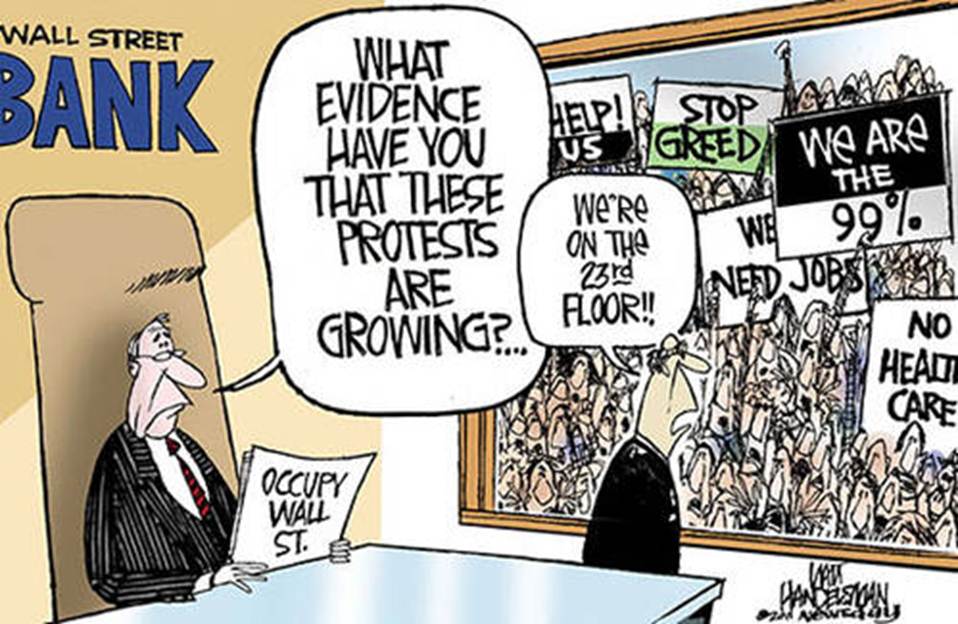
Why Are People Demonstrating in the Street

Here's a very simple, dollars-and-cents reason why the American people are angry and the Occupy Wall Street movement is growing. From a post by Paul Krugman on his NY Times blog:
Here, from the CBO report, are the changes, in percentage points, of the shares of income going to three groups. The top quintile excluding the top 1 percent – which is basically the abode of the well-educated who aren’t among the very lucky few – has only kept pace with the overall growth in incomes. Just about all of the redistribution has taken place from the bottom 80 to the top 1 (and we know that most of that has actually gone to the top 0.1).

Click to Enlarge

It’s a tiny minority, not a broad class of well-educated Americans, who have been winning here.
For over 30 years the bottom of the social order has been taking it on the chin as those in the top 1% (actually the top 0.1%) has bought politicians and corrupted the system to ensure their own "success". The cherry on top is the 2008 financial crisis. This was manufactured by Wall Street, it was fraud on an inhuman scale, they crashed the world economy, they got bailed out by the US taxpayer, and they even got to keep their multi-million dollar "bonuses for a job well done". Meanwhile, Main Street has been clobbered and is still flat on the mat 3 years later with no recovery in sight. No banker has gone to jail. No ratings agency executives have gone to jail for stamping junk mortagages as AAA "investments". That's why people are angry.

Here's Matt Taibbi characterizing this crappy situation:
Occupy Wall Street has not yet inspired many true villains outside of fringe characters like Anthony Bologna, but Bloomberg, with this one decision to trot out this preposterous schlock about congress forcing banks to lend to poor people, may yet make himself the face of the 1%’s intellectual corruption.

This whole notion that the financial crisis was caused by government attempts to create an "ownership society" and make mortgages more available to low-income (and particularly minority) borrowers has been pushed for some time by dingbats like Rush Limbaugh and Sean Hannity, who often point to laws like the 1977 Community Reinvestment Act as central villains in the crash drama.

But Rush Limbaugh and Sean Hannity are at least dumb enough that it is theoretically possible that they actually believe the crash was caused by the CRA, Barney Frank, and Fannie and Freddie.

On the other hand, nobody who actually understands anything about banking, or has spent more than ten minutes inside a Wall Street office, believes any of that crap. In the financial world, the fairy tales about the CRA causing the crash inspire a sort of chuckling bemusement, as though they were a tribal bugaboo explaining bad rainfall or an outbreak of hoof-and-mouth, a legend good for scaring the masses.

But nobody actually believes them. Did government efforts to ease lending standards put a lot of iffy borrowers into homes? Absolutely. Were there a lot of people who wouldn’t have gotten homes twenty or thirty years ago who are now in foreclosure thanks to government efforts to make mortgages more available? Sure – no question.

But did any of that have anything at all to do with the explosion of subprime home lending that caused the gigantic speculative bubble of the mid-2000s, or the crash that followed?

Not even slightly. The whole premise is preposterous. And Mike Bloomberg knows it.

In order for this vision of history to be true, one would have to imagine that all of these banks were dragged, kicking and screaming, to the altar of home lending, forced against their will to create huge volumes of home loans for unqualified borrowers.

In fact, just the opposite was true. This was an orgiastic stampede of lending, undertaken with something very like bloodlust. Far from being dragged into poor neighborhoods and forced to give out home loans to jobless black folk, companies like Countrywide and New Century charged into suburbs and exurbs from coast to coast with the enthusiasm of Rwandan machete mobs, looking to create as many loans as they could.

They lent to anyone with a pulse and they didn’t need Barney Frank to give them a push. This was not social policy. This was greed. They created those loans not because they had to, but because it was profitable. Enormously, gigantically profitable -- profitable enough to create huge fortunes out of thin air, with a speed never seen before in Wall Street's history.

The typical profit-generating cycle of subprime lending took place without any real government involvement. Bank A (let’s say it’s Goldman, Sachs) lends criminal enterprise B (let’s say it’s Countrywide) a billion dollars. Countrywide then goes out and creates a billion dollars of shoddy home loans, committing any and all kinds of fraud along the way in an effort to produce as many loans as quickly as possible, very often putting people who shouldn’t have gotten homes into homes, faking their income levels, their credit scores, etc.

Goldman then buys back those loans from Countrywide, places them in an offshore trust, and chops them up into securities. Here they use fancy math to turn a billion dollars of subprime junk into different types of securities, some of them AAA-rated, some of them junk-rated, etc. They then go out on the open market and sell those securities to various big customers – pension funds, foreign trade unions, hedge funds, and so on.

The whole game was based on one new innovation: the derivative instruments like CDOs that allowed them to take junk-rated home loans and turn them into AAA-rated instruments. It was not Barney Frank who made it possible for Goldman, Sachs to sell the home loan of an occasionally-employed janitor in Oakland or Detroit as something just as safe as, and more profitable than, a United States Treasury Bill. This was something they cooked up entirely by themselves and developed solely with the aim of making more money.

The government’s efforts to make home loans more available to people showed up in a few places in this whole tableau. For one thing, it made it easier for the Countrywides of the world to create their giant masses of loans. And secondly, the Fannies and Freddies of the world were big customers of the banks, buying up mortgage-backed securities in bulk along with the rest of the suckers. Without a doubt, the bubble would not have been as big, or inflated as fast, without Fannie and Freddie.

But the bubble was overwhelmingly built around a single economic reality that had nothing to do with any of that: new financial instruments made it possible to sell crap loans as AAA-rated paper.

Fannie and Freddie had nothing to do with Merrill Lynch selling $16.5 billion worth of crap mortgage-backed securities to the Connecticut Carpenters Annuity Fund, the Mississippi Public Employees' Retirement System, the Connecticut Carpenters Pension Fund, and the Los Angeles County Employees Retirement Association. Citigroup and Deutsche Bank did not need to be pushed by Barney Frank and Nancy Pelosi to sell hundreds of millions of dollars in crappy MBS to Allstate.

And Goldman did not need Franklin Raines to urge them to sell $1.2 billion in designed-to-fail mortgage-backed instruments to two of the country’s largest corporate credit unions, which subsequently went bust and had to be swallowed up by the National Credit Union Administration.

These banks did not need to be dragged kicking and screaming to make the billions of dollars in profits from these and other similar selling-baby-powder-as-coke transactions. They did it for the money, and they did it because they did not give a fuck who got hurt.

Who cares if some schmuck carpenter in Connecticut loses the pension he’s worked his whole life to save? Who cares if he’s now going to have to work until he’s seventy, instead of retiring at fifty-five? It’s his own fault for not knowing what his pension fund manager was buying.

And, of course, in a larger sense, the entire crisis was the fault of that janitor in Oakland, who took out too big of a loan, with the help of do-gooder liberals in congress and their fans in bleeding-heart liberal la-la land – you know, the same people Bloomberg wowed with his hep jokes about Snooki and Charlie Sheen.

This is the evil lie Bloomberg is now trying to dump on the Occupy movement. And the mayor put a cherry on the top of his Marie-Antoinette act with the rest of his speech:
"But [congress] were the ones who pushed Fannie and Freddie to make a bunch of loans that were imprudent, if you will. They were the ones that pushed the banks to loan to everybody. And now we want to go vilify the banks because it's one target, it's easy to blame them and congress certainly isn't going to blame themselves. At the same time, Congress is trying to pressure banks to loosen their lending standards to make more loans. This is exactly the same speech they criticized them for."

Bloomberg went on to say it's "cathartic" and "entertaining" to blame people, but the important thing now is to fix the problem.
Jesus … I mean, for one thing, Fannie and Freddie don’t even make loans. That’s how absurd this whole thing is.

And the condescension levels here are unbelievable, his air of aristocratic superiority almost breathtaking to behold. Listen to Bloomberg paternally conceding in one breath that it is certainly nice that some struggling people now have homes ("I'm not saying I'm sure that was terrible policy, because a lot of those people who got homes still have them and they wouldn't have gotten them without that"), just before chiding us with the next that there are sometimes negative consequences to doing something that sounds like goodness, like giving people a place of their own to live.

And then there’s this whole line in which he professes to indulgently understand the need for the "catharsis" and "entertainment" of protest, again almost like a Dad who tells his idiot teenage son that he understands the need to sow a wild oat or two, but please don’t wreck the family Mercedes next time.

Well, you know what, Mike Bloomberg? FUCK YOU. People are not protesting for their own entertainment, you asshole. They’re protesting because millions of people were robbed, by your best friends incidentally, and they want their money back. And you’re not everybody’s Dad, so stop acting like you are.
And the real kicker to this depressing story: the American people voted for "change you can believe in" with Barack Obama, but he has delivered more Wall Street fraud and criminality. It is under Obama's watch that the banks have used "robo-signing" fraud to cheaply toss people out of homes, even people who don't have a mortgage and who legally fully own their own homes. The banks don't care. They are in a hurry and a little fraud here and a little crime there, big deal! Obama seems to agree. No bank has been indicted or charged for the pre-2009 fraud and certainly none has been charged for the 2009 through 2011 robo-signing frauds.

So... what are people to do? The two major political parties are bought-and-sold to the top 0.1%. The only recourse is to go to the street and fight to get the country out of the hands of criminals, to fight and stop America on its slippery slope to becoming a banana republic. It is a desperate battle, but it must be won. There is no other choice.

Wednesday, November 2, 2011

Education & Income in America

Poor Paul Krugman. He is trying to fight the noise machine that the political right in the US uses to fool people into voting for Republican "ideas".

Here is a post in his NY Times blog pointing out that income is only loosely tied to education. The real big bucks are going to a tiny 0.1% elite who have a stranglehold on the economy (and politics):
A Mind Is A Terrible Thing To Lose

OK, I see that some people are doubling down on the claim that rising inequality is all about education — when what the CBO report drives home is that this is all wrong, the big increase has come from gains at the very top. I have to admit that I have a sneaking suspicion that this is in part driven by KDS (DS for derangement syndrome): some people will rush to take a position precisely because I have debunked it. But anyway, it’s really, really wrong.

Here’s the CBO result:

Click to Enlarge

Notice that the 81-99 percentiles have seen only modest gains; it’s really the top 1 percent that drives the story.

For comparison, here’s some data on wages of men by education from EPI:

Click to Enlarge

Not the perfect comparison, but good enough. Notice the difference in scales. College graduates have made only modest gains, and basically nothing after 2000; even advanced degrees weren’t giving anything like the gains we see for the top 1 percent (and the much bigger gains of the top 0.1 percent).

Yes, college grads have done better than non; but inequality in America is mainly a story about a small elite pulling away from everyone else, including ordinary college grads. And we’ve know this for a long time! There is no excuse for getting it wrong.
There is a modest effect of more education leading to more income. But that is swamped by the effect of being in the top 0.1%. I'm sure the top 0.1% have wonderful college degrees, but the degree isn't what makes them the money. It is the fact that they are in an elite position which lets them milk the system for the really big bucks.

The Robber Barons of the past didn't make their big money because of advanced degrees. They made it because they found ways to get a stranglehold on some key point in the economy and extort big bucks for themselves.

Positive News on the Political Front

From a post by Robert Reich on his blog:
A combination of police crackdowns and bad weather are testing the young Occupy movement. But rumors of its demise are premature, to say the least. Although numbers are hard to come by, anecdotal evidence suggests the movement is growing.

As importantly, the movement has already changed the public debate in America.

Consider, for example, last week’s Congressional Budget Office report on widening disparities of income in America. It was hardly news – it’s already well known that the top 1 percent now gets 20 percent of the nation’s income, up from 9 percent in the late 1970s.

But it’s the first time such news made the front page of the nation’s major newspapers.

Why? Because for the first time in more than half a century, a broad cross-section of the American public is talking about the concentration of income, wealth, and political power at the top.

Score a big one for the Occupiers.

Even more startling is the change in public opinion. Not since the 1930s has a majority of Americans called for redistribution of income or wealth. But according to a recent New York Times/CBS News poll, an astounding 66 percent of Americans said the nation’s wealth should be more evenly distributed.

A similar majority believes the rich should pay more in taxes. According to a Wall Street Journal/NBC News poll, even a majority of people who describe themselves as Republicans believe taxes should be increased on the rich.

I remember the days when even raising the subject of inequality made you a “class warrior.” Now, it seems, most Americans have become class warriors.

And they blame Republicans for stacking the deck in favor of the rich. In that New York Times/CBS News poll, 69 percent of respondents said Republican policies favor the rich (28 percent said the same of Obama’s policies).
I sure hope this signifies a sea change in American politics. The pendulum has swung too long and too far to the side of the elites and against the "ordinary people". It is time to redress the inequality and injustice.
The old view was also that great wealth trickled downward – that the rich made investments in jobs and growth that benefitted all of us. So even if we doubted we’d be wealthy, we still gained from the fortunes made by a few.

But that view, too, has lost its sheen. Nothing has trickled down. The rich have become far richer over the last three decades but the rest of us haven’t. In fact, median incomes are dropping.

Wall Street moguls are doing better than ever – after having been bailed out by the rest of us. But the rest of us are doing worse. CEOs are hauling in more than 300 times the pay of average workers (up from 40 times the pay only three decades ago), as average workers lose jobs, wages, and benefits.

Instead of investing in jobs and growth, the super rich are putting their money into gold or Treasury bills, or investing it in Brazil or South Asia or anywhere else it can reap the highest return.

Meanwhile, it’s dawning on Americans that in the real economy (as opposed to the financial one) our spending is vital. And without enough jobs or wages, that spending is drying up.

The economy is in trouble because so much income and wealth have been going to the top that the rest us no longer have the purchasing power to buy the goods and services we would produce at or near full employment.
Hopefully the new view is that "it takes a village to raise a child" so there will be more emphasis on education and job training, on fair wages and a minimum wage, and on social services for those who are falling behind through no fault of their own. The bottom 99% need to be re-booted so they can compete and get their fair share of the wealth of the society. The funny thing is: if you do this everybody prospers! But showering special deals and tax breaks on the rich impoverishes the bottom 99% and destroys the broader society.

Saturday, October 29, 2011

Stopgaps and Half Measures

Here is a bit from an article in the NY Magazine on the rising inequality in the US and the failure of policy makers to either admit the problem exists or come up with any policy to effectively deal with the problem. The Republicans deny it exists and the Democrats are willing only to propose partial remedies:
Over the last few decades, income growth for most Americans has slowed to a crawl, while income for the very rich has exploded. That’s a reversal of the three decades following World War II, when all income groups got richer, with the poor and middle class rising at a faster rate than the rich. Crucially, the Congressional Budget Office’s new analysis shows that changes in government policy over this period have made inequality worse. (In CBO-speak: “The equalizing effect of transfers and taxes on household income was smaller in 2007 than it had been in 1979.”)

We’re not having a debate about how to reverse or even stop the growth of inequality. Nobody has a real plan to do that. The Democratic plan is to slightly arrest the growth of inequality by hiking taxes on the rich a few percentage points, so as to minimize the need to cut the social safety net. The Republican plan is to slash taxes for the rich and programs for the poor, thereby massively increasing inequality.

That is a hard position to defend in the context of exploding inequality, and conservatives would rather not defend it. Instead the right’s response has been to persistently deny or ignore the facts. Rick Perry, pressed by a reporter to explain why he was proposing a tax plan that would widen income inequality further, replied, "I don’t care about that." The Wall Street Journal editorial page today dismissed the Tax Policy Center, whose calculations persistently show the ways in which various Republican tax proposals would widen inequality, as “liberal.” It didn’t even pretend to dispute the substance of the calculations. Eric Cantor gave a speech about income inequality centering on stories about how his grandmother worked hard and pulled herself up by the bootstraps in the old days. It was a nice speech if you like stories about plucky grandmothers. It failed to grasp the central dilemma, which is that it was a lot easier for poor people to move up sixty years ago, when tax rates on the rich happened to be far higher, than it is today.

...

The way to understand Ryan is that he’s deeply influenced by the theories of Ayn Rand, who believed that the root of all evil lay in attempts to alter the wealth distribution created by the free marketplace. Rand may have been a deranged cult leader, but she did live at a time when the fear of the poor devouring the rich had an actual real-world basis. She escaped communist Russia for the United States, Franklin Roosevelt — while not a reprise of the communists, as she mistakenly believed — really did denounce the rich and impose confiscatory tax rates. The world of Rand’s imagination bore a slight resemblance to the world she inhabited, but it bears no resemblance to the contemporary United States.

Ryan cannot process the realities of this world because they are so at odds with the imagined world of his ideology. After his speech, he was asked about the CBO’s report on inequality, and he brushed it off, falling back on Rand-esque lingo the virtuous rich (“takers”) and parasitic poor (“makers”):
“Let’s not focus on redistribution, let’s focus on upward mobility,” he said. “If these studies are used as justification for erecting new and more barriers for making it harder for people to rise, all that will do is reduce our prosperity in this country.”

“We’re coming close to a tipping point in America where we might have a net majority of takers versus makers in society and that could become very dangerous if it sets in as a permanent condition.
Don’t confuse Paul Ryan with the facts. If studies run up against Ryan’s ideology, then the studies must give way.
Sadly, the politics in America a deeply dysfunctional. No major party is addressing the concerns of the 99% so clearly visible in the Occupy Wall Street movement.


Wednesday, October 26, 2011

Examining Income Inequality

Here are some bits from an excellent article by Glenn Greenwald in The Nation:
Yet from 1980 to 2005, more than 80 percent of total increase in Americans' income went to the top 1 percent. Economic growth was more sluggish in the aughts, but the decade saw productivity increase by about 20 percent. Yet virtually none of the increase translated into wage growth at middle and lower incomes, an outcome that left many economists scratching their heads.

The 2008 financial crisis exacerbated the trend, but not radically: the top 1 percent of earners in America have been feeding ever more greedily at the trough for decades.

...

Not only have the overwhelming majority of Americans long acquiesced to vast income and wealth disparities, but some of those most oppressed by these outcomes have cheered it loudly. Americans have been inculcated not only to accept but to revere those who are the greatest beneficiaries of this inequality.

In the 1980s, this paradox—whereby even those most trampled upon come to cheer those responsible for their state—became more firmly entrenched. That’s because it found a folksy, friendly face, Ronald Reagan, adept at feeding the populace a slew of Orwellian clichés that induced them to defend the interests of the wealthiest. “A rising tide,” as President Reagan put it, “lifts all boats.” The sum of his wisdom being: it is in your interest when the rich get richer.

Implicit in this framework was the claim that inequality was justified and legitimate. The core propagandistic premise was that the rich were rich because they deserved to be. They innovated in industry, invented technologies, discovered cures, created jobs, took risks, and boldly found ways to improve our lives. In other words, they deserved to be enriched. Indeed, it was in our common interest to allow them to fly as high as possible because that would increase their motivation to produce more, bestowing on us ever greater life-improving gifts.

...

This is the mentality that enabled massive growth in income and wealth inequality over the past several decades without much at all in the way of citizen protest. And yet something has indeed changed. It’s not that Americans suddenly woke up one day and decided that substantial income and wealth inequality are themselves unfair or intolerable. What changed was the perception of how that wealth was gotten and so of the ensuing inequality as legitimate.

Many Americans who once accepted or even cheered such inequality now see the gains of the richest as ill-gotten, as undeserved, as cheating. Most of all, the legal system that once served as the legitimizing anchor for outcome inequality, the rule of law—that most basic of American ideals, that a common set of rules are equally applied to all—has now become irrevocably corrupted and is seen as such.
If you watch the popular media closely you will see that they try to discredit the OWS movement by claiming it is driven by envy, that these are all "hippies and ne'er do wells who are jealous of the rich". The point Glenn Greenwald is making sets this right: the American people are not against the rich, they are against the rich buying the politicians and getting "special rules" to exempt them for punishment when they commit financial crimes that blow up the economy.
Today, it is glaringly obvious to a wide range of Americans that the wealth of the top 1 percent is the byproduct not of risk-taking entrepreneurship but of corrupted control of our legal and political systems. Thanks to this control, they can write laws that have no purpose than to abolish the few limits that still constrain them, as happened during the Wall Street deregulation orgy of the 1990s. They can retroactively immunize themselves for crimes they deliberately committed for profit, as happened when the 2008 Congress shielded the nation’s telecom giants for their role in Bush’s domestic warrantless eavesdropping program.

It is equally obvious that they are using that power not to lift the boats of ordinary Americans but to sink them. In short, Americans are now well aware of what the second-highest-ranking Democrat in the Senate, Illinois’s Dick Durbin, blurted out in 2009 about the body in which he serves: the banks “frankly own the place.”

If you were to assess the state of the union in 2011, you might sum it up this way: rather than being subjected to the rule of law, the nation’s most powerful oligarchs control the law and are so exempt from it; and increasing numbers of Americans understand that and are outraged. At exactly the same time that the nation’s elites enjoy legal immunity even for egregious crimes, ordinary Americans are being subjected to the world's largest and one of its harshest penal states, under which they are unable to secure competent legal counsel and are harshly punished with lengthy prison terms for even trivial infractions.
The OCW people are in the streets because:
In lieu of the rule of law—the equal application of rules to everyone—what we have now is a two-tiered justice system in which the powerful are immunized while the powerless are punished with increasing mercilessness. As a guarantor of outcomes, the law has, by now, been so completely perverted that it is an incomparably potent weapon for entrenching inequality further, controlling the powerless, and ensuring corrupted outcomes.

...

That is what has changed, and a growing recognition of what it means is fueling rising citizen anger and protest. The inequality under which so many suffer is not only vast, but illegitimate, rooted as it is in lawlessness and corruption. Obscuring that fact has long been the linchpin for inducing Americans to accept vast and growing inequalities. That fact is now too glaring to obscure any longer.
The battle lines are drawn. The struggle begins. Sadly both political parties have defected to the 1%. So this will be a long and bitter struggle.

A Voice from the 1%

This is refreshing. Here is a post on The Daily Kos from someone who says he is part of the 1% but understands why the Occupy Wall Street movement is growing:
The impetus behind the Occupy Wall Street movement - a vague sense that the rich are getting ever richer while everyone else suffers - was confirmed by a recent report from the Social Security Administration showing that while total employment and average wages remained stagnant, the number of people earning $1 million or more grew by 18% from 2009 to 2010. Those figures give real substance to the "We are the 99%" slogan, yet Republicans continue to insist, despite all evidence to the contrary, that if anything those "job creators" deserve an even greater share of our national income. The Tea Party, meanwhile, has launched its own "53%" movement, inexplicably rallying the working class to the defense of the wealthy. The one group rarely heard from in this rancorous debate is the 1%, whose incomes and taxes are its focus. I am one of them, and here is my perspective, which may surprise you.

First let me note that I am not part of the yacht and private jet set, which represents an even smaller subset of incomes than mine. The threshold for inclusion in the top 1% of income earners in 2008, the most recent year for which published data is available from the IRS, was $380,354, enough for an extraordinary life but nowhere near enough for a harbor berth in St. Moritz. Nevertheless, I am - for now - comfortably ensconced in that demographic. Herman Cain's 9-9-9 plan would save me roughly $400,000 a year in taxes, and President Obama's tax proposals would cost me more than $100,000, yet I support the latter and consider the former laughable.

Thus you can imagine my amazement this summer when I watched the Republicans in Congress push the United States to the brink of default - and the world to the brink of ruin - over whether to repeal a portion of the Bush tax cuts and raise my taxes by 3.5%. I know a lot of people with high incomes and even the conservatives among them were confused by that sequence of events. Here is a secret about rich people: we wouldn't have noticed a 3.5% tax increase. That is not only because there isn't a material difference between having $1 million and $965,000, which is obvious, but also because most of us don't actually know how much money we are going to make in a given year. Most income at that level is the result of profits rather than salary, whether it comes in the form of bonuses, stock options, partnership distributions, dividends or capital gains. Profits are unpredictable and they tend to vary wildly. At my own firm, the general rule of thumb is that if we are within 5% of our budget for the year, everyone is happy and no one complains. A variation of 3.5% is merely a random blip.

I was not amazed but disgusted when John Boehner and his crew tried to justify the extremity of their position by rebranding the wealthy as "job creators." While true in a very basic sense, it obscures the fact that jobs are a cost that is voluntarily incurred only as a result of demand. Hiring has no correlation at all to profits or to income - none. Let me keep more of my money without increasing customer demand and I will do just that - keep it. Perhaps I will spend a little more of it, though probably not, but even if I do it won't help the economy very much. Here is another secret of the well-to-do: we don't really buy much more stuff than everyone else. It may be more expensive stuff, sure, but I don't buy cars, or appliances, or furniture, or anything else more frequently than the average consumer. The things I do spend more money on are services such as travel, entertainment, restaurants and landscaping, none of which generate well-paying middle class jobs. There, in a nutshell, is the sad explanation of what has happened to the American economy over the last 25 years of "trickle down" economics.

That's why I was so pleased when the Occupy Wall Street protests began. I support them wholeheartedly, for several reasons. ...
Go read the whole post to find out what his reasons are! He has an interesting life story that is well worth reading and he makes many points worth pondering.

Thursday, October 20, 2011

What Obama Hath Wrought


Here is an article on David Cay Johnston's blog at Reuters:
Anyone who wants to understand the enduring nature of Occupy Wall Street and similar protests across the country need only look at the first official data on 2010 paychecks, which the U.S. government posted on the Internet on Wednesday.

There were fewer jobs and they paid less last year, except at the very top where, the number of people making more than $1 million increased by 20 percent over 2009.

The median paycheck — half made more, half less — fell again in 2010, down 1.2 percent to $26,364. That works out to $507 a week, the lowest level, after adjusting for inflation, since 1999.

The number of Americans with any work fell again last year, down by more than a half million from 2009 to less than 150.4 million.

Click to Enlarge


The number of workers making $1 million or more rose to almost 94,000 from 78,000 in 2009. However, that was still below some earlier years, including 2007, when more than 110,000 workers made more than $1 million each.
At the very top, the number of workers making more than $50 million rose in 2010 to 81, up from 72 the year before. But average pay in this group declined $4.5 million to $79.6 million.

What these figures tell us is that there was a reason voters responded in the fall of 2010 to the Republican promise that if given control of Congress they would focus on one thing: jobs.

But while Republicans were swept into the majority in the House of Representatives, that promise has been ignored.
Not only has no jobs bill been enacted since January, but the House will not even bring up for a vote the jobs bill sponsored by President Obama. His bill is far from perfect, but where is the promised Republican legislation to get people back to work?

Instead of jobs, the focus on Capitol Hill is on tax cuts for corporations with untaxed profits held offshore, on continuing the temporary Bush administration tax cuts — especially for those making $1 million or more – and on cutting federal spending, which mean destroying more jobs in the short run.

...

More of the same approach we have had for most of the last three decades and all of the last ten years is not going to increase demand, create more jobs or enable overall prosperity. In the long run, continuing current policies will make even the richest among us less well off than they would be in a robust economy with government policies that foster job creation and the capital investment that grows from increased demand.

On top of this are the societal problems caused by something the United States has never experienced before, except during the Depression — chronic, long-term unemployment.

Having millions who want work go years without a single day on a payroll is more than just a waste of talent and time. It also can change social attitudes about work and not for the better.

The data show why protests like Occupy Wall Street have so quickly gained momentum around the country, as people who cannot find work try to focus the federal government on creating jobs and dealing with the banking sector that many demonstrators blame for the lack of jobs.

Will official Washington look at the numbers and change course? Or do voters need to change their elected representatives if they want to put America back on a path to widespread prosperity?
There is much more. Go read the original article by David Cay Johnston.

Voters in 2008 supposedly elected Obama to fix this problem. Obama came in knowing he had the worst recession since the Great Depression on his hands, but he failed to act strongly. He did a half-hearted "stimulus". He catered to Wall Street rather than Main Street. Read Ron Suskind's "Confidence Men" if you want to understand how and why Obama failed the American people.

Occupy Wall Street Goes Global

Here is a video clip covering Occupy Wall Street around the world. They note that over 1000 cities have spin-off demonstrations.


I like this coverage by the RT network, but I do find it ironic that this is Russian TV and they report "no demonstrations" in Russia.

How odd. Is there no 99% vs 1% split in Putin's autocracy? I can't swallow that. This is an example of one national TV service bashing other countries. RT is free to bash others using its "open" coverage. But they are not free comment on Russia. Putin's censorship keeps the situation in the home country utterly opaque.

What I do know about Russia is that, if you try to be an independent journalist, you will be killed by the KGB (now FSB). Putin supports "glasnost" for the rest of the world, but not for his oppressed people.

Tuesday, October 18, 2011

Inside Job

I watched the documentary Inside Job tonight. It is an excellent review of the fraud and corruption behind the 2008 financial crisis. The film makes it very clear that the entire industry is corrupt and it has completely corrupted the government including both major parties in the US.


If you want to understand the Occupy Wall Street protests, watch this film!

If you want to understand the true scope of the crime of the Wall Street bankers, go look at these pictures and read the stories of these people.

And here is MSNBC's Dylan Ratigan praises the movie Inside Job and briefly talks to the director Charles Ferguson and to Bill Black, the 1990s savings & loan regulator who cleaned up that mess and has been publishing lots and lots on the 2008 fraud and corruption:


Go watch this movie. I borrowed my copy from the library. Go get your hands on it and watch it!

Thursday, October 13, 2011

America's War of 1% Against the 99%

Here is a bit from a Bloomberg News report:
A widening gap between rich and poor is reshaping the U.S. economy, leaving it more vulnerable to recurring financial crises and less likely to generate enduring expansions.

Left unchecked, the decades-long trend toward increasing inequality may condemn Wall Street to a generation of unimpressive returns and even shake social stability, economists and financial-industry executives say.

“Income inequality in this country is just getting worse and worse and worse,” James Chanos, president and founder of New York-based Kynikos Associates Ltd., told Bloomberg Radio this week. “And that is not a recipe for stable economic growth when the rich are getting richer and everybody else is being left behind.”

Since 1980, about 5 percent of annual national income has shifted from the middle class to the nation’s richest households. That means the wealthiest 5,934 households last year enjoyed an additional $650 billion -- about $109 million apiece -- beyond what they would have had if the economic pie had been divided as it was in 1980, according to Census Bureau data.

Disputes over what constitutes economic fairness are moving to center stage amid a near-stagnant U.S. economy saddled with 9.1 percent unemployment yet boasting record corporate profits. President Barack Obama last month targeted “the wealthiest taxpayers and biggest corporations” for higher taxes, saying they should pay “their fair share.” That drew charges of “class warfare” from House Speaker John Boehner of Ohio.
The legacy or right wing politics, starting with Nixon in 1968 are obvious:
Since 1968, incomes in the U.S. have become steadily less equally distributed, according to the standard statistical measure of inequality known as the Gini coefficient. The U.S. Gini score rose from .39 in 1968 to .47 in 2010, meaning that incomes were becoming increasingly unequal.
And:
The typical American household, meanwhile, has yet to regain the ground it lost during the recession. The median income of $49,445 at the end of 2010 remained below the level reached in 1997.
And:
Raghuram Rajan, the IMF’s former chief economist, says countries with high levels of inequality tend to produce ineffective economic policies. Political systems in economically divided countries grow polarized and immobilized by the sort of zero-sum politics now gripping Washington, he said.
And:
The government’s response to the financial crisis may also have exacerbated the rich-poor gap by shifting liabilities from private banks to taxpayers. Households and businesses have trimmed their debts since the 2008 peak while government borrowing -- to recapitalize the nation’s banks and battle the recession -- has exploded.

As a result, total domestic nonfinancial sector debt topped $36.5 trillion at mid-year, compared with $32.4 trillion in mid- 2008. And that massive load leaves the economy vulnerable to future shocks.

“In the current climate, if nothing is done about income inequality there may be recurring crises,” says Kumhof, adding: “Leverage has not significantly improved. In terms of the danger of another crisis, we’re right back where we started.”
The problem is obvious and the people are in the street. Tragically the White House is occupied by an aloof, distant, non-politician more interested in "compromise" than in "solutions". It is looking like a situation where nothing will happen until enough blood runs in the streets to force the dithering politicians to "do their duty" and address the economic woes and return the American dream to people. Sad. An activist leader would be out in front of the mobs and defusing the situation. But Obama will dither until things boil over.

The Bloomberg article is excellent. Go read the whole thing.

Wednesday, October 12, 2011

Educating a 15 Year Old Daughter

Here is the sad tale of a father trying to arm his daughter to the ugly future she faces. He walks her through Wall Street and explains the real "facts of life"...

Click to Enlarge
For my daughter’s benefit, so that she might know the enemy better, know what he looks like, where he nests, and when and where to throw eggs at his head, we start the tour at Wall Street. It’s hot. August. We’re sweating like old cheese.

Here are the monuments that matter, I tell her: the offices of Deutsche Bank and Bank of New York Mellon; the JPMorgan Chase tower up the block; around the corner, the AIG building. The structures dwarf us, imposing themselves skyward.

“Linked together like rat warrens, with air conditioning,” I tell her. “These are dangerous creatures, Léa. Sociopaths.”

She doesn’t know what sociopath means.

“It’s a person who doesn’t care about anybody but himself. Socio, meaning society—you, me, this city, civilization. Patho, like pathogen—carrying and spreading disease.”

Long roll of eyes.

I’m intent on making this a teachable moment for my daughter, who is fifteen, but I have to quit the vitriol, break it down for her. I have to explain why the tour is important, what it has to do with her, her friends, her generation, the future they will grow up into.

On a smaller scale, I want Léa to understand what New York, my birthplace and home, once beloved to me, is really about. Because I’m convinced that the beating heart of the city today is not its art galleries, its boutiques, its restaurants or bars, its theaters, its museums, nor its miserable remnants in manufacturing, nor its creative types—its writers, dancers, artists, sculptors, thinkers, musicians, or, god forbid, its journalists.

“Here,” I tell her, standing in the canyons of world finance, “is what New York is about. Sociopaths getting really rich while everyone else just sits on their asses and lets it happen.”
Go read the whole article and weep.

The article references this study: Grow Together or Pull Further Apart?

The author, Chrisopher Ketcham makes this point:
But here’s the most astonishing fact: the One Percenters consist of just 34,000 households, about 90,000 people. Relative to the great mass of New Yorkers—9 million of us—they’re nobody. We could snow them under in a New York minute.

And yet the masses—the fireman, the policeman, the postal worker, the teacher, the journalist, the subway conductor, the construction worker, the social worker, the engineer, the architect, the barkeep, the musician, the receptionist, the nurse—have been the consistent losers since 1990. The real hourly median wage in New York between 1990 and 2007 fell by almost 9 percent. Young men and women aged twenty-five to thirty-four with a bachelor’s degree and a year-round job in New York saw their earnings drop 6 percent. Middle-income New Yorkers—defined broadly by the FPI as those drawing incomes between approximately $29,000 and $167,000—experienced a 19 percent decrease in earnings. Almost 11 percent of the population, about 900,000 people, live in what the federal government describes as “deep poverty,” which for a four-person family means an income of $10,500 (the average One Percenter household in New York makes about that same amount every day). About 50 percent of the households in the city have incomes below $30,000; their incomes have also been steadily declining since 1990. During the gala boom of 2002–07, the trend was unaltered: the average income in the bottom 95 percent of New York City households declined.
How can 34,000 households talk the other 9 million to let them pick their pockets? By political persuasion. For 40 years those 9 million have been told that if they agree to "just one more tax cut for the 'job creators' the economy will blossom and you will do better". When that fails, they simply repeat the message and get yet another tax cut. Even after the 1990 bubble busting, the 2000 bubble busting, and the 2008 bubble busting, the political right continues to sell the same message and still mesmerize the bottom 9 million with the promise that just a little more sacrifice, just one more tax cut for the rich, will deliver the New Jerusalem. It hasn't. It won't. It is political Kool-Aid!

Example of How the Ultra-Rich are Out-to-Lunch

Here is a post by Paul Krugman pointing out that the self-pity of the over-paid on Wall Street is shocking because (a) it is so ridiculous given how wildly inflated their remuneration is and (b) it is so out-of-touch with the very real harm that their financial "engineering" has caused to the overall economy:
A wonderful juxtaposition:

Max Abelson reports on the sorrows of the financial elite:
An era of decline and disappointment for bankers may not end for years, according to interviews with more than two dozen executives and investors. Blaming government interference and persecution, they say there isn’t enough global stability, leverage or risk appetite to triumph in the current slump.


Options Group’s Karp said he met last month over tea at the Gramercy Park Hotel in New York with a trader who made $500,000 last year at one of the six largest U.S. banks.

The trader, a 27-year-old Ivy League graduate, complained that he has worked harder this year and will be paid less. The headhunter told him to stay put and collect his bonus.

“This is very demoralizing to people,” Karp said. “Especially young guys who have gone to college and wanted to come onto the Street, having dreams of becoming millionaires.”
Meanwhile, Catherine Rampell reports on Bankers’ Salaries vs. Everyone Else’s, telling us that
the average salary in the industry in 2010 was $361,330 — five and a half times the average salary in the rest of the private sector in the city ($66,120). By contrast, 30 years ago such salaries were only twice as high as in the rest of the private sector.
It would all be hilariously funny if these people weren’t destroying the world.
I call the above the "Marie Antoinette" syndrome. The rich socialize with other rich. They always are jealous of somebody richer. They have completely lost contact with ordinary working class and middle class people. They simply don't realize that they live a pampered unreal life and that the policies they push (by bribing politicians!) are unsustainable.

I compare the current economic situation to a game of Monopoly. As one player owns most of the properties and has put houses or hotels on his properties, he soon gathers in all the money and forces the game to an end as he bankrupts everybody around him. The ultra-rich in the US are driving the entire country into bankruptcy because they want more, more, more! They want their taxes lower, lowered more, and lowered even more! They think nothing of tearing up the social contract to keep feathering their own nest. If the poor and middle classes complain and go out on the street like Occupy Wall Street protesters, this 1% elite accuse the bottom 99% of "class warfare"!