Sunday, September 25, 2011

Violence at Wall Street Demonstrations

Here is the title from an ABC News report: "‘Occupy Wall Street’ Protests Turn Violent; Video Shows Police Macing Women".

The obvious conclusion is that demonstratorss went berserk and the police had to resort to violence to contain the violence. Well... look for yourself:


These women are peacefully demonstrating, the police surround them with orange netting, then mace them. The only "violence" is the police.

ABC News has a title that misleads, then it starts its story with:
Video posted by the group Occupy Wall St from the eighth day of protests against corporations show police using Tasers and mace to control the crowd, which the group says has only made it more committed to keep up the demonstrations in lower Manhattan for the long haul.

A New York Police Department spokeswoman today confirmed the group’s claim that approximately 80 people were arrested Saturday, mainly for disorderly conduct and obstructing vehicular and pedestrian traffic.
The reader is left convinced the demonstrators "had it coming" because they were disorderly and confronting the police.

But if you watch the videos and read a little further into the article you find:
Among the video clips on the Occupy Wall Street website is one that shows a police officer macing a group of young women penned in by orange netting.
That is the full explanation for why the women were netted and maced. No violence. Nothing other than police arbitrarily imprisoning and then brutalizing them. But this is reported as "police restoring order". What?

ABC News goes on:
Another video has circulated of a police officer throwing a protester to the ground, though it is not clear why. The video shows the man standing in what seems to be a non-threatening manner before the incident.
Again, ABC News is presenting this as the police "restoring order" even as its very words show that the reporter sees no disorderly conduct other than police brutality. But ABC News maintains its sales job trying to present this as the poor overwhelmed police doing their best to deal with crazy mob violence.

You have to admire ABC News to sticking to its viewpoint even as it reports the opposite:
The website reported at least one protestor was arrested for taking photographs. An NYPD spokesman told ABC News Saturday that police were not targeting those with cameras.

Why are people demonstrating? It is for Occupy Wall Street

Meanwhile, in his Beat the Press blog, Dean Baker chastises the NY Times for its reporting about this event. The newspaper is cherry-picking what it reports to make the protests look ludicrous:
The NYT used its news section to mock critics of Wall Street. It presented the comments of some of the people protesting Wall Street. While the people quoted in this article do appear to be confused about the role of the financial industry in the economy, the paper would have no difficulty finding articulate critics of the financial industry.

For example, it could present the views of Nobel prize winning economist Joe Stiglitz. Or, it could present the views of Nobel prize winning economist, and NYT columnist, Paul Krugman. Or could interview Simon Johnson, a former chief economist at the International Monetary Fund.

It is not clear what news the NYT conveyed to its readers by by presenting the views of people who do not appear to be knowledgeable about the economy. This would be comparable to presenting the opinions of some of the more extreme people at a Tea Party rally as representative of the business community's arguments for lower taxes. This has not been done in the NYT or elsewhere.

Saturday, September 24, 2011

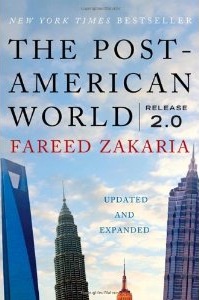
Fareed Zakaria's "The Post-American World 2.0"


This book is a fast read looking at America's relationship with the rest of the world. It focuses on two up-coming competitors, China and India. Zakaria says interesting things. This is a solid book. There are no big surprises and nothing controversial.

He takes the US to task for failing to live up to its ideals in the post-9/11 world. There is too much fear, too much security and too little civil liberties, and too much fear of "the other". He gives some solid advice. Again, pretty mainstream stuff.

Here's a bit to give you a taste of the book:
As it enters the twenty-first century, the United States is not fundamentally a weak economy, or a decadent society. But it has developed a highly dysfunctional politics. An antiquated and overly rigid political system to begin with -- about 225 years old -- has been captured by money, special interests, a sensationalist media, and ideological attack groups. The result is ceaseless, virulent debate about trivia -- politics as theater -- and very little substance, compromise, and action. A "can-do" country is now saddled with a "do-nothing" political process, designed for partisan battle rather than problem solving. By every measure -- the growth of special interests, lobbies, pork-barrel spending the political process has become far more partisan and ineffective over the last three decades.
And this:
To foreigners, American officials seem clueless about the world they are supposed to be running. "There are two sets of conversations, one with Americans in the room and one without," says Kishore Mahbubani, who was formerly Singapore's foreign secretary and ambassador to the United Nations. Because Americans live in a "cocoon," they don't see the "sea change in attitudes toward America throughout the world."
The book is a pleasant read. It won't startle you, but it does give a perspective on America that most Americans don't have. Zakaria was born in India and came to the US for college and never left. As an American with a unique background -- and a day job at Time magazine and CNN that lets him monitor the world and think about politics -- he has some useful things to say which other Americans should listen to.

As a Canadian I find it startling that not only is the average US citizen ignorant of the outside world, they are even poorly educated about their own history and political system. Every American needs to spend more time thinking about the role of America in the world. Turn off the political demagogues and read something thoughtful and get a broader understanding. Zakaria's book is a good place to start.

The Real History of Gold

Looking past the very short history of humans digging for gold, the real story of gold is the origin of the currently accessible gold. Here's the latest thinking:
During the formation of the Earth, molten iron sank to its centre to make the core. This took with it the vast majority of the planet's precious metals – such as gold and platinum. In fact, there are enough precious metals in the core to cover the entire surface of the Earth with a four metre thick layer.

The removal of gold to the core should leave the outer portion of the Earth bereft of bling. However, precious metals are tens to thousands of times more abundant in the Earth's silicate mantle than anticipated. It has previously been argued that this serendipitous over-abundance results from a cataclysmic meteorite shower that hit the Earth after the core formed. The full load of meteorite gold was thus added to the mantle alone and not lost to the deep interior.
I love the bit about paving the earth's surface 4 metres thick with gold. That should cause a panic attack among the gold bugs willing to pay $1900/ounce.

A Walk Down Memory Lane

Here is a documentary series on the 2008 financial crash entitled "Meltdown: The Secret History of the Global Financial Collapse".

This was done by the CBC (Canadian Broadcasting Company) and the homepage for the documentary is here and provides more information about the series.

Enjoy being an eyewitness -- from a Canadian perspective -- to the end of the world as we know it...

Part 1:


Part 2:


Part 3:


Part 4:


If you need an antidote to the above grim story, here is a bit from a post by Mark Thoma in his Economist's View blog:
It seems to me that the current crisis is, to a large extent, reversing the economics of hope. When workers look forward today, what do they see? Technical progress that will make them better off -- change that will elevate their standard of living -- or do they see a future where they'll be lucky to keep the job, benefits, and wage rates they currently enjoy (if they have a job at all)? Much of the rhetoric from the right -- from opposition to government trying to help to the age old worry that the rate of technological progress is slowing -- has been about "what you couldn't change," and pessimism about the future is as high as I can ever remember.

I refuse to give up. It's distribution, not production that has failed us over the last 30 or 40 years. We produce far more than we ever have, and we will continue to increase our ability to squeeze more and more out of the resources we have. We have the ability to produce enough stuff. But the distribution of the things we produce has been tilted toward the top. Instead of wages rising with productivity as our textbooks say they should, wages have stagnated and the rewards have gone elsewhere. Thus, while the pessimism of the past was about production not being able to keep up with population -- many classical economists looked forward to a long-run outcome of a dismal, stationary state with most people struggling at subsistence wages -- the pessimism of the present is driven largely by a failure of distribution. The haves get more and more, and the have nots get less and less even though overall output is rising. And to make it worse, those in power have successfuly promoted the idea that intervening to ensure that workers get to keep the share of output they've earned will harm our long-run growth prospects.

Pessimism about breaking through the wealth and power structures that stand in the way of change is understandable, as is the desire of the winners in our increasingly two-tiered society to keep the focus on growth rather than distribution. However, this outcome is not pre-ordained, it is not etched in stone, it's something we can fix without sacrificing our long-run growth prospects. But only if we refuse to buy into the narrative that the "it can't be changed so suck it up and deal with it" crowd is peddling.

The Anti-Libertarian Case

Here is a nice bit from Robert Paul Wolff's Credo that captures the complete falsity of a libertarian world view:
All of us eat grain we have not grown, fruit we have not planted, meat we have not killed or dressed. We wear clothes made of wool we have not combed and carded, spun or woven. We live in houses we have not built, take medicines we neither discovered nor produced, read books we have not written, sing songs we did not compose. Each of us is completely dependent on the inherited knowledge, skill, labor, and memory of all who have gone before us, and all who share the earth with us now.

We have a choice. We can acknowledge our interdependence, embracing it as the true human condition; or we can deny it, deluding ourselves into thinking that we are related to one another only as parties to a bargain entered into in a marketplace. We can recognize that we need one another, and owe to one another duties of generosity and loyalty. Or we can pretend to need no one save through the intermediation of the cash nexus.

I choose to embrace our interdependence. I choose to acknowledge that the food I eat, the clothes on my back, and the house in which I live are all collective human products, and that when any one of us has no food or clothing or shelter, I am diminished by that lack.
Sadly it is the crazy right wing libertarian viewpoint that dominates half of America, the half that applauds when a governor recites his "accomplishments" in executing people or a doctor/senator admits that if doesn't get paid he will quietly watch a man die because the only obligations he feels if for the money he makes off you.

Wolff offers up an alternate vision:
There are two images alive in America, competing for our allegiance. The first is the image of the lone horseman who rides across an empty plain, pausing only fleetingly when he comes to a settlement, a man apparently having no need of others, self-sufficient [so long as someone makes the shells he needs for his rifle or the cloth he needs for his blanket], refusing to acknowledge that he owes anything at all to the human race of which he is, nonetheless, a part.
The other is the image of the community that comes together for a barn-raising, working as a group on a task that no one man can do by himself, eating a communal meal when the day is done, returning to their homes knowing that the next time one of their number needs help, they will all turn out to provide it.

These images are simple, iconic, even primitive, but the choice they present us with remains today, when no one rides the plains any more, and only the Amish have barn-raisings. Today, as I write, there are tens of millions of Americans who cannot put a decent meal on the table in the evening for their families, scores of millions threatened with the loss of their homes. And yet, there are hundreds of thousands lavishing unneeded wealth on themselves, heedless of the suffering of their fellow Americans, on whose productivity, inventiveness, and labor they depend for the food they eat, the clothing they wear, the homes they live in, and also for the luxuries they clutch to their breasts.

The foundation of my politics is the recognition of our collective interdependence. In the complex world that we have inherited from our forebears, it is often difficult to see just how to translate that fundamental interdependence into laws or public policies, but we must always begin from the acknowledgement that we are a community of men and women who must care for one another, work with one another, and treat the needs of each as the concern of all.
I'm completely blown away by the cruelty of those who deny social entanglement of empathy and instead claim only the cold hard "money economy" as their only social relationship. I would hate to be the child of such a cruel and calculating parent. What good is a baby? What money can you make off it? I'm surprised that libertarians even bother to raise families because it goes so strongly against this political/social philosophy. But humans are not known for their consistency. They can espouse high ideals and secretly stab you in the back. Conversely, they can claim allegiance to the most vicious authoritarian ideals and still help the weak and defenseless. Humans are a puzzle.

Friday, September 23, 2011

Unraveling the Complexity of US Politics

What people say is not what they mean, especially politicians in the US. But even the electorate is sending mixed messages. Here's an attempt to unravel the complexity. Read these bits from an article by James Surowiecki in The New Yorker looking at Obama's "jobs plan" and the current political reality in the US:
There is no truer truism in American politics than James Carville’s catchphrase from the 1992 election “It’s the economy, stupid.” When people discuss Barack Obama’s current approval rating, which is at its lowest level ever, they may invoke his supposed lack of toughness or his tendency toward moderation, but the only really important factor is the dismal state of the U.S. job market. The American Jobs Act, which Obama is now promoting across the country, is an attempt to change this, by giving the economy a temporary boost with a mixture of tax cuts and government spending amounting to $447 billion. It’s an excellent idea: many independent analysts suggest that it could boost G.D.P. growth over the next year by 1.5 per cent or better, and create as many as one and a half million jobs. And it’s ideologically canny. A hefty chunk of it comes in the form of tax cuts, which Republicans typically love, and much of the rest would go toward more spending on infrastructure, which House Majority Leader Eric Cantor has expressed support for. Even so, it’s unlikely that House Republicans will pass the bill, and there’s a good chance that they’ll stop it even from coming up for a vote.

...

But people are underestimating a number of factors that could allow the G.O.P. to pursue an obstructive line without being much punished for it. To begin with, studies show that voters are more likely to hold politicians accountable for economic conditions when there’s “clarity of responsibility”—and responsibility for the economy now belongs to Obama and the Democrats. The recession started long before Obama took office. But, from a voter’s perspective, he had two years with sizable majorities in Congress to do something about it. While the 2009 stimulus plan succeeded in making the recession less awful than it might have been, you rarely get credit in politics for what didn’t happen. More important, in launching the plan, the President effectively took responsibility for the result. If you try to fix it, it’s yours.

...

It’s not that the Republican approach is popular: one recent Bloomberg poll found that forty-five per cent of those surveyed think congressional Republicans are responsible for the gridlock in Washington. But it seems to be working: for the past year and a half, the Party has consistently gone for a do-nothing approach and voters have consistently rewarded it. In the run-up to last year’s midterms, Republicans were explicit about their opposition to past, present, and future stimulus programs. They won a landslide victory. And, just last week, in two special elections for the House, Republican candidates who campaigned largely against Obama’s policies won seats in Nevada and New York by margins that were much bigger than expected. Americans may be saying that they want the government to use fiscal policy to get the economy moving again, but the way they vote tells a different story. Perhaps fourteen more months of economic stagnation and no job creation will change that. But, for now, it’s not only our representatives who are to blame. It’s ourselves.
So the story is complex. The Republicans profess a deep love of country but they are willing to block any attempt to revive the economy. The Democrats claim an eagerness to fix the economy but they put in place a stimulus which is too small and call it "adequate" and ignore the suffering. And to top it all off, the electorate wants to "send a message" but they use election results which will be read by the Republicans as a pat on the back and a "job well done!" when in fact the electorate is boiling with rage and feeling impotent. What a mess.

What the Republicans Have Wrought

It is amazing how effective the right wing politicians in the US have been in wrecking their own economy. They are doing this to plump up their chances of election because they reason that making things bad will cause the public to turn on the party that talk about sharing wealth and building up the economy. With enough despair they expect the public to turn to the party that talks about keeping your wealth and giving more to those very rich "job creators" in the hopes that you can bribe them into creating more jobs.

Here are some bits from an article by Robert Shiller in The Project Syndicate:
It might not seem that Europe’s sovereign-debt crisis and growing concern about the United States’ debt position should shake basic economic confidence. But they apparently have. And loss of confidence, by discouraging consumption and investment, can be a self-fulfilling prophecy, causing the economic weakness that is feared. Significant drops in consumer-confidence indices in Europe and North America already reflect this perverse dynamic.

We now have a daily index for the US, the Gallup Economic Confidence Index, so we can pinpoint changes in confidence over time. The Gallup Index dropped sharply between the first week of July and the first week of August – the period when US political leaders worried everyone that they would be unable to raise the federal government’s debt ceiling and prevent the US from defaulting on August 2. The story played out in the news media every day. August 2 came and went, with no default, but, three days later, a Friday, Standard & Poor’s lowered its rating on long-term US debt from AAA to AA+. The following Monday, the S&P 500 dropped almost 7%.

Apparently, the specter of government deadlock causing a humiliating default suddenly made the US resemble the European countries that really are teetering on the brink. Europe’s story became America’s story.

Changes in public confidence are built upon such narratives, because the human mind is very receptive to them, particularly human-interest stories. The story of a possible US default is resonant in precisely this way, implicating as it does America’s sense of pride, fragile world dominance, and political upheavals.

...

The timing and substance of these consumer-survey results suggest that our fundamental outlook about the economy, at the level of the average person, is closely bound up with stories of excessive borrowing, loss of governmental and personal responsibility, and a sense that matters are beyond control. That kind of loss of confidence may well last for years.

That said, the economic outlook can never be fully analyzed with conventional statistical models, for it may hinge on something that such models do not include: our finding some way to replace one narrative – currently a tale of out-of-control debt – with a more inspiring story.
Not since the Germans elected the Nazi party because of their promise to revive the economy and remove the stain of losing WWI has a political party so cynically lied to an electorate to gain power. The Nazis willing wrecked the German state in their mad bid to become rulers of the world. The Republicans are willing to wreck their own economy in order to toss out the Democrats and "rule" over America. I would have thought the disaster of Hoover in the early 1930s or the more recent disaster of George Bush in the early 2000s would have disqualified the Republicans from ruling anything more than a cesspit.